
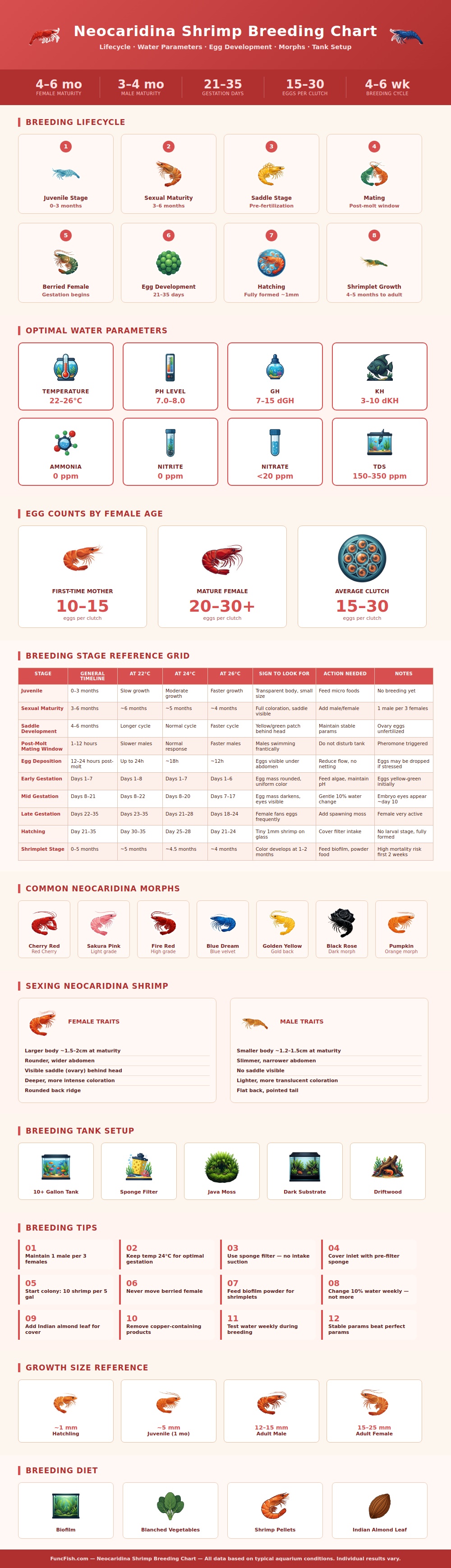
Sometimes when viewing a planted aquarium, you might see some shrimp hanging onto the glass. If you are like many hobbyists, you get all excited about it; only to become frustrated that population fails to increase over time. While fancy equipment isn’t necessary for breeding shrimp, achieving success typicaly boils down to two things: patience and stability.
Don’t worry; you don’t have to be a water chemist to raise these shrimp. But you should of know something about their life cycle so you can avoid making mistakes during times that will ruin your efforts. Understanding a species’ growth timeline; from juveniles to adult, will help you create reasonable expectations about how long it will take until they start breeding.
Tips for Breeding Shrimp
Biological reality is not in sync with human impatience, which means many new keeper purchase a small group of shrimps thinking they’re going to get some immediate action after a few weeks. In reality, those shrimps aren’t sexually mature yet. It takes them several months. Males typicaly reach full development faster then females do.
As long as the shrimp can access proper food sources, they grows at a steady pace, even if slowly, during this period. Don’t skip any steps here; it will only postpone the day your shrimps will breed. Remember that these shrimps is growing their bodies so they can breed.
When the shrimp are older, visual hints get easier; and knowing where to look helps. There is a clear “saddle” that forms just behind a female’s head. That’s her ovaries with unfertilized eggs inside them. This is easily seen on colored body. Depending on the variety, color will be greenish or sometimes more yellow. It stands out on a blue or red body. If she doesn’t have this, then it’s likely a male. Males aren’t nearly as wide and don’t has this at all.
Why does this matter? Because in order to mate successfully, you want a good mix of both sexes. The general rule of thumb is 3 females to 1 male so that the males won’t fight (and each female has plenty of options). Many folks forget about this until they realize their males aren’t going after the females… but rather running around trying to avoid each other.
The survival of the eggs all the way through hatch depends largely on water parameters, so it’s not about perfection as much as it is about stability. Sudden changes in temperature (or fluctuations in pH) can be stressful enough for a berried female that she’ll drop her eggs prematurely. Ideally, you’re looking at a low nitrite/ammonia level (even very small amounts are toxic), a neutral-to-slightly-alkaline environment, and stable pH levels.
Depending on your water temperature, gestation takes between three and five weeks, so there’s some wiggle room to correct things a little bit without endangering the egg(s). But making any major changes during this timeframe will probably spell doom for the clutch.
Finally, don’t get so focused on feeding the adults that you forget about the shrimplets. Because they’re only microscopic, they has specific nutritional requirements that differ from those of the adults. Specifically, they should be fed powdered foods as well as biofilm that settles on the substrate. This lets them graze while remaining safely out of reach of filtration suction.
A sponge filter is absolutely necessary for a breeding tank, regular intake tubes will suck up any baby shrimp that stray beyond the moss. If you haven’t already replaced all of your filters, simply cover your current intakes with some pre-filter sponges and it won’t happen.
And then there’s restraint. While it’s tempting to want to peek into your tank each day at a gravid female, she doesn’t require an audience. She requires peace. First, establish the tank with the right filtration, stable parameters, and lots of hiding places like Indian almond leaves or Java moss. After that, you’ll likely do yourself the best service by stepping away from the glass and letting nature take its course. Give the shrimp space to thrive, and they will follow their own timeline.