
So you set the hook and feel like you have a car tied to the back of the boat. Something heavy are on the other end. The rod doubles over and the drag goes screaming. For a few seconds you wonder if something isn’t wrong. Then it surfaces and guess what? It is a pike! It is not necessarily big fish of a lifetime, but it is still a good one. That’s what happens when you go northern pike fishing.
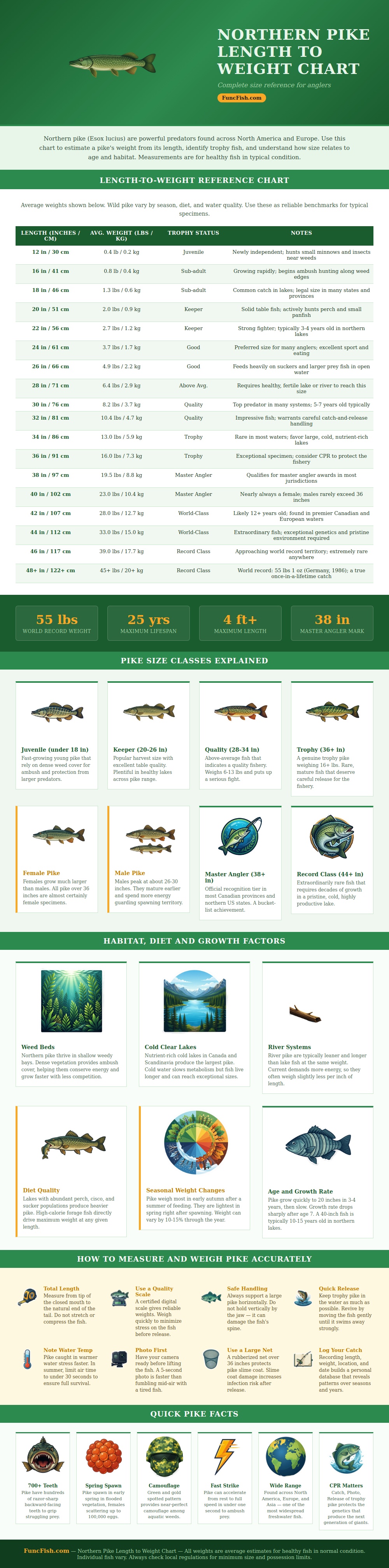
They’re known for their explosive nature coupled with its deceptive girth. Because of their shape, it can be extremely difficult to estimate their size based off weight alone. Having a solid reference point become important when attempting to determine what you’ve got on the end of your line. You want to know what you’re up against under water. Below is a chart of how all these long-tailed predator stack up in various size ranges.
Understanding Northern Pike Size and Weight
You can see clearly where the jump-off point is for becoming a true trophy versus a standard keeper. You could easily think that the bigger the fish, the heavier it must be. It is not so much with pike. While they do get longer, there growth is disproportionate. That’s why they are such an interesting species.
A 20-inch pike can certainly make for a good meal. By the time the fish reaches thirty inches, it begins to pick up considerable width in addition to length. That’s when you start seeing weight curve begin to climb steeply. This is one of those visuals that help put those expectations into perspective. This separates common catch from the rare giants that need special conditions to grow. That’s when it starts making sense as to why those size classes exist.
The less than 18 inch juveniles don’t really show themselves to many anglers. They lurk in thick weed beds, ambushing small minnows. They grows fast, fueled by high-protein diets and protection from larger predators. Then there’s that coveted keep slot where they reach the twenty-to-twenty-six-inch range. In healthy systems, you will find plenty of these fish. Not only do they make for some great table fare, but they don’t take any huge effort to catch either. In fact, you can catch dozens in a single day without even breaking a sweat. That’s good fishing for the family or for practice.
Twenty eight to thirty four inches is when the fun begins. You will find quality fish up to thirteen pounds that fight hard. Fish weighing six pounds or more know how to stay away from boats and requires you to present the lure better. To locate these fish you must begin thinking about habitat structure. Where do they hang out? Weed beds are an obvious place where there is food. On cold clear lakes such as found in Canada and Scandinavia the biggest pikes can be found.
These lakes has nutrient rich water that provides plenty of food for bigger forage fish such as cisco and perch. A big pike has a big appetite and requires a heavy diet to maintain its metabolism. If not much prey exists on the lake then it will be long and lean. Nothing affects weight more than diet quality. Not to mention, think about the time of year. In early fall, pike are at their maximum weight from several months of eating. By spring they’ve spawned and lost a lot of weight. That 20-pounder would of been more like an 18 on the scales in April. It is just biology, nothing magical.
So your books will vary based off what month or even week you catch ’em. If you’re keeping a log book for numbers, write down the water temp and the day. The bigger ones deserve respect and care. Don’t grab any pike over 30 inches by the lower jaw only. Even if it appears healthy at release, this puts excessive pressure on their spine and can cause serious injury or death. Support its body with one hand while keeping it horizontal and always keep them wet as much as possible. If you must use a net, it should be made of rubber to preserve its slime coat. The slime coat protects it from infection and other ailments. Damaging that slime coat upon landing is handing bacteria an open door.
Males peak around twenty-six to thirty inches, though females can grow much larger. In ideal waters, they’ll top out at more than forty inches. If a pike measure over thirty-six inches, it’s probably female. And this gender size difference tells us something: To catch one of those world class pikes, you’re seeking an old lady. She has wide shoulders and has lived through years of fishing pressure and survival from other predators. The odds aren’t great, but when you do, let her go so she can continue to pass along the genetics to the next generation.
To conclude. Pike fishing is a combination of perspective and patience. Sometimes you get the big one early and sometimes it’s a marathon that takes four hours to catch ten little guys. But no matter how many times you go at it, or when you catch them, make sure to treat them with respect and care for them accordingly. Learn about their development process. Learn how rare what you are holding in your hands is. And cherish every second because it’s yours to savor long after the number on the scale turns to zero.