Outboard Fuel Range Calculator
Estimate practical range, runtime, fuel burn, and return radius for fishing runs using engine load, fuel reserve, speed, hull weight, and water conditions.
📌Fishing run presets
⚙Range inputs
Fuel range forecast
Formula breakdown
📋Engine burn comparison grid
4-stroke EFI
Direct 2-stroke
Carb 2-stroke
Portable 4-stroke
📐Reference tables
| Engine type | Model factor | WOT fuel guide | Calculator use |
|---|---|---|---|
| Modern 4-stroke EFI | 0.52 lb/hp/hr | 0.085 gal per hp hr | Baseline fishing outboard |
| Direct-injected 2-stroke | 0.56 lb/hp/hr | 0.092 gal per hp hr | Slightly higher burn at load |
| Carbureted 2-stroke | 0.68 lb/hp/hr | 0.111 gal per hp hr | Older motor allowance |
| High-output 4-stroke | 0.55 lb/hp/hr | 0.090 gal per hp hr | Sport setup allowance |
| Small portable 4-stroke | 0.58 lb/hp/hr | 0.095 gal per hp hr | Portable tank estimate |
| Hybrid/electric assist troll | 0.45 lb/hp/hr | 0.074 gal per hp hr | Low-speed assist model |
| Reserve pattern | Fuel held back | Usable fuel | Common fishing use |
|---|---|---|---|
| Local water reserve | 20% | 80% | Small lakes and ramps nearby |
| Rule of thirds | 33% | 67% | One-third out, one-third back, one-third spare |
| Offshore safety margin | 40% | 60% | Long runs, bar crossings, reefs |
| Hull and load setting | Fuel factor | Speed factor | When to choose it |
|---|---|---|---|
| Light skiff / light tackle | 0.94 | 1.05 | Lean load, efficient planing hull |
| Average V-hull fishing load | 1.00 | 1.00 | General single outboard setup |
| Loaded bass boat lockers | 1.08 | 0.97 | Batteries, tackle, livewell water |
| Pontoon or high windage hull | 1.20 | 0.88 | Wide deck and wind drag |
| Offshore gear and ice | 1.16 | 0.92 | Coolers, bait, safety gear |
| Heavy crew / weekend load | 1.24 | 0.86 | Extra people and overnight gear |
| Water condition | Fuel factor | Speed factor | Planning note |
|---|---|---|---|
| Calm water / no current | 1.00 | 1.00 | Use normal GPS cruise speed |
| Light ripple or fair tide | 1.05 | 0.98 | Minor trim and throttle losses |
| Moderate chop or mixed current | 1.18 | 0.90 | Range drops from impact and trim |
| Head sea or strong current | 1.35 | 0.78 | Use a shorter turn-back point |
| Following sea / helpful current | 0.96 | 1.05 | Do not rely on it for the return |
💡Range planning checks
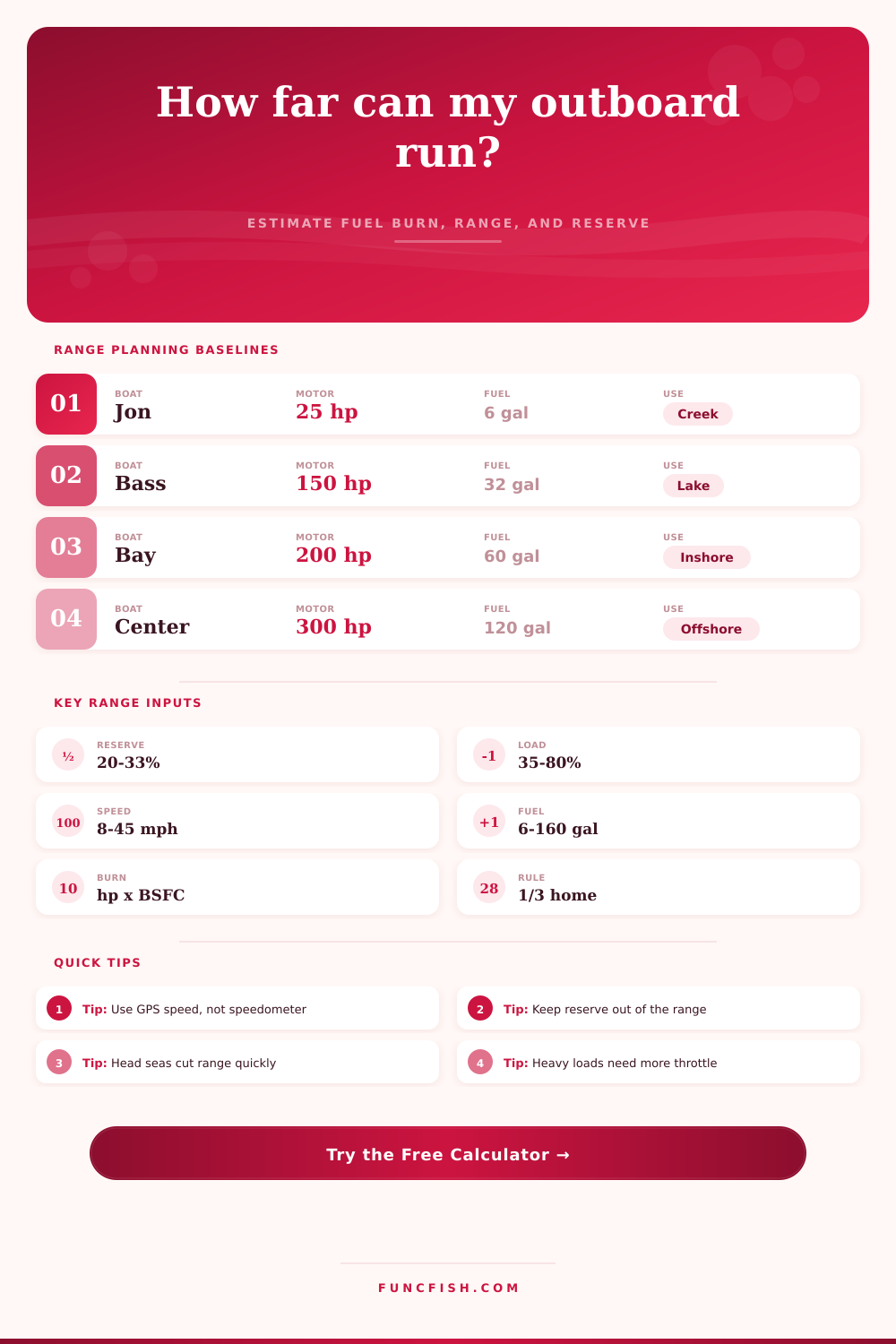
Tip: Base the speed input on GPS speed over ground at your planned trim and load. Dash speedometers can overstate range when the boat is heavy or the tide is moving.
Tip: Keep reserve fuel outside the one-way range. For offshore fishing, a conservative turn-back point is usually more useful than a perfect fuel burn estimate.
There’s no magic number for range. Your boat’s weight, the hunger of your engine and the attitude of the water all factor into it. Most folks considers range by gallons. Consider it instead in terms of margin. And always check your fuel gauge with a clear head… Particularly when you’re fishing calm water and feeling good about things.
After plugging in your horsepower and load into the calculator above, it will do all the math for you. You no longer has to guess at conversions and coefficients. This forces you to face factors that truly determine how far you can go.
How to Plan Your Fuel Range Safely
Usually, the first variable is the one you ignore: your speed. Sure, the dashboard might say you’re cruising along at thirty miles per hour, but when was the last time GPS told you the truth? When was the last time the current pushed you sideways or the tide come against you? That dashboard number isn’t right. And no, it doesn’t matter; it’s only a little thing. Enter your actual ground speed different than the needle’s estimate, and notice how the runtime decrease.
Then there’s the technology of the engine. Newer two-stroke engines with direct injection burn as efficienty as four strokes with immediate throttle response. Carbureted engines still available today has a bigger gas gut. You’ll notice in the table on this page, the break specific fuel consumption values that will increase or decrease hours in your day.
But even then it’s not all about the kind of engine. It’s about making the engine work harder. If you run an engine at 40% power, you might be more fuel-efficient mile for mile than if you gun it up to seventy percent for a brief period. You are fighting less drag. More load, less range.
An empty bass boat is nothing like a loaded one with a cooler, livewell full of water and all that tackle. That’s why the calculator takes into account factors that impact your range such as increased fuel burn, slower effective speed and so on. For those of us fishing from pontoons, which have planing resistance and more windage, there’s an even bigger penalty. On a calm lake, maybe you won’t see it. But out there fighting a head sea coming home? Yeah, you’ll feel it.
So this leads me to the most critical part of range planning; the reserve. A lot of folks look at the reserve as a bonus. Not so much. The reserve is insurance. And guess what? A good rule of thumb is the rule of thirds. That’s right, get out on a third, get back on a third, and leave a third sitting there unspent until you have an issue such as bad weather or engine failure.
Sure, if you’re just running down the street a few miles from home, you may be OK with less. But when you’re heading to a reef or crossing a bar, that reserve is what stands between you and a tow or a story.
All else being equal, the water magnifies all of the variables: current works against your propeller and chopping creates drag. Following seas are generous…though they never return the favor coming home. Actualy, the tool takes those factors into account to adjust the effective burn rate. It’s a reminder that range isn’t static. It vary depending on the weather.
The journey begins with preparation Preparation doesn’t mean getting to the spot. Preparation means leaving the dock with energy. Know before you launch what your turn around point would of been if things went bad. It wouldn’t just be bad, it would be worse.
Don’t burn that reserve fuel off; leave it in boat where it belongs. It’s the most precious pound you’ll ever lug all day. Instead of wondering “can I make this spot?” you’ll feel confident, not anxious. You won’t have to guess anymore. You will have more knowledge. Then when darkness sets in, you know you’ve got gas remaining to get home.