Oxygen Saturation by Altitude Calculator
Estimate dissolved oxygen saturation for fish water from elevation, temperature, salinity, pressure trend, measured percent saturation, and species oxygen demand.
📌Altitude oxygen presets
⚙Water oxygen inputs
Altitude-adjusted oxygen results
Formula breakdown
🐟Species oxygen comparison grid
📊Reference tables
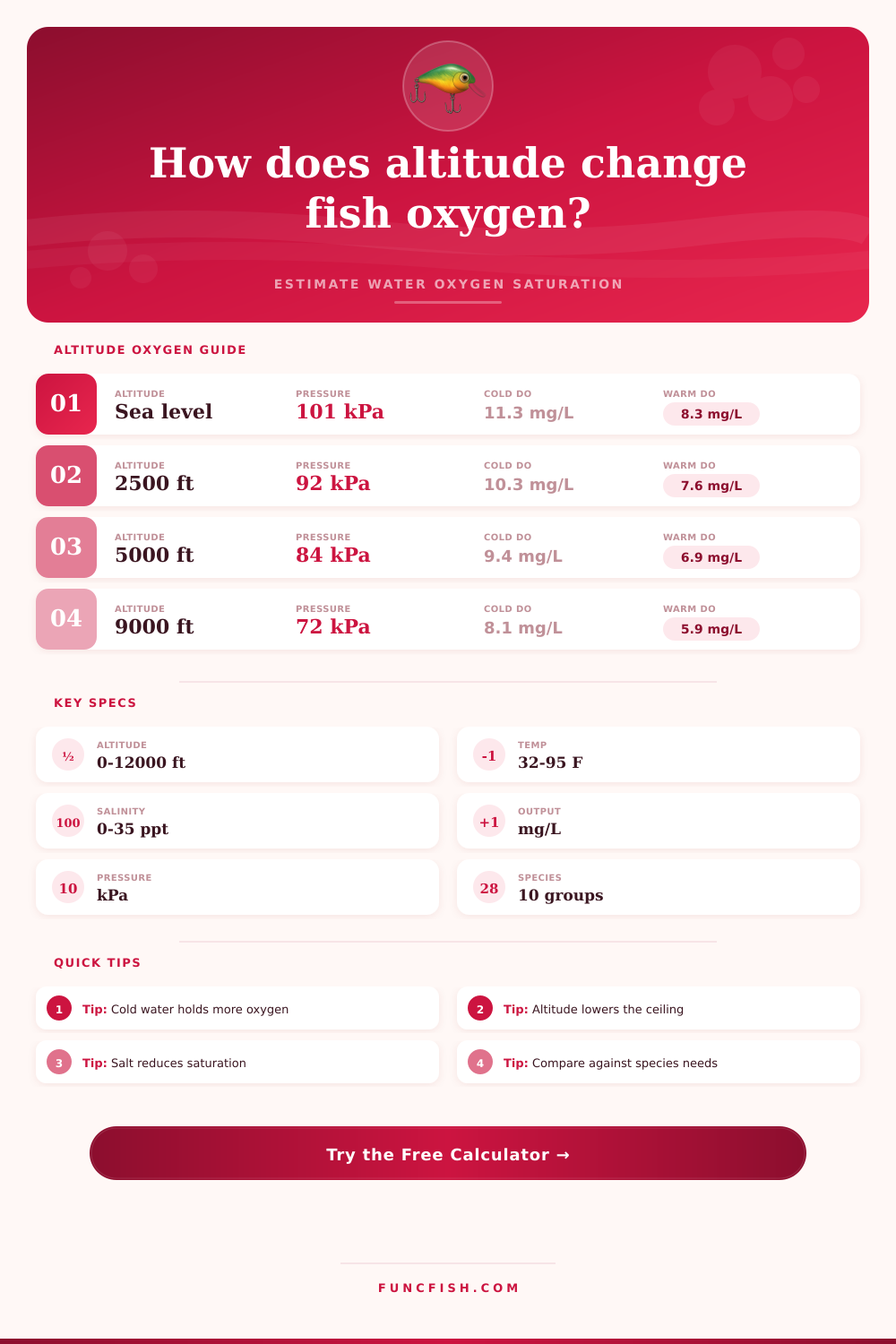
| Altitude | Approx pressure | Freshwater saturation at 50°F | Freshwater saturation at 77°F |
|---|---|---|---|
| Sea level | 101.3 kPa / 29.92 inHg | 11.3 mg/L | 8.3 mg/L |
| 2,500 ft / 762 m | 92.5 kPa / 27.31 inHg | 10.3 mg/L | 7.6 mg/L |
| 5,000 ft / 1,524 m | 84.3 kPa / 24.89 inHg | 9.4 mg/L | 6.9 mg/L |
| 7,500 ft / 2,286 m | 76.9 kPa / 22.71 inHg | 8.6 mg/L | 6.3 mg/L |
| 10,000 ft / 3,048 m | 69.7 kPa / 20.58 inHg | 7.8 mg/L | 5.7 mg/L |
| Temperature | Sea-level freshwater saturation | Fish interpretation | Altitude sensitivity |
|---|---|---|---|
| 39°F / 4°C | 13.1 mg/L | Excellent for trout if flow remains stable | Still high at mountain elevations |
| 50°F / 10°C | 11.3 mg/L | Strong coldwater holding condition | Useful benchmark for alpine streams |
| 68°F / 20°C | 9.1 mg/L | Good for many warmwater species | Can approach trout limits at high altitude |
| 77°F / 25°C | 8.3 mg/L | Warm ponds need evening and dawn checks | High elevations reduce margin noticeably |
| 86°F / 30°C | 7.6 mg/L | Low ceiling for dense fish loads | Risk rises quickly with altitude |
| Salinity range | Typical water | Saturation effect | Fish note |
|---|---|---|---|
| 0 ppt | Freshwater lake or stream | No salinity reduction | Temperature and altitude dominate |
| 2-8 ppt | Light brackish creek | About 1-5% lower | Common in tidal nursery areas |
| 10-18 ppt | Estuary or marsh pond | About 6-11% lower | Important for drum and redfish holding water |
| 25-35 ppt | Nearshore to ocean water | About 15-21% lower | Bait tanks need more aeration reserve |
| Species group | Minimum calculator threshold | Comfortable working range | Low-oxygen warning |
|---|---|---|---|
| Trout and char | 7.0 mg/L | 8-11 mg/L | Stress can begin near warm, crowded water |
| Salmon and steelhead | 6.5 mg/L | 8-10 mg/L | Raceway flow should keep extra headroom |
| Bass and sunfish | 5.0 mg/L | 6-9 mg/L | Feeding and recovery drop as oxygen falls |
| Catfish and bullhead | 4.0 mg/L | 5-8 mg/L | Warm dawn lows can still be dangerous |
| Shad and live bait | 5.5 mg/L | 7-9 mg/L | Dense bait loads consume oxygen quickly |
💡Calculation tips
Everyone talks about how big the fish are we’re trying to catch in our ponds and lakes. How many talk about the air pressure crushing the water? The number on your weather app isn’t just a number, it’s the main reason oxygen gets pushed into your pond or lake.
If you head out to go chase trout and drive up a mountain pass, you’ve left a lot of pushing power in your wake. Now you have water with less oxygen then when you were back at sea level. It might feel cool, but it don’t hold as much oxygen. That’s why the altitude can be such a hidden factor that makes a once-perfect fish catching spot into a death trap for stressed fish.
Why Air Pressure Matters for Fish
You input your local conditions and your elevation into this calculator and it does the rest. You won’t have to guess how many inches of headroom you’re really getting on your bait. You won’t have to memorize solubility curves or anything like that anymore. Just know that for every thousand feet of increase, the ceiling gets lower.
A stream might be a great spot for trout at five thousand feet, but if they move up to eight thousand feet and everything else stays the same, they will likely starve. The water isn’t holding as much oxygen no more because the barometric pressure has gone down. Since the water won’t hold any more oxygen than it’s designed to, it becomes supersaturated. Not because it doesn’t want to but because that’s its max physical limit.
The other factor most folks fail to understand is temperature. Warm water just doesn’t have the ability that cold water does to hold dissolved gases. It is a tricky situation at higher elevations on hot summer days. The sun warms those shallow parts of lake, and the air is already thin. Now you’re working off a smaller oxygen capacity.
Salt compounds the problem by having its molecules crowd out oxygen in the water’s structure. When you’re pulling redfish out of a brackish marsh up into a higher elevation tank, you’re fighting not only one but two forces that reduce the saturation ceiling. With these factors taken into account, calculator calculates both to show you how much oxygen is really available versus what the theoretical best-case might be.
The fact is different species has very different tolerance limits; failure to heed will result in premature death in raceways and livewells. Salmon and trout are high demand customers because they need constant rich oxygen levels to sustain their immune function and metabolism. Less demanding customer: Catfish and bass too are less forgiving but will be affected negative as the numbers fall below their comfort zone.
The pages’ reference tables lay this out clearly so you know exactly where your specific water conditions rate relative to the fish you’re holding. One or two milligrams per liter sounds like little on paper but means the difference between a fish swimming off strongly and one gasping at the surface until it becomes exhausted.
The other kicker is that storm systems also complicate things by lowering the oxygen saturation level, and falling barometric pressure lowers the solubility of oxygen just like being at higher elevations. You can sit at 0 feet of elevation all day long and watch your O2 levels plummet if a low pressure front rolls through. So not only do we need to check our dissolved oxygen meter, we should of be monitoring the weather prediction nearly as closely too.
Fortunately with this tool they let you enter a pressure departure number so you can adjust for this kind of stormy condition and get a heads up ahead of time. That’s a little something that can make a big difference when you’re tasked with keeping live bait alive during a thunderstorm.
“Nighttime is when plants respire and use up all the oxygen, so they stop photosynthesizing once the sun goes down and it’s typically the worst part of the day. Then you have the first thing in the morning, right at sunrise, which also happens to be the lowest point in barometric pressure for the day, the water chemistry hits its lowest point. Add to that a low ceiling from heat and elevation, and now this early-morning drop will knock the oxygen level into critical range.”
This dynamic also helps you understand a few things about time management and your catch. Suddenly, you’re no longer fishing with gut feel but rather looking at what dictates survival, the data. This isn’t about taking the fun out of it. This is about having more fun because you can keep the fish alive long enough to release them responsibly or catch them.
When you go back up into those mountains, remember the air’s thin up there and so is the oxygen in the water below your fish.