Photo Time Limit Calculator
Estimate a practical out-of-water photo window from species tolerance, water temperature, air conditions, fish size, handling setup, and the number of shots you want.
📍Catch photo presets
⚙Photo timing inputs
Photo time result
Calculation breakdown
🎣Species and gear grid
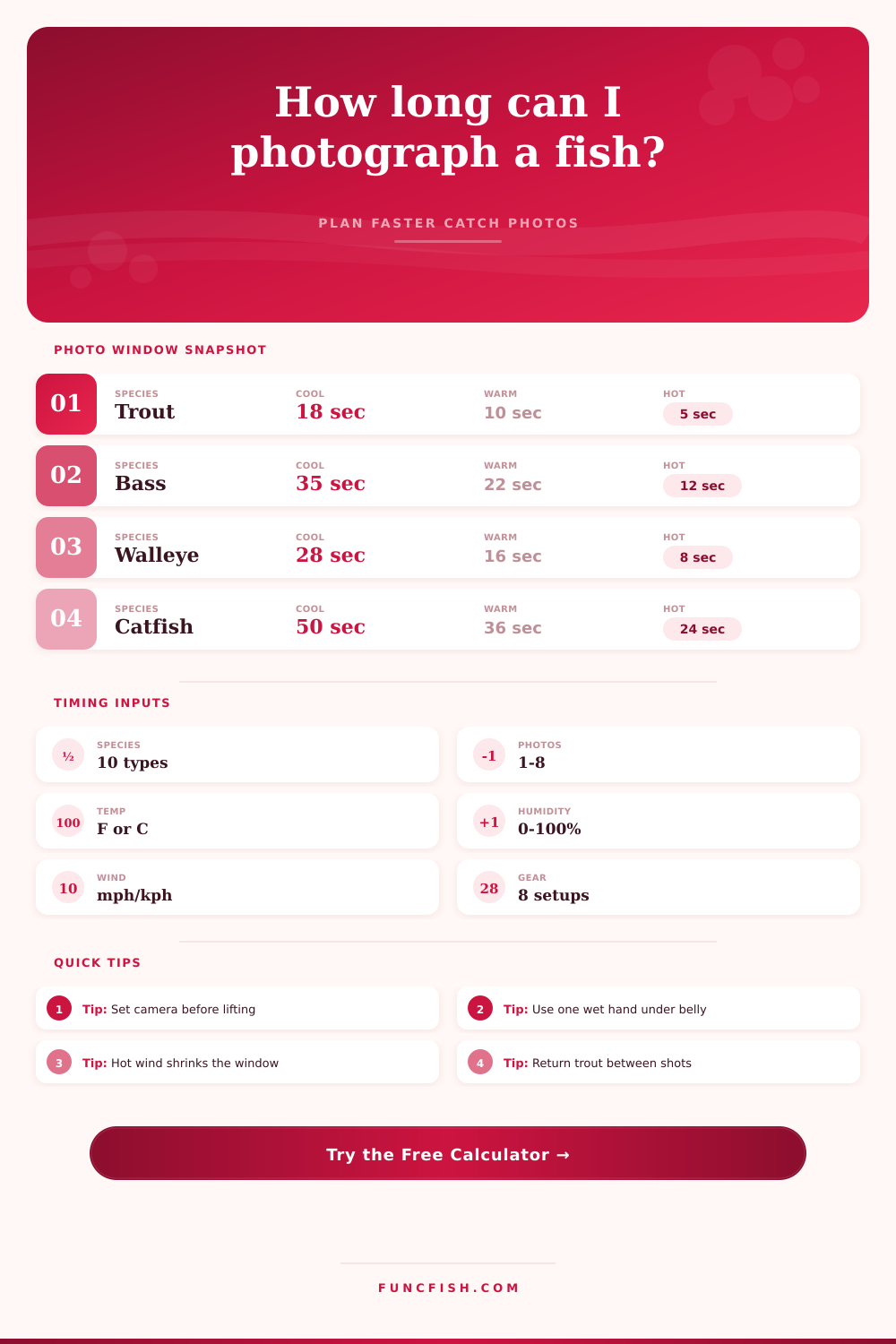
Coldwater salmonids get the shortest starting window, especially above their preferred water temperature.
Warmwater bass tolerate brief photos better, but hot air and dry contact reduce that allowance quickly.
Catfish are hardy, yet large fish still need horizontal support and shorter vertical lift time.
Measuring adds alignment time, so the calculator trims the photo window unless everything is wet and ready.
A second angler reduces fumbling time and supports a quick lift, click, and immediate return.
Low deck space and balance checks add handling risk, so this setup gets a meaningful penalty.
After a tight photo window, the reset recommendation grows with total air exposure and warm conditions.
Urgency scores near the top mean skip extra photos and prioritize controlled release posture.
📊Photo timing reference tables
| Species group | Base photo window | Preferred water range | Heat sensitivity | Planning note |
|---|---|---|---|---|
| Brook and rainbow trout | 18 to 22 sec | 50 to 62 F / 10 to 17 C | Very high | Use single quick lift and water reset between shots. |
| Walleye and striped bass | 28 to 32 sec | 55 to 70 F / 13 to 21 C | High | Shorten photos when water is warm or oxygen feels low. |
| Largemouth and smallmouth bass | 38 to 42 sec | 60 to 78 F / 16 to 26 C | Moderate | A brief grip-and-grin is usually fine when hands are wet. |
| Pike and muskellunge | 32 to 36 sec | 55 to 68 F / 13 to 20 C | High | Large bodies need horizontal support and fast camera work. |
| Catfish and panfish | 42 to 55 sec | 65 to 82 F / 18 to 28 C | Lower | Still avoid hot dry surfaces and repeated long lifts. |
| Condition | Small penalty | Moderate penalty | Heavy penalty | Why it matters |
|---|---|---|---|---|
| Air-water temperature gap | 0 to 8 F / 0 to 4 C | 9 to 18 F / 5 to 10 C | 19 F+ / 11 C+ | Large gaps dry gills and skin faster during photos. |
| Humidity | 70% or higher | 40% to 69% | Below 40% | Dry air accelerates moisture loss from gill tissue. |
| Wind at fish | 0 to 6 mph / 0 to 10 kph | 7 to 15 mph / 11 to 24 kph | 16 mph+ / 25 kph+ | Wind removes the protective wet film quickly. |
| Sun and deck heat | Shade | Broken or direct sun | Hot dry deck | Bright surfaces add heat and contact stress. |
| Photo plan | Seconds per shot | Best use | Calculator effect | Release cue |
|---|---|---|---|---|
| One prepared hero photo | 3 to 6 sec | Most catch-and-release fish | Lowest photo load | Return immediately after shutter. |
| Two quick angles | 5 to 8 sec | Partner camera or boat deck | Moderate load | Dip fish between poses if near limit. |
| Measure plus photo | 8 to 14 sec | Bump board records | Setup penalty | Wet board first and skip extra angles. |
| Solo timer sequence | 12 to 25 sec | Only hardy fish in mild conditions | High load | Stop early if framing takes too long. |
| Landing setup | Time factor | Handling factor | Best match | Watch point |
|---|---|---|---|---|
| Wet rubber net with camera ready | Fast | Protective | Trout, bass, walleye | Keep net bag in water until lift. |
| Partner camera ready | Fastest | Supportive | Large bass, redfish, pike | Agree on pose before fish leaves water. |
| Bump board measurement | Moderate | Variable | Record fish | Wet board and read mark before lifting. |
| Sand, carpet, or dry contact | Slow | Rough | Emergency only | Avoid placing fish on dry abrasive surfaces. |
💡Photo handling tips
Pre-stage the shot: Unlock the phone, wet the net or board, and decide who lifts before the fish leaves the water.
Use water resets: If you need a second angle, put the fish back in the water long enough for steady balance and gill movement.
The sun is shining, your buddy’s got his camera out, and there’s the net, dripping with water as soon as you pick up the fish. You’re not just fishing anymore; now you’re also playing the role of timer, but each tick of the clock adds more stress and removes precious mucus from the fishes surface, depleting its oxygen faster each second it’s out of water.
The more we know about how much we can handle, the better our decision will be between taking the shot or releasing the fish, so, the calculator below translates stress into a hard-and-fast time limit. Fish physiology is what most folks do not think about; instead they concentrate more on camera settings, i.e., shutter speed. Big mistake! The tool takes species tolerance into consideration. In other words, a largemouth bass in a cool stream has more time then does a rainbow trout in warm water.
Why Fish Get Stressed Out of Water
Biological reality is included in the equation along with environmental factors, e.g., air temperature/humidity. Humidity also matters. If it is dry, wind will strip the protective slime coat off the fish skin. That slime is the fish’s first line of defense. It’s gone and you’ve done damage to the fish…even if it manage to swim away.
It considers what’s going into the system as much or perhaps even more than what comes out of it. Placing a fish in a wet rubber net with the belly supported and kept horizontal so it can still breathe through its gills is better for its circulation than holding it vertical at the lip for a picture. That’s why the calculator subtracts points for that position. Gravity do not drain blood from the gills or brain when it’s held horizontally in a wet rubber net.
Choosing a solo kayak reduces the risk regarding space and balance, so it makes up for that in other ways. Balancing on a slim deck while fumbling takes more time than working on a boat deck. Then there’s how many photos. It could be a single snap, or a series staged from multiple angles with a measuring board. The calculator measures up, then compares all that air time against a safe limit. It’ll let you know if your plan runs beyond the window.
So if you think “moving fast” means you have more time; think again. Biology doesn’t take speed into account. You get a reset value which most folks don’t consider when using a calculator. That indicates how long it takes to hold the fish’s gills and head under water before another shot. Why? A couple of seconds under water will restart gill movement, but more importantly, buy you time for next shot while flushing out stress chemicals. If you don’t give them time to recover, the stress compounds and the fish go into shock. That is why the calculator emphasizes this point: If you stop, they will recover.
The page breaks out these factors into reference tables, listing how sensitive each group of species is to the factors. For example, catfish are at the low end, walleye is moderate, and brook trout are high. But, you can overdo it with hot-dry conditions, even for tough fish. The tables also detail wind and sun penalties. Direct sunlight beating on a hot deck is bad news and cooks the fish from below.
The calculator is more like a conservative guideline; it’s safe rather than sorry. If the urgency to release is high, you should of skip the extra photos. Don’t risk your fish’s life for any photograph. The memory is what we’re after, not at the expense of an animal’s life. We’ll have time to snap a follow-up picture, but not this one.
The secret is preparation. Have your partner on deck. Get your net wet. Unlock that dang phone. And remember, this makes things faster. That’s why you did it. It takes away friction. You’re not wasting any time. The fish is out of the water quicker. There’s no airtime. They go back in and they swim away. It is healthier. It is faster. The process is shorter. There is less friction. You click. Lift. Release. Then click again when the hook comes off. Time it. Stop the clock as soon as possible so you can avoid the damage caused by stress.