Pier Height to Casting Angle Calculator
Convert pier height, target distance, wind, line drag, and rig profile into a practical launch angle, cast speed, flight time, and water-entry angle.
🎯Fishing presets
⚙Cast inputs
Casting solution
🧵Line and rig drag grid
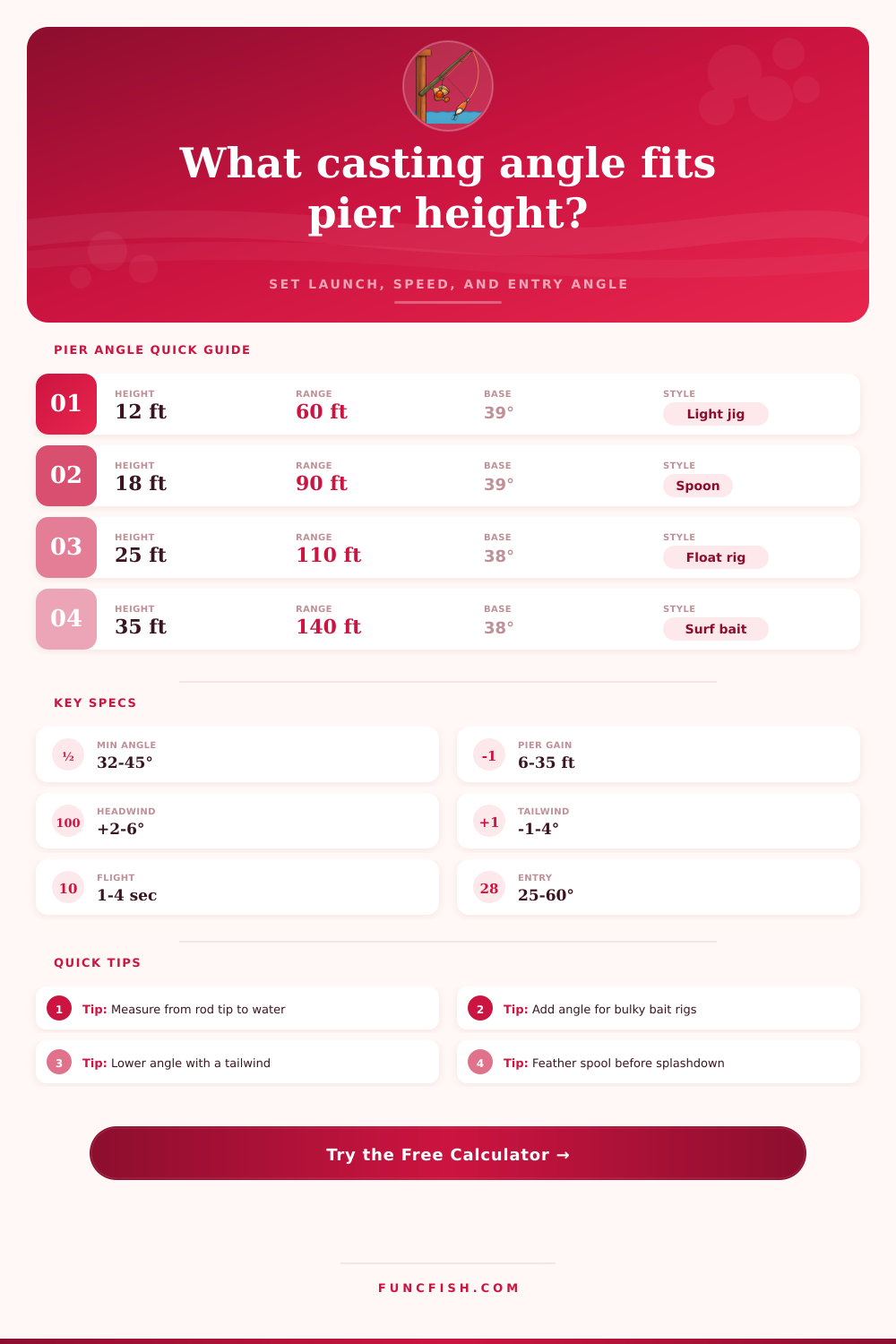
📐Pier height angle reference
| Effective release height | 60 ft target | 90 ft target | 120 ft target | Use case |
|---|---|---|---|---|
| 10 ft / 3.0 m | 40.3° | 41.8° | 42.6° | Low pier, shallow flat, trout jig |
| 18 ft / 5.5 m | 36.7° | 39.3° | 40.6° | Average ocean pier, spoon or bucktail |
| 25 ft / 7.6 m | 33.6° | 37.2° | 39.0° | High rail, live bait or float rig |
| 35 ft / 10.7 m | 29.9° | 34.3° | 36.7° | Deep-water pier, heavier bottom rig |
| 45 ft / 13.7 m | 26.6° | 31.7° | 34.6° | Very high deck, controlled lower trajectory |
Angles in this table are the minimum-speed projectile angle before wind, lure profile, and line-drag corrections.
🌬Wind and profile corrections
| Condition | Angle correction | Speed reserve | Best paired rig | Watch point |
|---|---|---|---|---|
| Light tailwind | -1.5° | +4% | Spoon, casting jig, slim plug | Stop the spool early to prevent overrun |
| Strong tailwind | -3.0° | +6% | Metal lure or compact sinker | Flatten cast so it does not balloon |
| Light headwind | +2.0° | +10% | Compact jig, bucktail, heavier plug | Use a clean release and lower loop |
| Strong headwind | +5.5° | +18% | Dense lure, shorter target line | A high cast stalls before the target |
| Strong crosswind | +2.5° | +13% | Braid, leader trimmed short | Allow side drift before splashdown |
🐟Species and pier presentation grid
| Species or target | Typical range from pier | Common rig weight | Preferred entry | Gear match |
|---|---|---|---|---|
| Speckled trout under lights | 35-80 ft / 11-24 m | 1/8-3/8 oz / 4-11 g | Soft 28-38° | 8-12 lb braid, light leader |
| Spanish mackerel or bluefish | 70-140 ft / 21-43 m | 3/4-2 oz / 21-57 g | Fast 35-48° | 15-30 lb braid, wire bite guard |
| Pompano or whiting | 55-120 ft / 17-37 m | 1-3 oz / 28-85 g | Firm 38-52° | 12-20 lb mono or braid leader |
| Sheepshead near pilings | 15-45 ft / 5-14 m | 1/4-1 oz / 7-28 g | Steep 45-62° | 20-30 lb leader, controlled lob |
| Tarpon or kingfish live bait | 40-100 ft / 12-30 m | 1-4 oz / 28-113 g | Low 24-38° | 30-50 lb braid, shock leader |
📊Rod, lure, and line matching table
| Setup | Rod power | Lure sweet spot | Line behavior | Angle note |
|---|---|---|---|---|
| Ultralight pier jig | Light to medium-light | 1/16-1/4 oz / 2-7 g | Low drag but wind sensitive | Add 2-4° if lure is underloaded |
| General pier spinning | Medium | 1/2-1.5 oz / 14-43 g | Balanced braid or mono feed | Use base angle plus wind correction |
| Heavy bait runner | Medium-heavy | 2-4 oz / 57-113 g | Leader knot and bait add drag | Add 3-6° for bulky rigs |
| Long spoon cast | Medium to medium-heavy | 3/4-2 oz / 21-57 g | Fast line flow, low profile | Flatten 1-3° with tailwind |
| Float or cork rig | Medium | 1/2-2 oz / 14-57 g | High air drag and swing | Favor higher arc and shorter target |
If you’ve watched fishermen on a pier, you know what I mean. They’re going all-out on their casts and then 10 feet away, there lure smacks into the pilings. That’s not a lack of strength; it’s physics. In pier fishing, unlike beach casting, the bait is fighting gravity as well as air resistance. Your arm strength isn’t as important than the angle at which you let go of the bait. Whether it lands next to a school of trout or splashes onto the rocks hinges on this.
This calculator do all of those equations for you. It takes all the complicated variables like rod tip elevation and deck height. It even accounts for lure profile and line drag. Then, once you input all of those values it shows you how your system flys in the air. Does it have a big cork float on it or a heavy sinker? How will that cut into wind? That’s what the tool uses to adjust needed launch angle.
How to Use the Pier Fishing Calculator
Then it tells you how fast to go with some sort of buffer reserve just in case the wind comes up and you don’t want to come to a dead stop midair. That last part help as I think most anglers underestimate how much headwind slows a lure down before it even crosses target.
So half the battle is knowing what the inputs are. First off pier height doesn’t remain constant, a few feet on or off of the water and that’s going to change the geometry of the cast completely. Measuring at low tide but fishing at high tide will result in a steeper measured angle then it actualy needs to be. That’ll cause the bait to loop short as a result. You want to account for true water level when you make your cast.
Everything else is relative to wind direction. It’s tempting to throw the bait out there flat when there’s a bit of a tailwind, but more often than not, the lure balloons and throws beyond target zone. For various wind conditions, the page has a reference table with the requisite amount of speed reserve required. Throwing into a headwind requires both throwing harder and higher. That air becomes like a wall, increasing the angle drastically. If you attempt to cast flat into a stiff breeze, it’ll just drop in place. Give it a bit of an initial lift to get over that resistance and then let gravity take over.
“People mess up here with entry angle. They are so concerned about distance, they forget how it will hit the water. Too steep of an entry and it breaks delicate hooks off live baits or scares the shad away. Too shallow an entry and it skips right by fish. You’ll see an estimate of entry angle in the calculator which will help you plan for your retrieval strategy. If the calculator tells you it has a forty-five-degree entry, then I’d know to be ready to strip slack as soon as it splashes down. If it’s not as steep, you may want to let it fall back down. That gives you this feedback loop where what started out as a crazy cast ends up being a controlled presentation.”
The other side of the equation is tackle choice. Bulky wire leaders and thick monofilament has significantly more drag in the air than thin braid. The calculator accounts for these types of lines by factoring in their profile. A large diameter leader does increase weight but can interrupts the air flow as well. So it’s not simply distance, but efficiency of travel.
Having the right rod load to match the recommended speed will allow you to maintain good timing while avoiding any backlash issues. The transition should be seamless, with the rod flexing smoothly during the release to transfer energy cleanly. Adapting and rhythm are the names of the game with pier fishing. That’s what the numbers give you as a base. But the sea doesn’t stand still so you’ll have to adapt throughout the day. Take the calculated number, make a small tweak in angle and go from there. What you learn is the connection between wind, height and trajectory and when you do, you leave short casts behind you. You no longer fight the pier; you use it for your gain.