
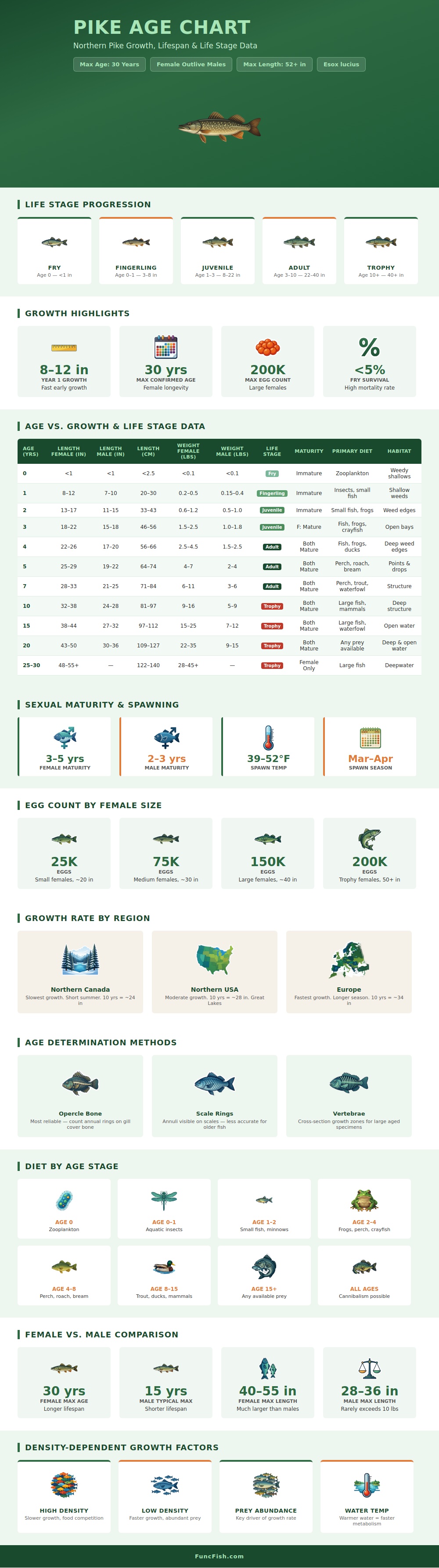
Age: Most of us concentrate on hiding spots of the fish, we don’t think about how old they are. What’s the fish’s age? Is it worth keeping? Age matter because it helps you choose lures and answer those questions. It transforms the animal into more than a piece of meat; instead, it becomes a living story with a start, middle and finish. This is easily seen in the chart above.
Northern pikes aren’t unchanging creatures. They undergoes various life stages which determine what they will eat, where they’ll live and what behaviors to expect. When you know process, you consistently have more success out on the water.
Why Pike Age Matters for Fishing
The early years are defined by survival rather than size. Small fry begin life as miniature plankton crushers in shallow, vegetated water. Less than 5 percent of those fry will make it past there first year. It is a tough test that separates the weak from the strong. What survives into fingerlings feed on bugs and smaller baitfish and hold tight to cover.
Sometime between ages two and three they make the leap. They leave heavy cover and begin patrolling edge looking for bigger meals such as minnows and frogs. That is when they change from ambush predators into active hunters, making them the most sought-after fish among many anglers who regulary cast lures at them.
Female pike outperform males on the time front as well. They not only lives longer but grow far larger. While a male might top-out at 15 years old, a female will commonly make it into her thirties. The difference in longevity is directly related to their reproductive biology. Female pike possess hundreds of thousands of eggs. In trophy sized fish, they often have more than twice that number. Those big bodies aren’t acquired without a price tag; that kind of egg load require a lot of energy. And females pay up with body size in order to be able to support all those eggs.
Males don’t add nearly as much physical mass. Therefore they don’t get as large, instead maturing early and staying small. Understanding this difference in behavior help explain how every lake’s largest fish are virtually always female.
Not all waters grows equally. A European ten year old pike may be thirty-four inches long. In northern Canada he may only measure but twenty-four inches. Metabolism is dictated by climate. Growing seasons are shorter which means they expand more slowely. Adjust your expectation of size to age accordingly if you’re targeting cooler water in higher latitude lakes.
It’s not just genetics that determines the ceiling. Environment does too. That applies to both catching and planning a trip. What appears to be an ancient fish on one lake may be relatively young on another.
It’s hard to tell exactly how old a pike you catch unless you have special equipment for it. You’d need to sample their vertebrae or opercle bones that shows annual growth rings similar to how trees grow rings. But most anglers will just guess based off size trends.
Many people think big = old when fishing for pike but they often pack on the pounds fast in a plentiful diet environment where there’s plenty of prey. Density also matters greatly. Low population allows more food for each fish so they’ll grow faster. High density results in more competition and slows them down no matter how big they could potentially be.
Once they reach age of ten, however, those predators completely change what they eat. They no longer pursues fast moving baitfish. They will go for any easy meal: mammals, ducks… even other pike. Cannibalism plays a large role in its ecology. They become much more opportunistic creatures to trick. They rely less on speed and use more ambush tactics around deep structure.
If you do hook into one of these veterans, it’s going to be a fight with an animal who has beaten back natural predation and fishing pressure for decades. A better approach is to practice better care of the resource and catch-and-release, which means respecting the natural timeline of a pike’s life cycle. Letting big old females go makes a difference, they get another chance at spawning and contribute to the population. Removing some of those young male may reduce pressure while giving most fish a good chance at spawning later on.
This isn’t all about numbers; it’s about appreciating the life cycle we’re a part of when we hook one of these toothy critters. So the next time you grab a pike in your hands, stop looking at teeth and think about how many springs that fish has lived through. You should of thought about this sooner.