Plait Length Calculator
Estimate finished fishing plait length, starting doubled line, plait count, lock turns, and tag allowance for mono, fluorocarbon, braid, or wire leader connections.
📌Scenario presets
⚙Plait and line inputs
Plait length results
Calculation breakdown
🧵Material and plait data grid
Nylon mono
Fluorocarbon
8-carrier braid
Single wire
📏Recommended plait body lengths
| Line class | Typical diameter | Finished plait body | Starting doubled length | Common use |
|---|---|---|---|---|
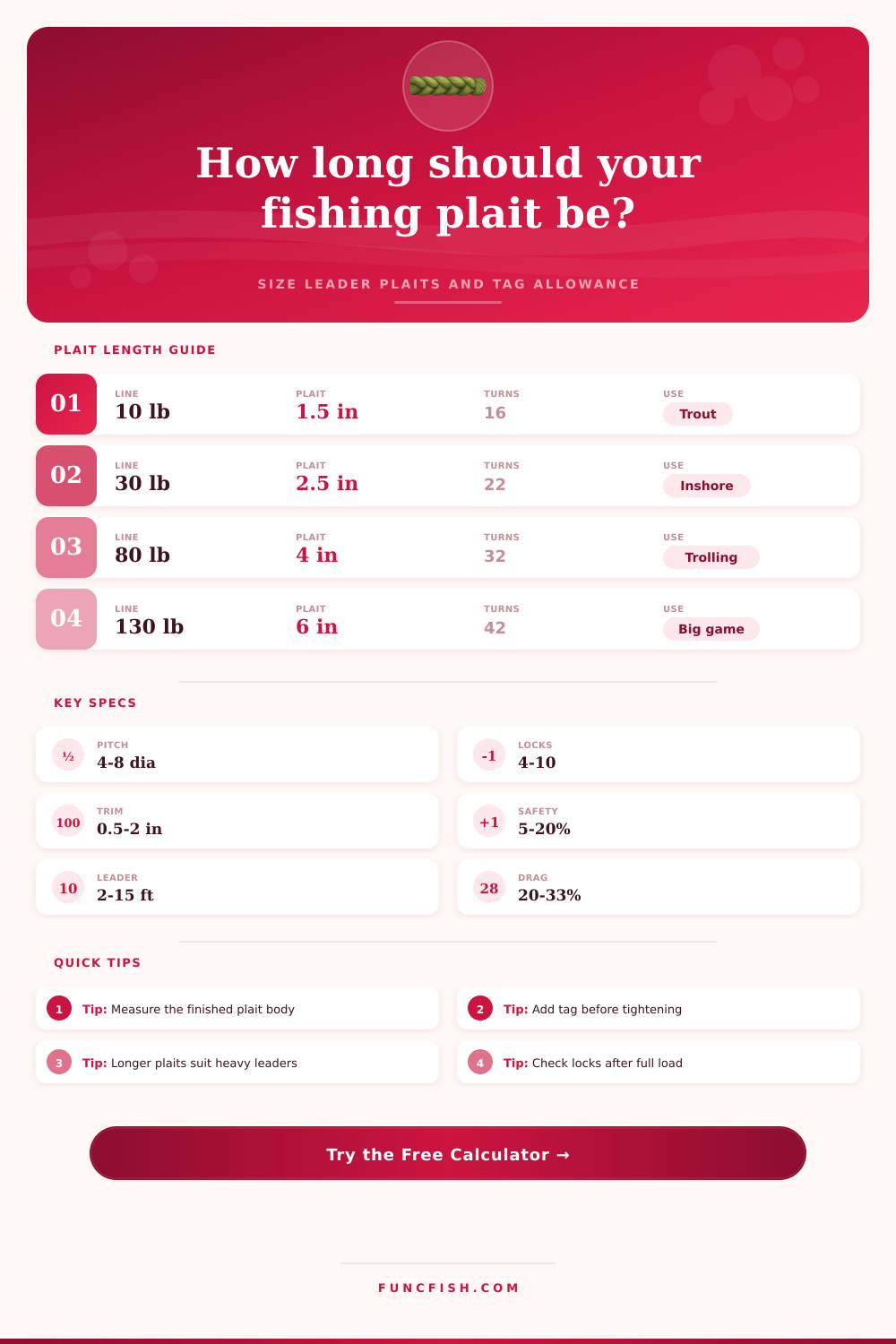
| 6-12 lb / 3-5 kg | 0.008-0.013 in / 0.20-0.33 mm | 1.0-1.8 in / 2.5-4.6 cm | 2.5-4.5 in / 6-11 cm | Trout, panfish, finesse bass |
| 15-30 lb / 7-14 kg | 0.014-0.023 in / 0.36-0.58 mm | 1.8-3.0 in / 4.6-7.6 cm | 4.5-7.5 in / 11-19 cm | Bass, walleye, light inshore |
| 40-60 lb / 18-27 kg | 0.024-0.033 in / 0.61-0.84 mm | 3.0-4.5 in / 7.6-11 cm | 7.5-11 in / 19-28 cm | Surf, catfish, snook, tarpon |
| 80-100 lb / 36-45 kg | 0.034-0.044 in / 0.86-1.12 mm | 4.0-5.5 in / 10-14 cm | 10-14 in / 25-36 cm | Offshore trolling and jigging |
| 130-200 lb / 59-91 kg | 0.045-0.070 in / 1.14-1.78 mm | 5.5-8.0 in / 14-20 cm | 14-22 in / 36-56 cm | Big game, wind-on leaders |
🐟Species and technique comparison
| Species / technique | Line class | Plait body target | Drag check | Why it fits |
|---|---|---|---|---|
| Stream trout micro leader | 4-8 lb / 2-4 kg | 1.0-1.4 in / 2.5-3.6 cm | 20-25 percent | Small guides and light tippet need a compact plait. |
| Bass spinning double line | 10-20 lb / 5-9 kg | 1.5-2.3 in / 3.8-5.8 cm | 25-30 percent | Balances casting clearance with knot grip. |
| Surf shock leader | 40-80 lb / 18-36 kg | 3.5-5.0 in / 8.9-13 cm | 15-25 percent | Longer body spreads casting shock on heavy mono. |
| Catfish bottom rig | 50-100 lb / 23-45 kg | 3.5-5.5 in / 8.9-14 cm | 25-33 percent | Abrasive cover rewards extra tag and lock allowance. |
| Pike wire trace | 30-60 lb / 14-27 kg | 2.0-3.5 in / 5.1-8.9 cm | 20-30 percent | Wire needs fewer sharp bends and a controlled twist stack. |
| Offshore trolling | 80-130 lb / 36-59 kg | 4.5-6.5 in / 11-17 cm | 25-33 percent | Heavy leader plaits need length for smooth load transfer. |
⚓Plait style matching table
| Plait style | Line materials | Pitch rule used | Lock allowance | Best application |
|---|---|---|---|---|
| Australian plait | Mono, fluoro, copolymer | 5.6-6.6 diameters per crossover | 0.75 lock diameter per turn | Double-line strength loop before terminal leader. |
| Three-strand plait | Mono, braid, soft cable | 4.8-6.2 diameters per crossover | 0.70 lock diameter per turn | Short leader sections and looped traces. |
| Hollow-core plait | Hollow braid over mono | 4.2-5.4 diameters per crossover | 0.60 lock diameter per turn | Wind-on leaders and top-shot transitions. |
| Wire plait | Single-strand or coated wire | 6.8-7.8 diameters per crossover | 0.95 lock diameter per turn | Toothy fish bite leaders and stiff traces. |
| Surf shock plait | Heavy mono or tapered leader | 5.8-6.8 diameters per crossover | 0.80 lock diameter per turn | Spreading casting acceleration across the leader. |
🧭Leader planning reference
| Leader plan | Extra start allowance | Trim allowance | Compaction note | Check point |
|---|---|---|---|---|
| Light freshwater | 5-8 percent | 0.4-0.8 in / 1-2 cm | Fine mono tightens quickly | Plait should pass guides cleanly. |
| Inshore casting | 8-12 percent | 0.8-1.2 in / 2-3 cm | Saltwater leaders flatten under load | Pull to expected drag before fishing. |
| Surf casting | 12-18 percent | 1.0-1.8 in / 3-5 cm | Shock load needs longer body | No loose crossovers after hard cast. |
| Offshore big game | 15-22 percent | 1.5-2.5 in / 4-6 cm | Heavy mono needs gloved seating | Test with drag scale before rigging. |
💡Plait calculation tips
Measure after seating: Plaits shorten as the crossovers pull down. The calculator applies compaction, but the final check should be made after wetting and loading the knot.
Diameter matters: Strength alone is not enough. A 50 lb braid, 50 lb mono, and 50 lb fluorocarbon need different pitch and lock allowances because their diameters and stiffness differ.
When the drag screams, the leader often breaks at the connection point. Why? The plait was likely too short. Concentrating that shock load in a small area makes for a good cast but results in a lost line.
Most guys simply see the plait as yet another knot to tie. But it’s really a mechanical connecting area, it exists to distribute tension across several strands. That way the leader material can gradualy absorb the load instead of failing under shock. Doing it right means staying attached more often during the fight.
Why Plaits Break and How to Fix It
The tool above does all of this for you. Just input your desired target length and line diameter, and it will calculate your initial measurements. Be sure to input good information, as not all line are created equal.
For instance, nylon monofilament behaves very different from fluorocarbon or heavy braid. The monofilament is stretchy and compressible. This means you can use shorter overall plaits and tighter pitches. On the other hand, fluoro is denser and stiffer; so, you must give it extra room on each turn. Otherwise, you’ll have weak points as line pinches down on itself. Inputting mono settings on fluorocarbon will result in a weak connection that snap when needed most.
Consider the pitch. This refers to the amount of line that gets sucked out of sight with each wrap in the knot. Because larger diameter line has bigger circumference, it require more line per loop. So if you are making a 50-pound leader, you’ll need a lot more initial line than a 10-pounder to reach an equal-length finished body. The calculator uses that to estimate the number of wraps.
Also factor in tag allowance. This is the excess line you reserve prior to cinching the final knot. It provides margin to stretch and get things all nice and snug without getting tight on line. Go too tight here and you risk pulling apart under the load.
Nearly everything else follows from that material selection. Soft mono handles differently than wire (it stretches and compresses easily). It needs more turns but less crimps precisely for those reasons. A wire on a serve end will require exact crimping where a weave by hand will require careful plating.
Pitch factors change with material as the table on the page demonstrates. While nylon may only take six diameters of line between each cross-over, wire can requires seven or even eight. Multiply that by 30 turns and the difference adds up fast. Your knot won’t be right because it will be either too tight to tie or too loose to stay tied.
Most folks don’t think about how important tension is. When you put firm tension on a plait that was lightly tied, it will tighten considerably. Water or even just a little spit will cause a plait to compact too. That will shorten the finished body and potentially change its strength than.
On the tension profile, you have choices that goes from light hand tie to a tight pull with gloves. Choose the right profile to get a starting length that will likely work well when you are finally fishing on the water. Ask for some extra if you expect to use gloves and pull hard.
The other problem with drag is that you frequently see heavy trolling drag settings running higher than the break off strength of your leader. If the force isn’t even, it can cause problems. A longer plait helps to spreads this force more effectively. They function like a shock absorber when a big game fish suddenly lunges forward. That’s one reason you’ll notice longer bodies on some line types in surf casting and offshore situations versus finesse freshwater applications. It’s more than looks; it’s a form of insurance for those sudden bursts of speed.
So stop guessing at where to start from based off some half remembered tutorial or scribble of what you think is the correct length. Each spool will have its own individual stiffness and diameter profile which changes the equation. You should of used the calculator. Take the time to measure out yours. Feed those measurements into the calculator above. Let it do the maths for you.
A good-sized plait is tidy and holds up well under pressure, it keeps you tied-in when it matters most.