Pole Section Length Calculator
Plan fishing pole sections from assembled length, ferrule overlap, section count, trim loss, pack tube allowance, and the section pattern used by match poles, whips, travel rods, and long surf blanks.
🎯 Pole and Rod Presets
⚙ Pole Section Inputs
Pole Section Results
Full Calculation Breakdown
📏 Section Cut Map
📊 Ferrule and Pole Section Reference
| Pole or rod type | Typical sections | Common overlap | Section pattern | Planning note |
|---|---|---|---|---|
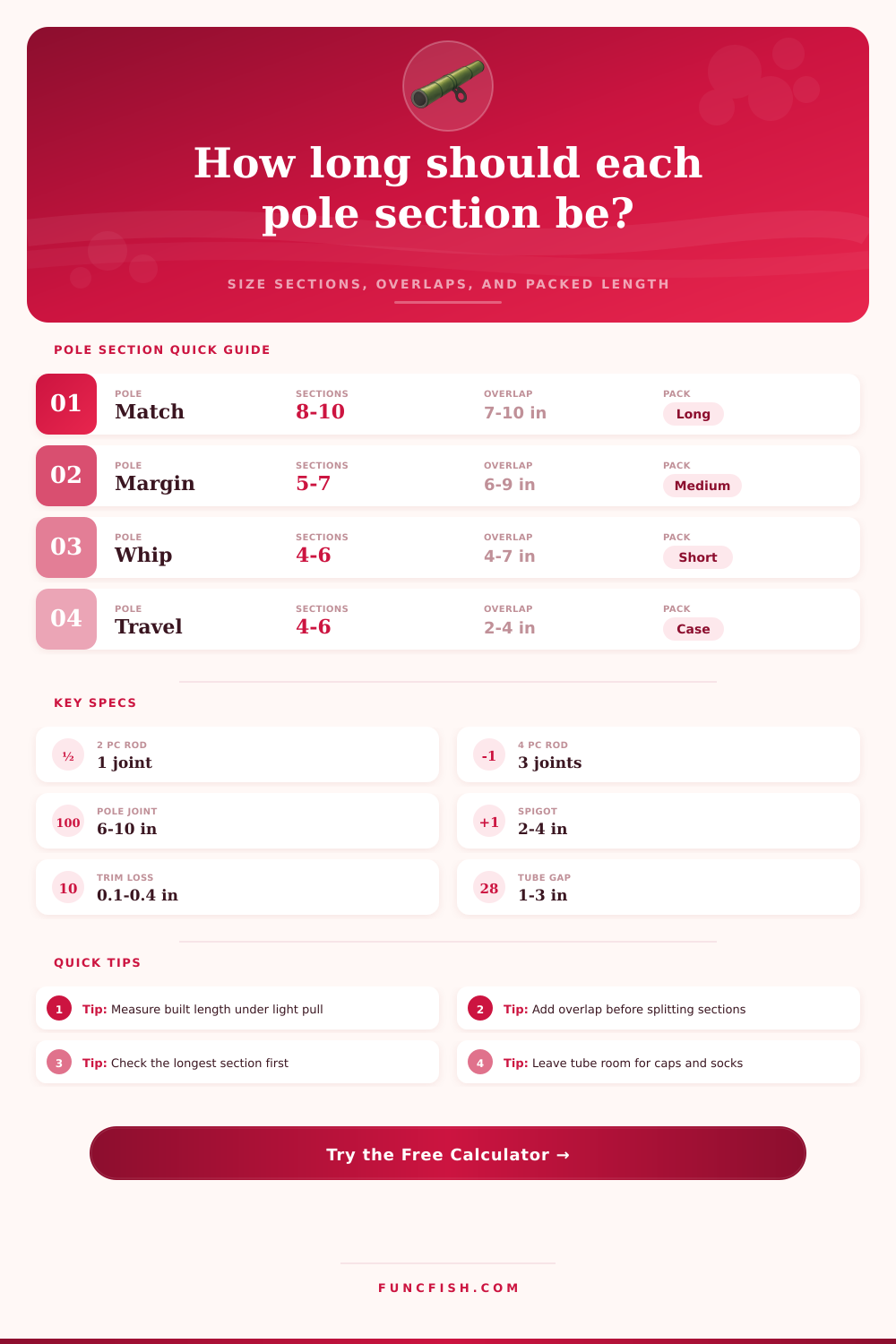
| Competition match pole, 13 m / 42.7 ft | 8 to 10 take-apart sections | 7 to 10 in / 18 to 25 cm | Progressive butt longer | Top kits and No. 3 sections often control practical pack length. |
| Margin carp pole, 8 to 10 m | 5 to 7 take-apart sections | 6 to 9 in / 15 to 23 cm | Butt-biased sections | Extra overlap supports side strain and elastic pressure. |
| Telescopic whip or tenkara pole | 6 to 12 nesting sections | 3 to 7 in / 8 to 18 cm | Short tip, long butt nesting | Closed length depends on wall thickness and nested taper stack. |
| Travel spinning rod, 4 to 6 pieces | 4 to 6 ferruled sections | 1.8 to 3.5 in / 5 to 9 cm | Equalized for case | Spigot or sleeve ferrules need shorter insertion but tighter tolerances. |
| Surf or carp rod, 2 to 3 pieces | 2 or 3 long sections | 3 to 5.5 in / 8 to 14 cm | Equal or butt-long | Handle length and butt cap can make the rear piece longest. |
| Fly rod with spigot ferrules | 3 to 5 sections | 1.5 to 3 in / 4 to 8 cm | Equal sections | Leave a visible spigot gap so wear can settle over time. |
🎣 Gear and Species Matching Grid
| Use case | Species or venue | Length range | Section focus | Overlap preference |
|---|---|---|---|---|
| Match pole | Roach, skimmers, bream, F1s | 11 to 16 m / 36 to 52 ft | Top-kit consistency and No. 4 balance | Moderate sockets with clean alignment marks |
| Margin pole | Commercial carp and tench | 6 to 10 m / 20 to 33 ft | Strong butt and power top sections | Longer overlap for side pressure |
| Whip or tenkara | Small trout, dace, panfish | 3.6 to 7 m / 12 to 23 ft | Nested closed length and light tip | Shorter overlap, smooth telescoping fit |
| Surf rod | Striped bass, drum, pompano | 10 to 15 ft / 3.0 to 4.6 m | Long casting sections and handle offset | Reinforced sleeve or strong put-over ferrule |
| Travel spinning | Bass, inshore fish, pike | 6.5 to 9 ft / 2.0 to 2.7 m | Equalized tube fit | Short spigot insertion with alignment marks |
| Boat rod | Cod, pollock, wreck fish | 6 to 8 ft / 1.8 to 2.4 m | Heavy butt and foregrip length | Deep ferrule or one-piece butt joint |
⚖ Blank Material Comparison
High-Modulus Carbon
7-9 inLong-pole sections stay light, but socket fit should be conservative because thin walls dislike point loading.
Standard Carbon
6-8 inGood default for margin poles and general rods, with balanced stiffness and practical overlap allowance.
Glass Composite
5-7 inHeavier and tougher, so slightly shorter sections often remain durable when ferrules are reinforced.
Spigot Carbon
2-4 inCommon in travel and fly rods where a separate internal spigot creates compact packed sections.
📐 Planning Reference Tables
| Calculation item | Formula | Imperial example | Metric example |
|---|---|---|---|
| Total hidden overlap | (section count - 1) x overlap | 8 joints x 8.5 in = 68 in | 8 joints x 21.6 cm = 172.8 cm |
| Physical blank before fitting | assembled blank + overlap + reserve | 511.8 in + 68 in + reserves | 1300 cm + 172.8 cm + reserves |
| Average section length | cut blank length / sections | 647 in / 9 = 71.9 in | 1643 cm / 9 = 182.6 cm |
| Tube clearance | case ID - cap gap - longest section | 76 in - 2 in - 71 in = 3 in | 193 cm - 5 cm - 180 cm = 8 cm |
| Visible assembled length check | sum sections - overlap - fitting loss | 579 in - 68 in = 511 in | 1471 cm - 173 cm = 1298 cm |
💡 Section Length Tips
All outputs are planning dimensions for fishing pole and rod section layout. Final fitting should follow the actual blank taper, ferrule style, and safe wall thickness at each joint.
Buying a blank rod means you’ve made a commitment to some hard facts, and they don’t give a damn what you think looks good. That number stamped on the package isn’t the real one until you subtract the sawdust and add back hidden inches lost to ferrules. And then there’s the issue of breathing room once they’re all stuffed inside their travel case. Mental math is no match for dividing twelve meters of pole into nine sections that each has to be squeezed into a six-foot tube.
It does the math for you so you can concentrate on whether the taper seems correct. It also removes the concern about snapping off tip section while trying to assemble.
How to Calculate Rod Lengths Correctly
That said, there are two common ways to build a sectioned bamboo fly rod. Most builder begin at the end and count up: divide the finished length by the number of sections. Wrong! That’s a sure-fire way to make a mistake. Rather than working forward, you have to work backwards, reverse engineering the blank length from the final state back to the raw material.
First, enter the length of completed rod into the calculator. It adds the penalties of building to that entry, layer upon layer. Each joint eat up length that won’t show when the pole is done. For example, a ten-section match pole has nine joints and needs some overlap at each joint to form a good grip. That means several inches of overlap per joint. This lost length doesn’t matter if you’re counting it, but it does matter if you’re ignoring it and your sections isn’t long enough. Your rod won’t reach as far than you hoped. The tool handles those deductions automatically to produce a real-world cut list rather than a wishful one.
How aggressively can I cut? That depends on what material you choose. Glass or standard carbon composites are more forgiving, they absorbs shock, so there’s some leeway in reinforced joints and slightly shorter section lengths. But high modulus carbon is light and stiff, yet brittle around the edges. It requires precise fits in ferrules and has zero tolerance for slop. This difference is pointed out clearly in the interface reference table, which also shows that not all poles requires the same tolerance, particularly between telescopic whips and beefy surf rods.
To minimize the overall closed length of a tenkara pole, overlap must be short and the tapers must be smooth so that sections fits together tightly. For a carp margin pole, side pressure will be applied, so the engagement lengths of the ferrules must be long enough to keep them from separating if a fish should run off sideways. Knowing why the differences exist allows for adjusting the inputs when making something a bit out of the ordinary.
But how does the style affect all of this? This is where we’ll see that pattern selection is more important than it might look at first glance. Calculating equal sections is simple enough, but in practice, most anglers don’t find them right. A more gradual taper (i.e. Butt section longer and tip section shorter) better reflect the natural bend curve and adds to the balance. That’s why the calculator accounts for this too, assigning a matching physical share for each segment depending off the selected style.
And remember to account for a small but critical allowance for trim loss; that is sanding your ferrule down to size and then squaring off the end. If not accounted for, you will be scraping away precious inches of already short tip sections to obtain a nice clean fit.
Many times, the “deal breaker” on a travel rod will be packed length. Will it fit into your luggage or vehicle? That’s typically determined by longest section. This tool accounts for protective socks and caps. It also checks the space between your tube(s) and dimensions of your luggage/tube. So if the calculator indicates no clearance, you know right away that your design isn’t workable and won’t require a single cut. You will no longer feel frustrated after a beautiful build when you realize it won’t fit in its case.
There’s no undo button when trimming blanks. You have one chance at it. Going too long means you can sand it down, but you cannot fix it if it is too short. Planning for precision should of save you hours of fixing things later on.
Use this tool to run what-if scenarios with both aggressive and conservative margins to find how much room you have in your design. Visualize what cases and reaches result from various levels of overlap. The numbers will tell you precisely how much blank to purchase to get what length and durability you desire, and will guarantee that each inch has a purpose instead of being lost to fitment mistakes and waste.