Poly Leader Sink Rate Calculator
Estimate an adjusted poly leader sink rate, countdown time, downstream drift, and fishing depth from leader rating, tippet, fly profile, current, cast angle, and retrieve speed.
📌Scenario presets
⚙Sink rate settings
Poly leader sink forecast
Full breakdown
📋Poly leader density reference
Hover
Intermediate
Sink 3
Sink 7
📐Sink rate and rig tables
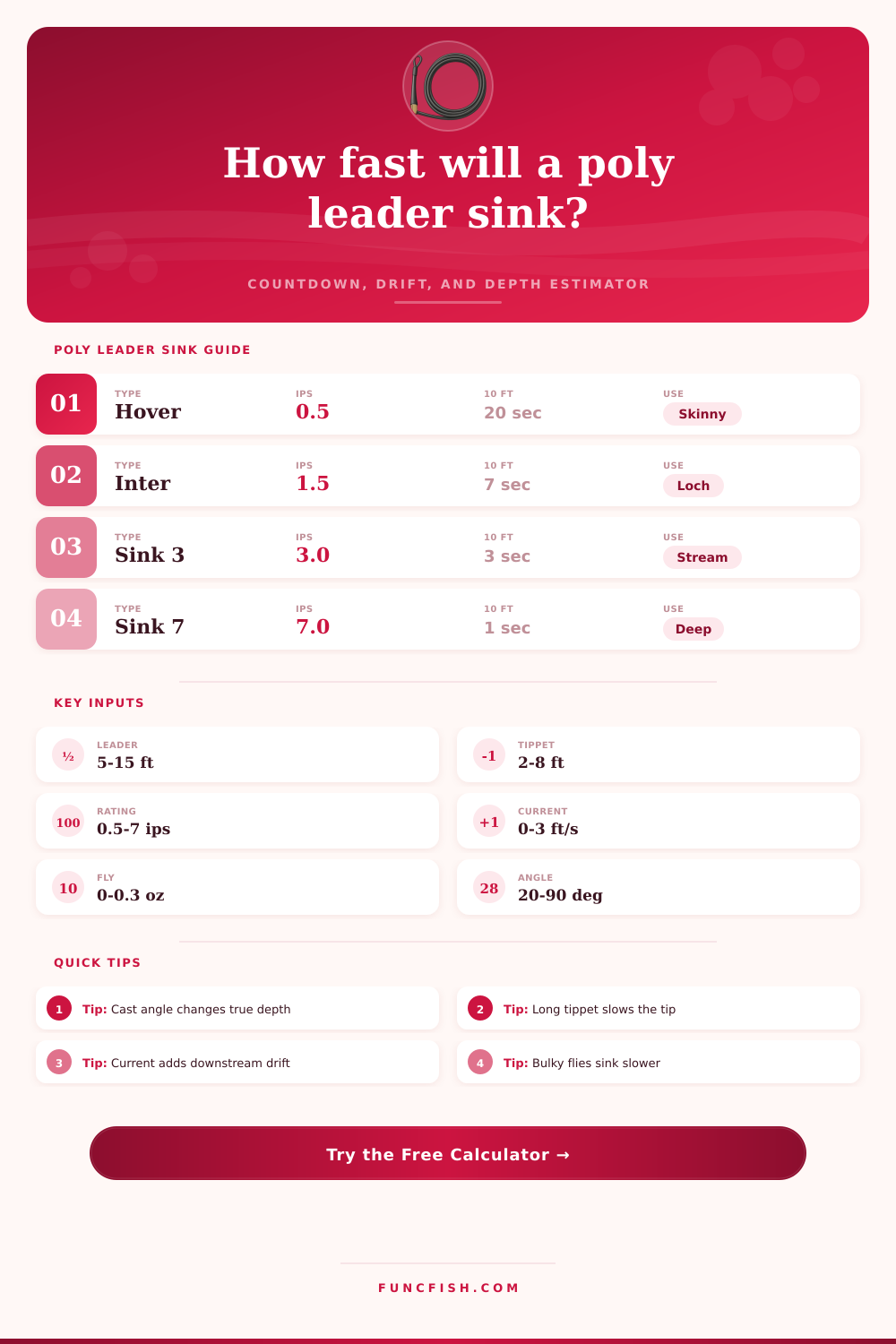
| Leader type | Rated IPS | Rated cm/s | Approx 6 ft countdown | Typical presentation |
|---|---|---|---|---|
| Hover / neutral | 0.5 | 1.3 | 144 sec | Skinny water, subsurface wake |
| Intermediate | 1.2 | 3.0 | 60 sec | Stillwater buzzer, shallow baitfish |
| Slow sink 1.5 | 1.5 | 3.8 | 48 sec | Soft hackle, slow swing |
| Medium sink 2.5 | 2.5 | 6.4 | 29 sec | Bank streamer, loch drift |
| Sink 3 | 3.0 | 7.6 | 24 sec | Pulling streamers near dropoffs |
| Sink 5 | 5.0 | 12.7 | 14 sec | Reservoir ledges and strong wind |
| Sink 7 | 7.0 | 17.8 | 10 sec | Deep pike flies and fast pools |
| Extra super fast | 8.0 | 20.3 | 9 sec | Short deep shot with heavy flies |
| Rig factor | Low drag value | High drag value | Calculator effect | What it means |
|---|---|---|---|---|
| Tippet length | 2 ft | 8 ft | Slower with length | More unweighted mono holds the fly up |
| Tippet diameter | 0.006 in | 0.014 in | Thicker sinks slower | Diameter adds water resistance |
| Fly weight | 0.01 oz | 0.25 oz | Weight increases rate | Bead, cone, or tube mass pulls down |
| Fly bulk | Sparse | Foam | Bulk reduces rate | Hair, foam, and rabbit trap water |
| Retrieve | 0 in/sec | 15 in/sec | Fast retrieve lifts | Line tension makes the sink path flatter |
| Cast angle | 25 deg | 90 deg | Steeper sinks deeper | Vertical component is the useful depth |
🐟Species and presentation windows
| Target | Common leader | Starting count | Working depth | Adjustment cue |
|---|---|---|---|---|
| Stillwater trout | Intermediate to Sink 3 | 5-20 sec | 2-8 ft | Count longer until takes stop rising |
| River trout | Hover to Sink 2.5 | 2-8 sec | 1-4 ft | Shorten count if ticking bottom |
| Salmon swing | Sink 3 to Sink 7 | 3-12 sec | 3-9 ft | Use drift result for lead angle |
| Pike streamer | Sink 5 to Sink 7 | 8-25 sec | 6-14 ft | Account for bulky fly drag |
| Sea trout | Intermediate to Sink 5 | 4-15 sec | 2-7 ft | Lift rises when strips get fast |
| Saltwater flats | Hover to Intermediate | 1-6 sec | 1-3 ft | Avoid too much countdown over grass |
💡Practical checks
Tip: Rated IPS is measured in controlled conditions. Treat the adjusted sink rate as a starting countdown, then confirm by contact, follows, and strike depth.
Tip: If the fly tracks above fish, first add countdown. If it still rides high during the retrieve, reduce retrieve speed or shorten tippet before changing leader density.
TIP: Sink rates aren’t always what they seem The tag that says “sinks three inches per second” is not always true. You have to consider leader, your tippet, the added weight of a big fly, and pull of casting into current. Line companies test their leaders in controlled lab setting without any drag behind them. It is not much like how you fish. Knowing your own rig’s true sink rate are far better than trusting some number on a package. You want to know its performance in the current and under tension, not just an out-of-context claim.
This page’s calculator closes that gap between what happens in theory versus in practice. It factors in variables within your control (cast angle, water speed, fly profile, tippet length) and apply those to base sink rating. It accounts for physics when you fish subsurface presentations. For shallow flats fishing with a hover leader, math is easy enough to perform in head. Things gets complicated when using intermediate or fast-sink leaders in deeper rivers or lochs. The tool do all of that math for you so that you can focus on timing and casting.
Understanding How Flies Sink in Real Life
The sink rate change dramatically with tippet length. Longer lengths (either fluorocarbon or mono) create a drag force that holds the fly up even if you have heavier leader. The calculator includes this drag penalty. That’s important since most anglers blame leader density issues on having too much untapered line behind their leader. Going from a heavy leader to one rated for more sinking power won’t always help, shortening your tippet can get you deeper than going down in leader size. It is a little thing, but it would of been a huge deal for stealth and simplicity.
Consider also profile of your fly. Wet flies with thin hackle slice through the water with low resistance, letting the leader take over on sink rate. Foamy bobbies and chunky strips of bunny fur trap air and generate noticeable lift. Buoyancy drag gets factored into the calculator. When you’re swinging that big streamer, what gives with a deep-sink leader not getting down? It may well be fly battling gravity. Knowing the tradeoff help you make smarter rig decisions. You can do this before you step off bank.
Adding to the complexity is water current that will have your fly drifting downstream. It tells you both how deep you are and how far your fly has traveled during your countdown. Knowing your lead distance can be as critical as knowing your depth when fishing down a river. You could be perfectly positioned for depth with your fly, but have it thirty feet downstream of where you wanted. That’s where the drift estimate comes into play. It help you strip and swing your line better to account for that drift.
Sink efficiency also depend on cast angle. With a flat cast you spread that leader out and lessen vertical part of sink. Direct, steep presentations let gravity do its thing more efficient. This is the kind of geometric reality that the tool takes into account. Straight presentation isn’t a matter of throwing harder but rather about making more efficient casts. These are tweaks that turn numbers into actualy strategy.
Remember, however, don’t take these numbers as truth. It’s just a baseline. Things differ out on water. Wetting of flies, wind chill and water temperature can alter the rate of sinking beyond what a stationary calculator might explain. Your best bet is to believe the math for planning and then confirm by sight when you’re actualy fishing.
Observe the track of fly. Feel pull on line. Is it up high? Before changing leaders, try shortening tippet or slowing down in the retrieve. The more precise you can get the better. This isn’t rocket science and doesn’t require a PhD in physics but it does require that you pay attention. Inches of water depth matter. Seconds in your countdown make or break keepers from empties. These small details improve presentations for you. You worry about the fish, and the tool will crunch the numbers.