PR Knot Bobbin Turns Calculator
Estimate PR knot bobbin turns, tension range, bite length, locking finish, guide clearance, and retained connection strength for braid-to-mono or braid-to-fluorocarbon leaders.
Use the measured braid diameter if the package number is optimistic.
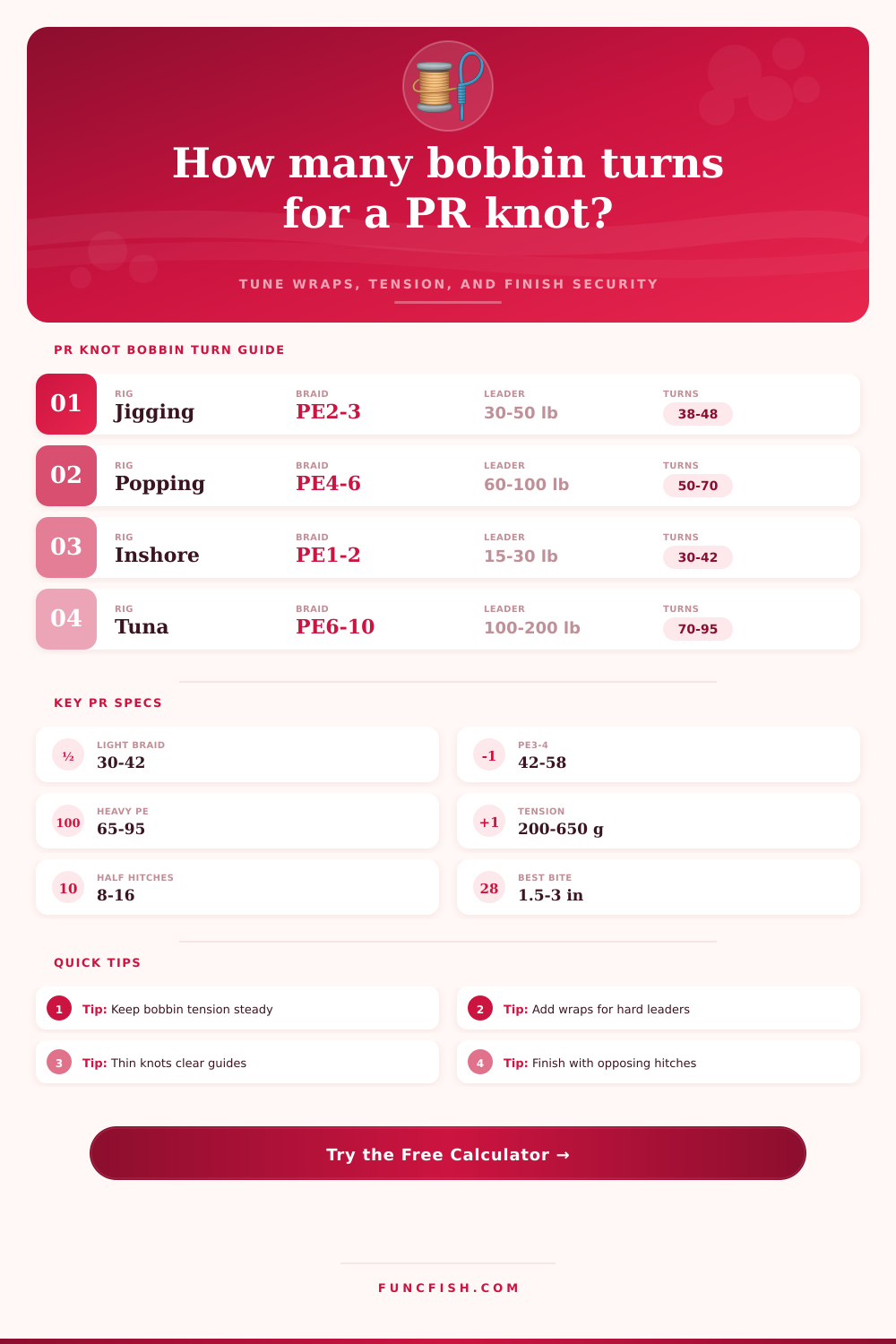
| PR knot class | Braid range | Leader range | Working tension | Normal bobbin turns |
|---|---|---|---|---|
| Light game | PE 0.4-0.8 | 6-15 lb / 0.18-0.33 mm | 150-280 g / 5.3-9.9 oz | 24-36 turns |
| Inshore finesse | PE 0.8-1.5 | 12-30 lb / 0.28-0.50 mm | 220-380 g / 7.8-13.4 oz | 30-44 turns |
| Snapper and surf | PE 1.5-3 | 25-50 lb / 0.45-0.70 mm | 320-520 g / 11.3-18.3 oz | 38-55 turns |
| Offshore jigging | PE 3-5 | 40-80 lb / 0.60-0.90 mm | 420-650 g / 14.8-22.9 oz | 48-68 turns |
| Popping leaders | PE 5-8 | 80-150 lb / 0.90-1.40 mm | 560-780 g / 19.8-27.5 oz | 62-84 turns |
| Tuna and heavy reef | PE 8-12 | 130-220 lb / 1.20-1.80 mm | 700-950 g / 24.7-33.5 oz | 76-105 turns |
| Material pair | Grip behavior | Turn adjustment | Tension note | Finish note |
|---|---|---|---|---|
| Coated 8-strand PE to soft fluoro | Balanced bite once packed | Base turns | Medium tension seats cleanly | 10-12 alternating hitches |
| Smooth 12-strand PE to hard fluoro | Slick braid over stiff leader | Add 6-10 turns | Use higher steady tension | Rizzuto helps lock braid tag |
| 4-carrier braid to nylon mono | Coarse braid grips quickly | Subtract 2-4 turns | Avoid flattening mono | Slim finish usually enough |
| Hollow core PE to wind-on mono | Round braid compresses slowly | Add 4-8 turns | Ramp tension gradually | Extra hitches after pull test |
| Worn fuzzy braid to hard mono | High surface bite, uneven packing | Add 2-5 turns | Keep wraps aligned by hand | Trim after second pull test |
| Target or rig | Typical braid | Leader class | PR turns | Guide priority |
|---|---|---|---|---|
| Aji, crappie, trout finesse | PE 0.4-0.8 / 4-10 lb | 4-12 lb fluoro | 24-34 | Very slim, short bite |
| Bass spinning and clear water | PE 0.8-1.2 / 8-15 lb | 8-16 lb fluoro | 30-40 | Passes micro guides |
| Redfish, snapper, light jigging | PE 1.5-2.5 / 20-35 lb | 25-50 lb leader | 38-52 | Balanced slimness |
| Surf plugs and metal jigs | PE 1.5-3 / 20-40 lb | 40-70 lb shock | 44-60 | High cast shock |
| Kingfish, amberjack, grouper | PE 4-6 / 50-80 lb | 60-120 lb leader | 58-78 | Reef surge margin |
| GT, tuna, heavy popping | PE 6-10 / 80-130 lb | 100-220 lb leader | 70-98 | Drag strength first |
| Smallest guide ID | Leader diameter | Knot diameter target | Guide clearance | Suggested finish |
|---|---|---|---|---|
| 0.10-0.14 in / 2.5-3.6 mm | 0.008-0.018 in / 0.20-0.46 mm | Under 45% of ID | Micro guide casting | Slim finish, short hitches |
| 0.14-0.20 in / 3.6-5.1 mm | 0.018-0.032 in / 0.46-0.81 mm | Under 50% of ID | General spinning rods | Standard hitches |
| 0.20-0.30 in / 5.1-7.6 mm | 0.032-0.055 in / 0.81-1.40 mm | Under 55% of ID | Jigging and surf rods | Rizzuto or insurance hitches |
| 0.30 in plus / 7.6 mm plus | 0.055-0.080 in / 1.40-2.03 mm | Strength before slimness | Heavy popping rods | Extra hitches after pull test |
Sometimes when you set the hook on a heavy jig after feeling a bite all the way down to the bottom, the line just slides right out from underneath you. It is not always bad luck. Often times that’s a poor friction management issue.
A knot like the PR knot is renowned for its strength due to it’s large surface area of contact between dissimilar material. However, just doing it 50 times doesn’t mean it’s secure unless those wrap are even and tight. The calculator model the level of mechanical grip needed for your particular leader and braid combo so you can stop guessing.
Why Your Fishing Knots Fail
But here’s what most angler don’t know… It’s all about consistent tension. Without enough, you get wrapped around a bunch of times, but the loose coil won’t create enough friction to hold the line. It is the same as when stacking bricks; they look neat from far away, but the stack fall apart under pressure.
It calculates how much tension should of been used based off the size of your leader and braid and then inform whether you’re forcing too hard or too soft. Even a couple more ounces of tension per turn mean the difference between keeping a snapper and watching it go over the reef with lighter PE line.
But there’s one more wrinkle (material mismatch). Braid these days is super slick when wet; really slick. Combine that slickness with a stiffer fluorocarbon leader and what do you get? This create a slippery surface that doesn’t readily bite into itself. To compensate for this, the reference table within the tool recommend additional turns when braid is smoother than the leader material. It is not because it makes the knot bulkier for bulkiness’ sake. It help compensate for lack of friction by keeping the knot from creeping under load.
In the real world; on the water, theory and practice run into guide clearance. “You’ve dialed up a sweet knot that holds ninety-five percent of its initial strength, but it’s so big that it won’t go through your smallest guide; what good does that do?” The calculator consider both the leader size and the internal diameter of your rod’s guides. So what comes out of the machine is a knot profile thin enough to easily slide along. When a knot hitch on a guide at the time of launch, it concentrates pressure points until connection weakens. Even before the knot has been used to set a fish.
Now you also want to pay close attention to how much braid wrap around your leader. That’s the bite length. How much distance of your leader is covered by your braid wraps? When there isn’t enough bite length, the braid will cut through your leader when it’s on a high drag load. Too much bite length make the knot bulky and gets in the way. You need to find that sweet spot where the correct amount of tension (fewer turns) or the correct amount of turns (more tension) hold properly.
Knots are dynamic, not static; under load. Forces change quickly when you set the drag and a fish run off. A properly finished and tied PR knot spread the shock evenly over the whole wrapped length of the line. Beyond being traditional, finishing with alternating half-hitches secures the tag end preventing it from coming apart as the knot take a surge. Depending on whether you’re explosive topwater casting or smooth drag fishing, the tool recommends finish style. The resulting stress patterns vary greatly different than the two.
So in conclusion, tying a good knot isn’t really about the rite or ritual but the science behind it. It is about controlling tension, knowing material differences, and creating a profile that your equipment can manage without being too cumbersome. They don’t have to be tied like a surgeon does, just intentionaly. The calculator will do the diameter and friction math for you, so you can concentrate on the part that counts, feeling the bite and setting the hook comfortabley.