Pre-Spawn Timing Estimator
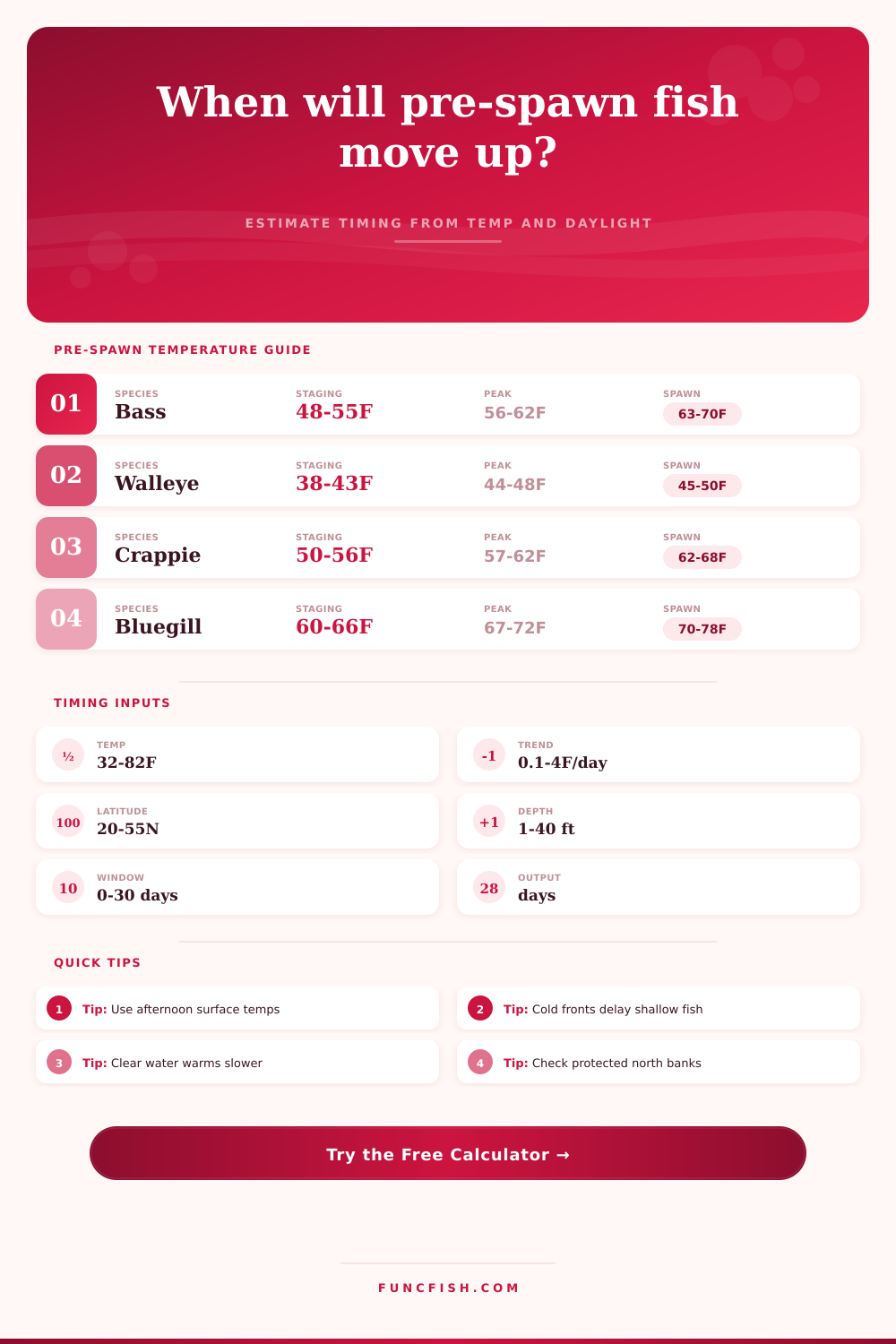
Estimate when fish are likely to shift from deep staging to shallow pre-spawn movement and active spawning based on temperature, warming rate, daylight, species, and water stability.
🏷Timing signals
📌Pre-spawn presets
⚙Water and species inputs
Pre-spawn timing estimate
Calculation breakdown
🐟Species timing grid
Largemouth Bass
Walleye
Crappie
Bluegill
📊Temperature and movement reference
| Species | Deep staging | Active pre-spawn | Likely spawn | Temperature note |
|---|---|---|---|---|
| Largemouth bass | 45-50°F / 7-10°C | 51-61°F / 11-16°C | 62-70°F / 17-21°C | Protected banks warm first |
| Smallmouth bass | 43-48°F / 6-9°C | 49-58°F / 9-14°C | 59-65°F / 15-18°C | Rock flats hold heat |
| Walleye | 35-38°F / 2-3°C | 39-43°F / 4-6°C | 44-50°F / 7-10°C | Current can advance runs |
| Crappie | 46-50°F / 8-10°C | 51-61°F / 11-16°C | 62-68°F / 17-20°C | Stable coves matter |
| Bluegill | 56-60°F / 13-16°C | 61-69°F / 16-21°C | 70-78°F / 21-26°C | Often repeats in waves |
| Rainbow trout | 36-40°F / 2-4°C | 41-47°F / 5-8°C | 48-55°F / 9-13°C | Flow stability is key |
⚖Habitat comparison table
| Waterbody type | Warm-up behavior | Timing adjustment | Best temperature reading | Pre-spawn check zone |
|---|---|---|---|---|
| Small pond or pit | Fast surface response | Advance 1-3 days | Mid-afternoon bank pocket | Dark bottom coves |
| Protected cove | Fast if wind-sheltered | Advance 1-2 days | Northwest corner | First inside break |
| Clear natural lake | Slow and depth-lagged | Delay 2-5 days | Sunlit gravel or sand | Rock transition edges |
| Reservoir creek arm | Upper arm warms first | Advance 0-2 days | Back third of creek | Channel swing to flat |
| River pool or run | Flow controls timing | Delay 0-4 days | Slack edge near current | Tailout and side pocket |
| Marsh or backwater | Very quick in sun | Advance 2-5 days | Protected vegetation edge | Flooded grass margin |
🌡Trend interpretation table
| Warming trend | Timing meaning | Fish position | Confidence effect | Calculator treatment |
|---|---|---|---|---|
| Cooling below 0°F/day | Spawn clock pauses | Back to breaks or depth | Lower | Add delay before heating resumes |
| 0.1-0.5°F/day | Slow seasonal rise | Staging expands | Moderate | Use longer window |
| 0.6-1.5°F/day | Reliable spring push | Transition routes active | Higher | Use direct thermal ETA |
| 1.6-3.0°F/day | Fast shallow movement | Bank and flat checks improve | High if stable | Shorten early edge |
| Over 3.0°F/day | Volatile warm spike | Fish may surge then stall | Mixed | Cap confidence and widen range |
🗺Species comparison grid
| Species group | Primary trigger | Secondary cue | Typical staging depth | Spawn location pattern |
|---|---|---|---|---|
| Black bass | Stable warming water | Increasing daylight | 6-18 ft / 2-5 m | Protected hard-bottom flats |
| Walleye and sauger | Temperature plus current | Night movement | 8-25 ft / 2-8 m | Gravel shoals, dams, rivers |
| Panfish | Shallow warmth | Moon around colony waves | 4-12 ft / 1-4 m | Coves, sand, brush edges |
| Trout and salmonids | Flow and cool range | Gravel quality | 2-10 ft / 1-3 m | Riffles, tailouts, tributaries |
| Pike and pickerel | Ice-out and marsh warmth | Flooded vegetation | 2-8 ft / 1-2 m | Marsh grass and backwater |
| Catfish and carp | Late spring warmth | Stable shallow cover | 4-15 ft / 1-5 m | Cavities, riprap, backwaters |
💡Timing notes
Temperature tip: Enter the shallowest reliable afternoon reading near the fishable spawning area, not only the main-lake morning temperature, because protected flats can lead the basin by several degrees.
Trend tip: A single warm day can pull fish forward, but this estimator gives more weight to three or more stable days because repeated warmth usually creates the strongest pre-spawn movement.
Fishing in spring is as much about timing as it is casting. Fishing deep water when the fish is staging on shallow banks wastes time.
In the pre-spawn phase they come from their winter holes to head to spawning areas. That window are narrow and fast. If relying on gut feeling, you can easily miss it.
How to Fish in Spring
The estimator takes species behavior, daylight, and temperature. It puts them together into one probability window. People see the temp and think it is 52 degrees but that means nothing. Does that mean it warmed up over a week or cooled down over three days? That makes all the difference. It’s the trend not just the number. There is no magical number fish turn on when it hits a certain point. It’s about stability. When it warms quick it pulls out a few scouts but as long as they feel like it might cool off again the rest stays deep. The calculator accounts for this by favoring longer sustained warm ups over short bursts.
Why does this matter? Because a cold front can delay them a week whereas a slow steady increase of a degree a day pushes whole school up.
“Light is more important than most people realize. The lengthening days set off a hormonal cue in the fish which will override temperature to some degree. That’s what causes the fish in Florida to move in late February and the ones in Minnesota to wait until May with the same water temps. The tool factors in where you live (your latitude) as well as day of the year. That makes it adjust for this photoperiod effect. It knows the days is barely beginning to get longer up north. It factors that in and understands a northern fish require a greater thermal push.
Another factor to consider is where they sleep. How deep is staging depth? If you are in a muddy river the fish will hold shallower than if it’s a clear lake because clear water allows sunlight to reach down into the water column making the shallows cooler longer. On the flip side, mud warms up quicker as light above penetrates through the muddier water. Tuning your water clarity changes the temp threshold. This accounts for the thermal lag of each environment. For example a point with lots of protection warms up far more quick than main lake body. Often the guess is that fish will show up sooner in protected coves then on exposed flats.
There’s one other factor: Moon phase. Nocturnal activity increase with moonlight, which means full moons will also speed up spawning runs (a few days). Conversely, new moons suppress fishing activity, keeping fish more wary and down deep. Adding that dimension adjust the timeline. This is particularly effective on fish whose migration is influenced by the moon, such as crappie and bass.
It spits out a probable window and a readiness score. Don’t consider that a promise. It’s nature. Mother Nature is messy. Consider it a probability map.
If the score is low, stay shallow and wait until a solid pressure system hits. Aggressively work those transition areas if the score comes back high. You aren’t trying to be there at the second they spawn. You’re trying to be there when they are moving towards their spawning grounds. They will feed like crazy and overlook slightly imperfect presentations during this phase.
Narrow down where to look with the data. Then look around with your eyes and find the fish.
Spring fishing can be the toughest timing game. Get it right and a dry morning becomes a tournament winning day.