Pressure Canning Time Calculator
Estimate tested processing time, altitude pressure, jar batch duration, and seafood jar-size limits for a fish pressure canner run.
🎚Unit Mode
📌Fast Presets
⚙Canning Inputs
Use this calculator as a planning aid with currently tested pressure-canning directions. Do not shorten processing time, vent time, or required pressure.
Calculation Breakdown
🐟Species and Jar Planning Grid
📊Altitude Pressure Reference
| Altitude Range | Metric Range | Dial-Gauge Pressure | Weighted-Gauge Pressure |
|---|---|---|---|
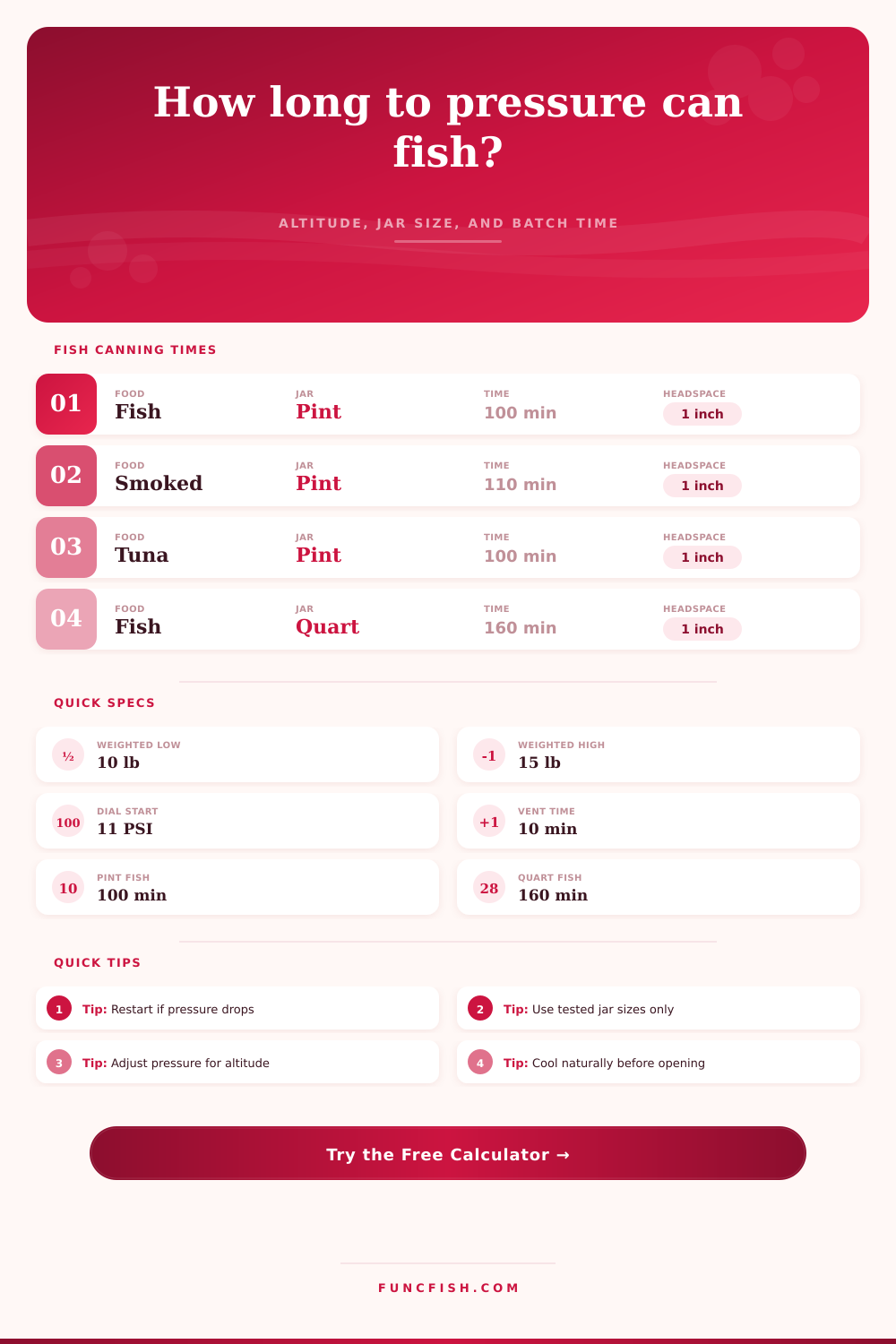
| 0 to 2,000 ft | 0 to 610 m | 11 lb pressure | 10 lb pressure to 1,000 ft |
| 2,001 to 4,000 ft | 611 to 1,219 m | 12 lb pressure | 15 lb pressure |
| 4,001 to 6,000 ft | 1,220 to 1,829 m | 13 lb pressure | 15 lb pressure |
| 6,001 to 8,000 ft | 1,830 to 2,438 m | 14 lb pressure | 15 lb pressure |
| Above 8,000 ft | Above 2,438 m | Use a verified local extension table | 15 lb pressure if approved locally |
⏱Seafood Processing Time Reference
| Food Category | Tested Jar Size | Processing Time | Calculator Treatment |
|---|---|---|---|
| Fresh fish pieces, including salmon and trout | Pints or half-pints | 100 minutes | Standard fish cycle |
| Tuna | Pints or half-pints | 100 minutes | Tuna cycle |
| Smoked fish | Pints only | 110 minutes | Blocks untested quart choice |
| Fresh fish quart jars | Specific straight-sided quarts | 160 minutes | Quart-fish cycle only |
| Untested fish jar choices | Any unsupported size | No calculated time | Calculator blocks the output |
🧪Jar Load and Time Planning Table
| Planning Item | Typical Entry | Why It Matters | Calculator Output |
|---|---|---|---|
| Heat-up period | 15 to 35 minutes | Canner reaches steady steam before venting | Added before processing |
| Steam vent | 10 minutes minimum | Air is driven from the canner | Forced to at least 10 minutes |
| Processing cycle | 60 to 160 minutes | Time starts only at target pressure | Primary safety time |
| Natural cool-down | 30 to 60 minutes | Pressure returns to zero without forced cooling | Added after processing |
| Pressure drop restart | 0 expected | A drop means timing restarts from the beginning | Warns and totals restarted time |
📋Species and Pack Matching Table
| Species or Seafood | Common Jar Choice | Pack Style | Notes for Calculation |
|---|---|---|---|
| Salmon, trout, halibut, rockfish | Pint | Raw pack | Uses 100 minute fish cycle |
| Tuna | Pint or half-pint | Raw or pre-cooked pack | Uses 100 minute tuna cycle |
| Smoked salmon or whitefish | Pint | Lightly smoked pack | Uses 110 minute smoked cycle |
| Fresh fish in quarts | Quart | Raw pack | Uses only the tested quart fish path |
| Mackerel and catfish | Pint or half-pint | Raw pack | Uses 100 minute fish cycle |
| Rockfish or cod | Pint or half-pint | Raw pack | Uses 100 minute fish cycle |
💡Calculation Tips
Now you are pressure canning, so it’s all over but the waiting (well, actualy you’re still waiting). The pressure canner is on the stove. You have a hand that smells like stinky salt water. There are fish scales in every corner of the kitchen. You packed those jars. Now what? Do you wait another half hour or call it good? Will the food be cooked enough? How long will it take? What happens if…? What do you need to know?
Pressure canning isn’t just math; it’s thermodynamics. It’s altitude. It’s botulism spores and the conditions under which they thrive. Timing is everything.
How to Pressure Can Fish Safely
When most folks hear “canner,” they picture starting to count at steam-out time. Oops, wrong. Processing time don’t even start ticking until the canner reaches its targeted pressure and maintains it. What’s happening before then? You’re venting air, heating water. And here’s the thing about air: it is a thermal insulator. Leave it inside the canner, and the heat won’t distribute evenly. Some jars will be cooking away; other ones may not even have warmed up yet. Ten minutes of constant steam, the venting phase, isn’t negotiable. That phase purges the cool air, allowing the heat to penetrate all the jar evenly.
The canning-time calculator on this page does the math on scheduling. It breaks it down into three steps: venting, heating up, and processing. It adds one more step for cooling. This gives you a realistic total time to help you plan your day without going crazy in the kitchen or burning dinner.
But there’s another variable that completely changes the game: Altitude. The lighter the air pressure over your head, the cooler the temperature at which water boils. Two hundred twelve degrees Fahrenheit is the boiling point of water at sea level. Eight thousand feet above sea level means that water will boil more like one hundred ninety-eight degrees. Sounds like nothing, right? It’s a chasm for destroying Clostridium botulinum spores. To break down those spores, you need to apply very high heat for an extended period of time. If you are high up in the mountains, you’ll need to increase the pressure inside the canner to raise the boiling point back to a safer level. For dial-gauge canners, this has to be done manually. Weighted gauges includes settings for two different altitudes (low/high), which is one reason people recommend them to beginner canners. See the chart below for specific pressure adjustments according to height. That way you don’t accidentally under-process simply because you happen to live close to the mountains.
First, fish is delicate and soft. Unlike beans or beef, fish breaks apart easily. Unlike beans or beef, fish breaks apart easily. But fish? Nope. That’s why you’ll find that most species are usually packed into pint jars. Those little guys heat fast and hold together well in a small container. Quart jars on the other hand are dicey. More volume mean that the middle portion of the jar takes forever to get hot enough to kill anything. For those looking to put fish in a quart jar, there is a set process (that works) that takes into account slow heating. Going with the same timing used for pints for quarts, however, is asking for trouble.
That’s where our tool comes in. It doesn’t let you make that mistake. It knows that fresh salmon goes in faster than smoked. Tuna has different requirements still. Making assumptions about what happens inside the jar is dangerous. Maybe it’ll work once, maybe twice. Eventually though, the physics will catch up with you.
Heating isn’t all that matters. Cooling is also critical. Why? Because if you dump cold water on the jars, you’ll cause a temperature shock, and that might cause the glass to crack and ruin the seal right there. No, no, no. Always allow the canner to cool down slowly; it will take time (up to an hour or longer). As it cools, it will still be cooking the jars gently, and creating the vacuum seal. If you open it before then, you will suck out the contents of the jar. Now you have a mess on your counter and nothing but a jar full of watery goodness.
The last ingredient is patience. It doesn’t appear in the recipe but makes the difference between a successful and unsuccessful batch. Preserving is both a science and a little bit of a ritual. There’s bacteria out there. And there’s heat. Respect them. But also be prepared with a good schedule. Because the last thing you want is to be chained to your kitchen on a Sunday afternoon.
That’s why we created this calculator up top to run the numbers for exactly how many jars you’re using, at what altitude. The calculator generates a realistic timeline for you, time to grab a book and get to work on finishing that project (or simply breathing). Then when the canner cools down and you listen to the satisfying ping of those lids sealing shut, you’ll know: it was worth the wait. Your pantry thanks you. And your dinner plans won’t have to go off-track. Safe preserving is all about preparing, being precise, and knowing when to back away and let the pressure do its work.