
Why did you buy a puffer fish? Because it’s a living toy. It is a small, round toy that follows you with its big eyes around the room. That makes you think: harmless curiosity. But you couldn’t be more wrong. The initial appeal of this fish is only that… An illusion.
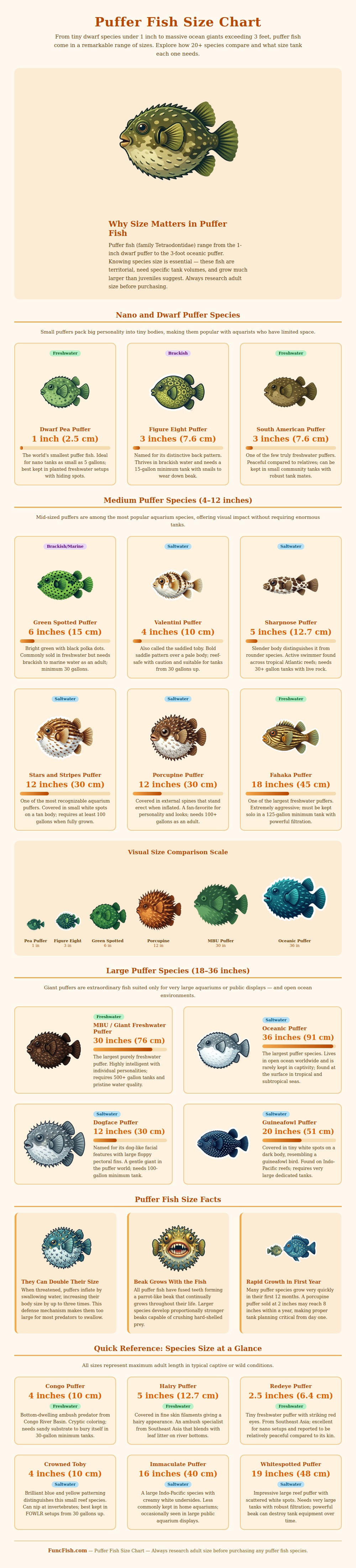
In six months, what you’ll have in your five-gallon bowl will probably bear little resemblance to what you started with. How these animals really grow alters everything you do when setting up your tank. Your expectations go from aesthetics to biology and space. This is where the size of each species also comes into play visually. As you look at the species above, there’s no question who will be tiny and who will grows to be very large. That makes a difference, as the one you hold in your hands now could require a bathtub tomorrow.
Why Size Matters for Puffer Fish
Most people starting out think about physical presence of the fish at present. They don’t consider what it will take up once it’s an adult. That is how set-ups fail and fish gets stressed. Look at expected adult size so you know what species matches your real-life available space.
You’re hoping they won’t get big because they like it when you change their water? For example, consider the dwarf pea puffer. As its name implies, it really is small. In fact, many don’t exceed an inch or so in length. That makes it ideal for nano tanks where every square inch matter. But even then, there’s more to consider beyond just square inches.
For example, it’s a territorial species; a bottom dwelling species with a mean streak. A small tank works only if it is designed with plenty of hiding spots and visual barriers. Otherwise, the fish won’t have a moment’s peace as it faces off against itself and everything else in the tank in constant reflection. And there they are on the size chart; the dwarves among giants.
What the chart points out is that “small” is relative when discussing puffers. Second, there are mid-sized types such as the figure eight puffer or green spotted puffer. This is perhaps the most frequent mistake beginners make with these species. You buy them as juveniles and think they’ll be ok in your modest aquarium. What you don’t know is that mid-sized species like green spotted or figure eight puffers are best kept in brackish water conditions. And they need far more space once they get bigger.
That three-inch juvenile may look fine in a thirty-gallon. But it becomes too cramped for a six-inch adult that needs space to roam its territory. Changing diets isn’t simply switching foods. It’s an entire environmental makeover that many keepers fail to appreciate until there are health problems.
But then there’s the big guys, which poses an entirely different challenge if you have the space for one. Species like the porcupine puffer or the MBU puffer can reaches a large size. Hundreds of gallons of water. It is not for a casual observer. The large species aren’t pets for casual observation; they’re complex creatures, intelligent ones, that demand special care and diet. They eat hard-shelled invertebrates (which they need to help grind down their continuously growing beak). And they need a strong filtration system, again, if you want to keep one. You’ll also need a strong tank. That’s what the infographic starkly shows.
The difference between the small and the really big is quite dramatic. This visualization helps to drive home the point that keeping one larger fish costs much more both in equipment and in time and maintenance. Size matters but not just in terms of raw numbers. Behavior associated with size also matters.
When pufferfish feel threatened they will puff up (inflate). In doing so, they effectively double or triple their apparent volume. What was barely too big to fit into a filter intake while relaxed now jams it entirely while panicking. There is another wrinkle on the sizing question, and this one is about a defensive posture. Not only do you want space for the cruising version of the animal but you want room for its inflated state. This is an often-overlooked detail even in general care information.
This is critical for day-to-day tank care. In the end, the decision on what type of puffer is best depends on you. Be honest about how much room you have. What kind of resources can you provide? Don’t be fooled by juveniles. They are cute but don’t get suckered into something you can’t maintain. Consider the destination, not the journey.
How does the species fare once it reaches adulthood? I broke it down in the chart above. It helps you see the end game before purchasing. Are you in the market for an MBU puffer or more of a shy pea puffer? Know the growth curve and plan accordingly. Make sure your tank is set up for adult size from day one.
This is how you ensure the puffer stays healthy and fun. It keeps the fish from being cramped and stressed. Pay as much attention to its physical requirements as you did to its personality. When you’ve got the right sized habitat, you’ll be able to appreciate the true character of these amazing fish. No longer will you need to worry if/when it’s going to grow out of its environment.