Pulley Rig Drop Calculator
Size the lead drop on a surf or rough-ground pulley rig from trace body length, hook snood reach, bait clip position, bait bulk, line stretch, cast style, and ground clearance.
📌Scenario presets
⚙Rig geometry inputs
Pulley rig drop result
Calculation breakdown
📏Pulley rig component data
Mono Snood
Fluoro Snood
Wire Trace
Heavy Mono
📊Drop length reference
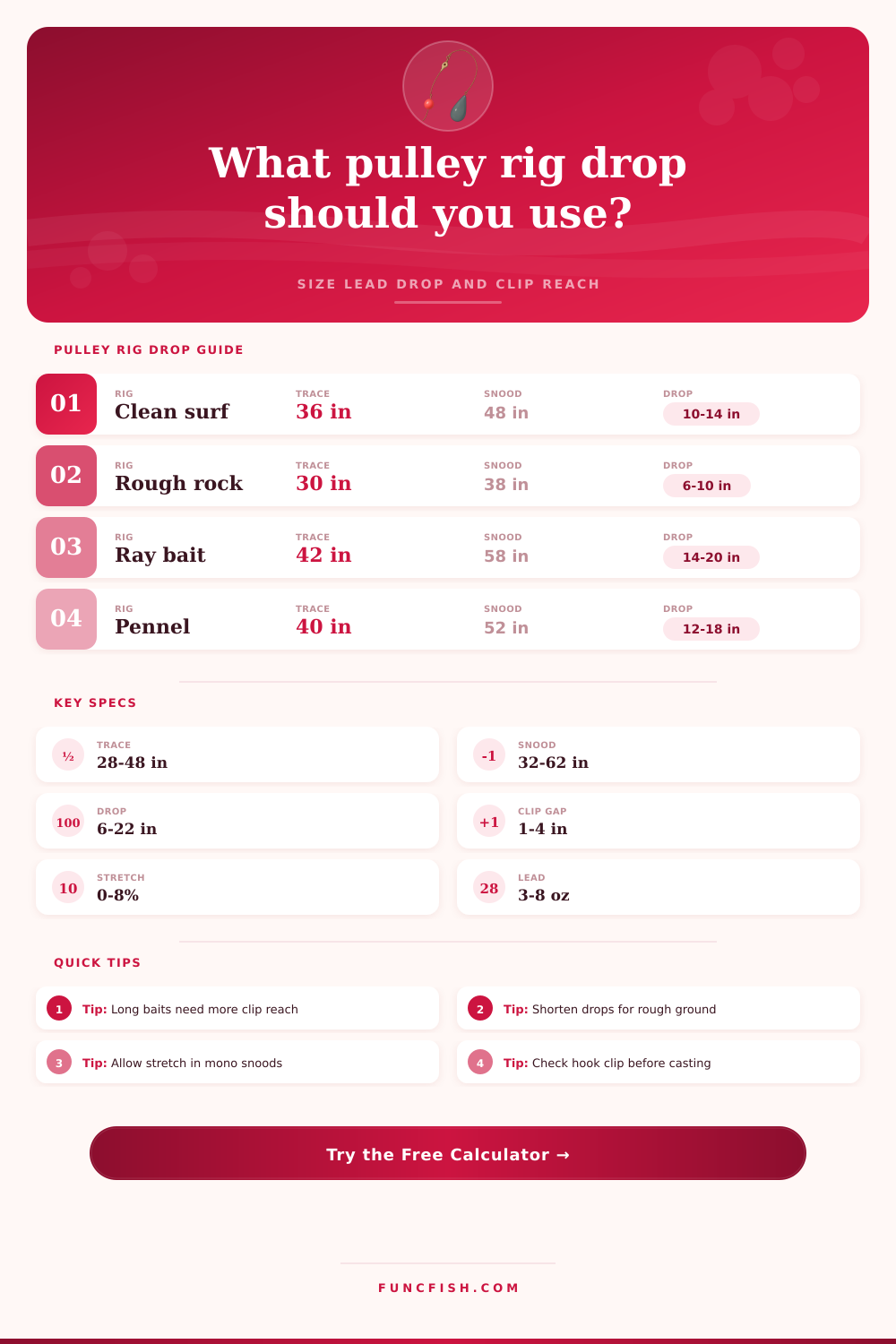
| Rig setup | Trace body | Hook snood | Typical drop | Notes |
|---|---|---|---|---|
| Clean beach cod pulley | 34 to 40 in / 86 to 102 cm | 44 to 52 in / 112 to 132 cm | 9 to 14 in / 23 to 36 cm | Balanced for clipped worm, squid, or fish baits. |
| Rough-ground short pulley | 28 to 34 in / 71 to 86 cm | 32 to 42 in / 81 to 107 cm | 5 to 10 in / 13 to 25 cm | Shorter lead drop reduces snag sweep after landing. |
| Ray or hound pennel pulley | 38 to 46 in / 97 to 117 cm | 52 to 64 in / 132 to 163 cm | 13 to 22 in / 33 to 56 cm | Longer snood and bulky bait need extra clip reach. |
| Up-and-over pulley | 40 to 52 in / 102 to 132 cm | 56 to 72 in / 142 to 183 cm | 12 to 20 in / 30 to 51 cm | Rig length rises quickly, so check rod drop clearance. |
| Rotten-bottom pulley | 30 to 38 in / 76 to 97 cm | 36 to 48 in / 91 to 122 cm | 6 to 12 in / 15 to 30 cm | Leave room for weak link, lead release, and stop bead. |
🎯Species and bait matching
| Target | Bait length | Lead range | Drop behavior | Rig comment |
|---|---|---|---|---|
| Cod and whiting | 3 to 6 in / 8 to 15 cm | 4 to 6 oz / 113 to 170 g | Medium | Clip reach matters more than a very long drop. |
| Bass over mixed ground | 4 to 7 in / 10 to 18 cm | 3 to 5 oz / 85 to 142 g | Short to medium | Keep the lead close enough for controlled landing. |
| Rays and smoothhound | 5 to 9 in / 13 to 23 cm | 5 to 7 oz / 142 to 198 g | Medium to long | Crab, squid, or fish sections need extra hook clearance. |
| Conger and huss | 6 to 10 in / 15 to 25 cm | 6 to 8 oz / 170 to 227 g | Shorter | Rough ground usually limits the safe drop length. |
| Flatfish | 2 to 5 in / 5 to 13 cm | 3 to 5 oz / 85 to 142 g | Short | Small baits clip easily; avoid unnecessary lead swing. |
⚖Rig style comparison
Standard Pulley
8-16 inGood all-round range when the snood is 10 to 16 inches longer than the trace body.
Pennel Pulley
12-22 inBulky baits and second hook position usually require more drop and clip clearance.
Rough Ground
5-11 inShorter drops reduce swinging lead travel and help the pulley lift sooner.
Up-and-Over
12-20 inLong snoods can cast well, but total rig length must fit the rod and casting drop.
💡Calculation notes
Clip reach: If the recommended drop clamps at the minimum, the hook snood is probably short for the trace body and bait clip position.
Ground clearance: Rough ground, kelp, and rotten-bottom links usually benefit from a shorter drop even when geometry allows more length.
“Your form when you cast a pulley rig is good; however, half way down your bait clip catches on the trace body. Then as the lead reaches bottom, the hook snood wraps over your main line.” This is not bad luck. It’s geometry. More than most anglers know, it has to do with that space between swivel and the metal stop bead. That’s what controls whether your bait will come up naturaly or if it’ll tangle in midair.
How much line are we talking about? What kind of line? What weight are we using? How long? These things all has to do with each other under tension, and getting it right have less to do with guesswork and more to do with how weight, length, and line behavior interact. It takes into consideration all those crazy trade offs.
How to Fix Your Pulley Rig Tangles
For example, you have to decide how much the snood needs to extend from body of the trace and where on the trace the clip needs to be. And it will adjust based off the particular components you choose. So what kind of bait are you fishing? What size line do you run on the snood? Then the drop length shown on the calculator should keep it clean.
The variables included takes into account things most guys aren’t thinking about. It takes into account things like the compression of the bait on a hard cast or the stretch in nylon leader. That bait compresses as it strikes the water. If you’re using a soft section of mackerel to start with, it compresses further. The hook’s reach has shorten.
If you haven’t accounted for that reduction, the clip slides too high. Bingo… You’ve got your bait buried in a mess. The tool compensates for that reduction. It provides you with a drop length that still separates the snood from the lead once the cast settles down.
A common mistake among new anglers is thinking longer is more sensitive. But too much drop causes a bigger arc as it swings back and forth. That extra range of motion turn the lead into an anchor of its own. When you’re fishing rough bottom areas where there are weed beds or kelp, that hanging weight will snag on any irregularities in the bottom. So you need something short enough to fall straight down without sweeping sideways into anything.
The table at the bottom of page provides some typical ranges based on conditions. It explains why you’ll see short drops used most often around rocky bottoms and longer drops preferred different than clean sand bottoms. Not only is it good for avoiding hang-ups but it’s also good for casting efficiency. Dragging a long drop increases resistance. It also has a tendency to brake hard when it hits water and kills your casting distance.
That’s where hook snood materials come into play. If you use monofilament, it stretches like crazy under load. That can be good for absorbing shock but bad if you’re trying to be precise with your presentations. Fluorocarbon is thinner and stiffer. It also maintains a tighter shape in current. It sinks quicker as well.
The tool adjusts the equation based on what line you choose. Depending on your line type, it knows how much that material will stretch at the bite. It also knows how much it stretches at impact when the lead touches the bottom. That’s not theory. We’ve all been there when we smack our snood off a rock and it shoots back and pulls the clip down and cinches the rig up tighter than it should of be. Lines with less give don’t do that. This leads to more consistent presentation.
Clip reach relates to bait size With bigger baits, there should be enough space so they can hang freely. Rays love big pieces of crab; therefore you’d want some extra length on that drop and snood. Keep everything separated. With smaller baits like bass or whiting, you’re going to have a tighter setup. This keeps the bait from looking unnaturaly.
The tool helps you visualize the balance here. How much clearance do I have from my lead link to my clip? That’s a small detail, but it avoids frustration. After every retrieve you won’t find your hook wrapped around the trace.
Everything is influenced by casting style. Harder casts create more force then a short lob from a pier for example. That creates compression on soft baits and stretches elastic parts for a brief moment. These are things that the calculator consider. It will make sure whatever length of drop you choose will work even with an overly aggressive or hard cast.
We tend to chase fancy rigs trying to overcomplicate our own rig building. Ultimately, the fundamentals always apply. Balance matter. So does separation. Knowing why your rig acts the way it does turns random success into something you can repeat.
Finally A pulley rig is what you make of it. If you show up at the beach with a knot in your bait, the fish won’t care what kind of line you used or which swivel you tied to the other one. Measure these things out carefully. Practice them on dry land prior to hitting the surf.
Account for ground type, tide strength and local conditions. Adjust for local conditions, tide strength, and ground type. Always remember that you want a clean presentation. You want the fish to be able to feed comfortabley without being suspicious. When your rig sinks true and stays that way, you’re not wrestling your tackle anymore. You’re fishing.