PVA Mesh Length Calculator
Calculate cut length, filled stick size, total roll usage, bait capacity, and dissolve timing for PVA mesh sticks used in carp, barbel, catfish, and feeder fishing.
📌Scenario presets
⚙PVA mesh and bait inputs
PVA mesh length results
Calculation breakdown
🧰PVA mesh tube data
Narrow mesh
Slim mesh
Standard mesh
Wide mesh
📊Mesh size reference table
| Mesh tube | Inside diameter | Volume per 10 cm | Typical stick fill | Best use |
|---|---|---|---|---|
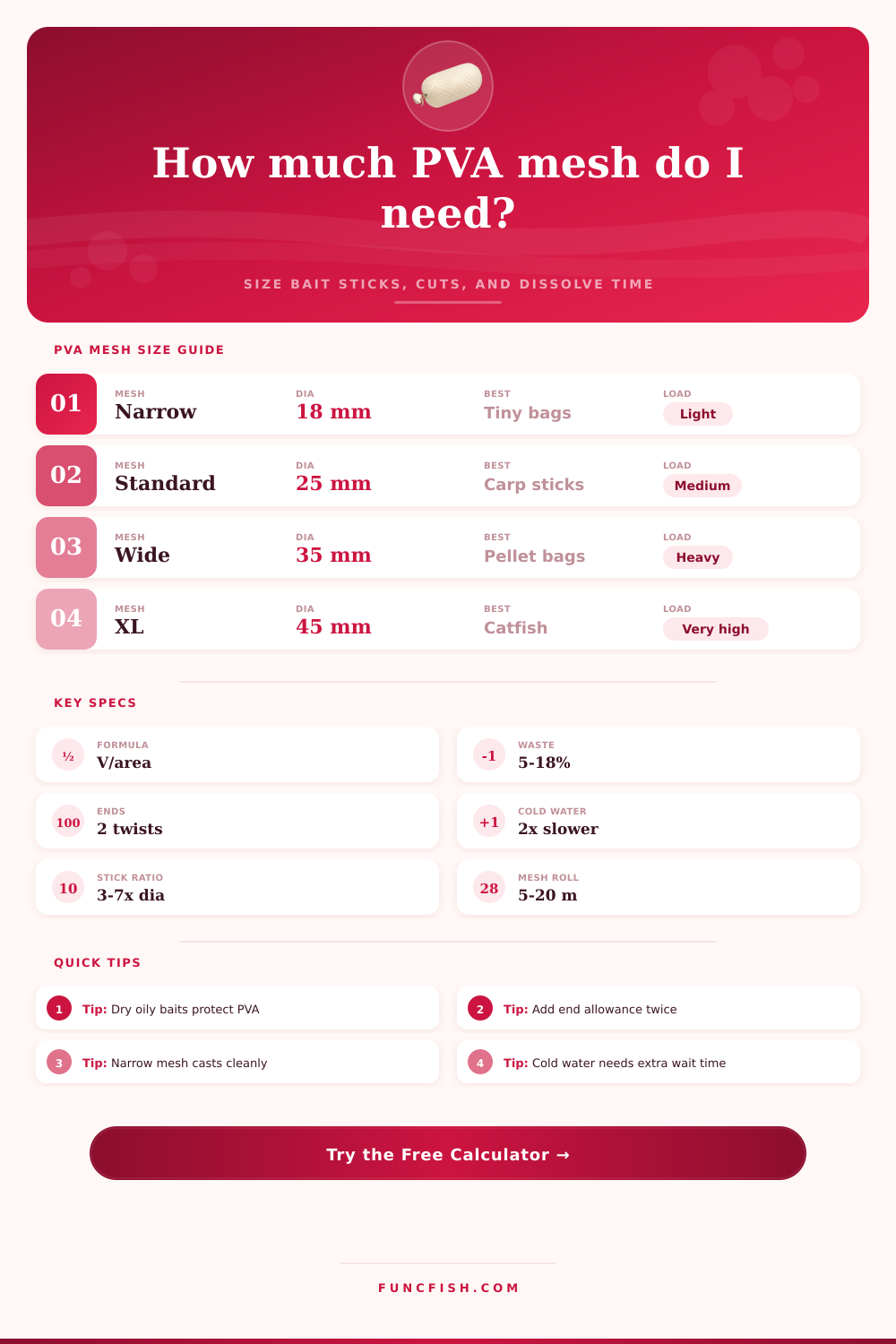
| Narrow stick mesh | 18 mm / 0.71 in | 25 ml | 10-28 g | Long casting, small hookbait parcels, winter bites |
| Slim stick mesh | 22 mm / 0.87 in | 38 ml | 18-42 g | Short carp sticks and feeder top-ups |
| Standard stick mesh | 25 mm / 0.98 in | 49 ml | 25-58 g | General carp, method feeder, boilie crumb |
| Wide pellet mesh | 35 mm / 1.38 in | 96 ml | 50-120 g | Pellet bags, barbel, margin fishing |
| Extra wide mesh | 45 mm / 1.77 in | 159 ml | 90-220 g | Catfish pellets, boat drops, very heavy payloads |
📝Bait density and packing reference
| Bait mix | Loose bulk density | Normal packed density | PVA caution | Typical mesh choice |
|---|---|---|---|---|
| 2 mm micro pellets | 0.62 g/ml | 0.72 g/ml | Use dry or pre-oiled pellets | 18-25 mm |
| Halibut pellets | 0.68 g/ml | 0.78 g/ml | Oily pellets usually protect mesh well | 25-45 mm |
| Crushed boilie crumb | 0.48 g/ml | 0.58 g/ml | Screen dust if the mesh tears easily | 22-35 mm |
| Dry groundbait crumb | 0.38 g/ml | 0.48 g/ml | Keep dry; water activates PVA instantly | 22-35 mm |
| Oily stick mix powder | 0.44 g/ml | 0.55 g/ml | Liquids must be PVA friendly | 18-25 mm |
| Foam nuggets | 0.08 g/ml | 0.11 g/ml | Low weight but high volume | 18-22 mm |
🎣Species and rig comparison grid
Carp method feeder
25 mmUse 20-60 g payloads with a 3-6 diameter stick ratio for tidy casting behind the lead.
Barbel river pellet
35 mmWide mesh carries pellets and breaks down around a feeder without making an overlong tube.
Catfish pellet bag
45 mmLarge tubes handle high pellet loads for underarm drops, boat placements, and heavy bottom rigs.
Winter carp bite
18 mmNarrow sticks keep the food signal small and improve cast shape with micro pellets or crumb.
⏱Dissolve timing guide
| Water temperature | Thin fast mesh | Standard mesh | Heavy slow mesh | Practical note |
|---|---|---|---|---|
| 4-8°C / 39-46°F | 70-110 sec | 90-150 sec | 130-220 sec | Test at the margin before casting far |
| 9-14°C / 48-57°F | 45-80 sec | 65-115 sec | 95-170 sec | Good range for winter or spring sticks |
| 15-20°C / 59-68°F | 30-55 sec | 45-80 sec | 70-125 sec | Standard bench-mark timing |
| 21-26°C / 70-79°F | 22-42 sec | 32-65 sec | 50-95 sec | Make sticks close to cast time |
| 27-32°C / 81-90°F | 16-32 sec | 24-50 sec | 40-80 sec | Avoid wet hands and damp bait trays |
📏Stick proportion reference
| Filled length to diameter ratio | Cast behavior | Mesh use | Best rig style | Adjustment |
|---|---|---|---|---|
| 1.5-2.5x diameter | Stubby and stable | Higher per bait gram | Margin or feeder drop | Use wider mesh if too bulky |
| 3-5x diameter | Balanced stick shape | Efficient | Most carp and barbel rigs | Good default target |
| 5-7x diameter | Slim and aerodynamic | Efficient but longer | Long casting or solid PVA tidy-up | Pack firm and tie neat ends |
| Over 7x diameter | Can bend or helicopter | High total length | Only light crumb or foam | Split into more sticks or use wider mesh |
💡Calculation tips
End allowance matters: a short 40 mm bait column can still need 20-30 mm of extra mesh at each end once the stick is twisted, knotted, or nicked onto the hook.
Measure the loaded diameter: mesh stretches differently with pellets, crumb, and foam. If your filled stick looks wider than the tube label, select Custom and enter the measured diameter.
Cold water slows the release: PVA can take roughly twice as long in winter water, especially with firm packing and heavy mesh, so margin-test one stick before fishing at range.
Keep bait PVA safe: dry mixes, oils, and PVA-friendly liquids are the safest inputs. Water-based dampness can weaken the mesh before the rig reaches bottom.
It’s frustrating for an angler to have a bait presentation that falls apart on its way to the targeted area. Maybe you’ve spent some time putting together a nice bait stick made off delicate components. You load it up with pellets and form it into a solid mass. With high hopes, you make your cast and it’s gone within a few meters of the cast. The bait has fallen apart and fish haven’t even had a look at it.
That’s almost always due to not understanding how twist allowance, the amount of bait in the stick, and mesh size work together. The key isn’t simply packing as much bait into the tube as possible. Other considerations includes structural integrity, aerodynamics, and how fast the polymer dissolves in water. When you enter your chosen mesh size and target weight into the calculator, it give you the right amount. You won’t have to guess if a particular tube will stay together. Knowing what these figures mean lets you understand the difference between an effective cast and one where everything goes pear-shaped.
How to Stop Your Bait from Falling Apart
The first thing to consider is the twist allowance. A common error by many angler is to cut mesh precisely to suit the bait they want to carry. However, to ensure the bag holds well and stays tied up, you require additional mesh on each end to which you can either twist or tie the bag. Too little extra and the bait falls straight through. What happens then? You get a plume of water full of tiny nuisance fish rather than trying to catch the bigger fish such as barbel and carp. The twist allowance is added automatically by the tool, but don’t forget to allow for it yourself when preparing your rig.
How does diameter impact performance? Most folks don’t think about this, but a lot of things depends on mesh size. For example, an 18mm diameter tube is pretty aerodynamic. Little wind resistance means it goes a long way and flies straight. But when packing, there’s not much room for error because the diameter are small. Overpack and it’ll be rock solid. Rock solid doesn’t cast so well. Plus, it has a tendency to tumble through the air. That is why the calculator takes your desired compression level into account.
Loose fill is gentle on mesh but results in a longer, floppier stick. On the other hand, firm packing give a dense payload that casts accurately but takes longer to dissolve since the tight pellet matrix make it hard for water to penetrate. So, what are you looking for this session: distance or quick release?
PVA performance is highly sensitive to water temperature. When the water drops to near four degrees Celsius such as in winter time, the dissolving action really slows. It doesn’t just dissapears like in warm weather. You may have used one of these and had it release a bait in forty seconds in the middle of a hot July day. Well it will take twice as long in January. And that can cause issues if your rig catches in some weeds and stuff piles up around your hookbait until your food shows up. They include a chart with their product showing how different mesh weights behave across temperature ranges.
So its good to remember that when making them out there on the bank vs. You can make them ahead of time back home. You can make some ahead of time and put them in your dry bag to have them ready for a long day. However, make new ones for cold water fishing so they gets into the water at their most effective moment.
One additional factor is bait compatibility. Some baits do not play nice with PVA mesh. Moist groundbaits and oily pellets will break down the fibers before any casts are made. For this reason many anglers employ some type of liquid protectant spray or pre oil their dry mixes. This allows the bait to stay together throughout the cast.
To accurately predict volume and density several bait options is built into the calculator. For example, if you choose a foam nugget mix, it will have very low weight but take up a lot more space. You would of needed a longer cut of mesh than a dense halibut pellet load of equal mass. Knowing these physical characteristics will allow you to make the right choice on tube size for your bait selection as opposed to a random guess.
The more precise you are with rig prep, the less you miss and the better chance you have of keeping a fish. It is as much an art as it is a science. You have to know how to dissolve a bait in the right time and place, and understand how that helps you rig it to be delivered exactly how you intended. If it is a couple of inches too short or too long after considering the twist ends, or if you don’t match the mesh to the water temp, you won’t succeed; but when you do it right, bingo… Your bait hits just like you planned, intact and ready to reveal itself. Which is why a quiet wait for a bite is so different than a frustrating day spent patching together busted rig.