Spinning Reel Bail Spring Tension Calculator
Estimate torsion spring rate, preload angle, closing torque, and line-roller force for a spinning reel bail return spring.
📌Scenario presets
⚙Bail spring inputs
Bail spring tension estimate
Full breakdown
📋Spring material data grid
302 Stainless
Music Wire
316 Stainless
Phosphor Bronze
📏Bail spring reference tables
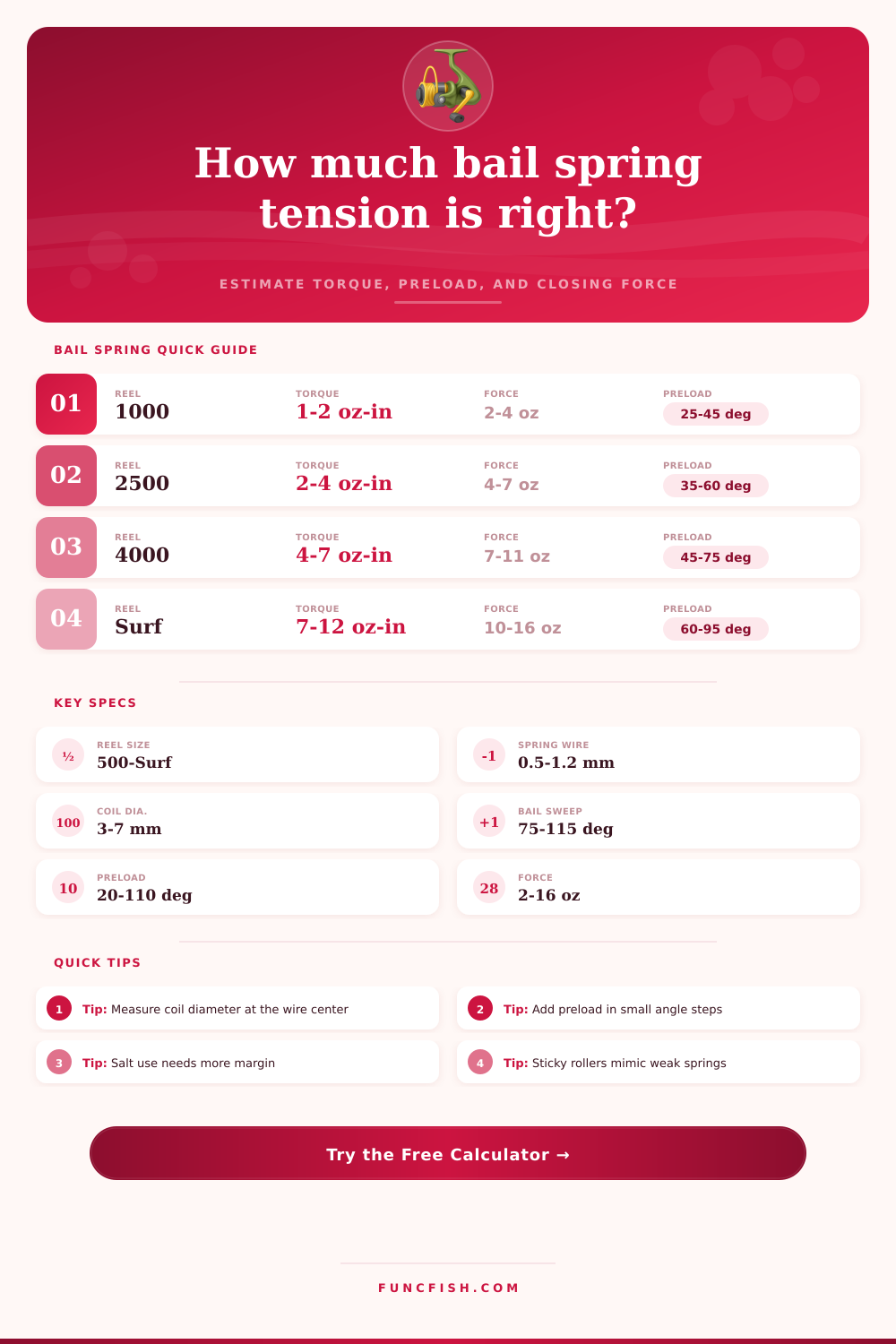
| Reel size | Arm radius | Typical torque | Roller force | Preload window |
|---|---|---|---|---|
| 500 ultralight | 0.95-1.15 in / 24-29 mm | 0.8-1.6 oz-in / 5.6-11.3 N-mm | 1.5-3.5 oz / 0.4-1.0 N | 20-40 deg |
| 1000 light | 1.05-1.25 in / 27-32 mm | 1.2-2.4 oz-in / 8.5-16.9 N-mm | 2.5-4.5 oz / 0.7-1.3 N | 25-45 deg |
| 2500 finesse | 1.25-1.50 in / 32-38 mm | 2.2-4.2 oz-in / 15.5-29.7 N-mm | 4.0-7.0 oz / 1.1-1.9 N | 35-60 deg |
| 3000 all-around | 1.35-1.60 in / 34-41 mm | 2.8-5.2 oz-in / 19.8-36.7 N-mm | 4.8-8.5 oz / 1.3-2.4 N | 40-65 deg |
| 4000 inshore | 1.50-1.85 in / 38-47 mm | 4.0-7.2 oz-in / 28.2-50.8 N-mm | 6.5-11.0 oz / 1.8-3.1 N | 45-75 deg |
| 6000 surf | 1.75-2.15 in / 44-55 mm | 6.5-11.5 oz-in / 45.9-81.2 N-mm | 9.0-15.0 oz / 2.5-4.2 N | 60-95 deg |
| Spring wire diameter | Common reel class | Mean coil diameter | Active coils | Expected feel |
|---|---|---|---|---|
| 0.020-0.024 in / 0.51-0.61 mm | 500-1000 | 0.120-0.155 in / 3.0-3.9 mm | 4.5-6.0 | Light close |
| 0.025-0.031 in / 0.64-0.79 mm | 2000-3000 | 0.150-0.190 in / 3.8-4.8 mm | 3.8-5.2 | Standard snap |
| 0.032-0.039 in / 0.81-0.99 mm | 3500-5000 | 0.180-0.235 in / 4.6-6.0 mm | 3.3-4.8 | Firm snap |
| 0.040-0.047 in / 1.02-1.19 mm | 6000-8000 | 0.220-0.285 in / 5.6-7.2 mm | 3.0-4.4 | Heavy surf |
| Fishing use | Reel size | Closure feel | Added margin | Why it matters |
|---|---|---|---|---|
| Trout stream | 500-1000 | Soft to standard | Low | Thin line and small rotors need clean return without excess slap. |
| Bass spinning | 2500-3000 | Standard | Medium | Frequent casting benefits from a positive but smooth bail close. |
| Walleye jigging | 2500-3000 | Standard | Medium | Cold hands and braid loops need consistent roller seating. |
| Inshore braid | 3000-5000 | Firm | High | Salt, braid tension, and spray raise the needed snap reserve. |
| Surf casting | 5000-8000 | Firm to hard | High | Sand and long bail wires add friction and inertia. |
| Catfish bottom | 4000-6000 | Firm | Medium | Heavier rotors and thicker bail wire need more working torque. |
| Symptom | Likely tension issue | Calculator value to check | Adjustment direction | Boundary check |
|---|---|---|---|---|
| Bail closes lazily | Low preload or sticky hinge | Roller force | Increase preload 5-10 deg | Keep stress score above 55% |
| Bail snaps harshly | Excess working torque | Working torque | Reduce preload or wire size | Avoid hard stop impact |
| Spring breaks quickly | Overstress or corrosion | Reliability score | Lower preload or upgrade material | Use salt margin |
| Line misses roller | Not enough closing force | Minimum force margin | Raise firmness or service roller | Check roller offset |
💡Practical checks
Tip: Measure the mean coil diameter through the center of the spring wire. Measuring the outside diameter makes the calculated spring rate too soft.
Tip: If the calculator calls for a large preload jump, clean the roller, hinge, and trip ramp before bending or replacing the spring.
After the cast, the bail arm frequently rest in some sort of middle ground somewhere between open and closed. That interrupts the flow and compels you to bump it back into place with your finger before making another attempt. And though it’s just a minor bit of mechanical problem, it can cause you to lose your mind. Spinning reels is supposed to be effortless.
In most cases, the culprit is the bail spring tension. It’s not a mystery, it’s merely a matter of torsion mechanics fighting against friction and inertia. Getting that snap back are more important than many anglers may think because it allows for a seamless casting motion. This calculator work out all of those details and shows you the tradeoff.
Fix Your Stuck Bail Arm
The firmer you make it, the less likely it will get stuck in a gritty condition. However, there is also a risk that if roller closes too hard on the spool, it could snap off the line. You can input the material of the spring, size of the reel, and how firm or soft you want the feeling of the close to be. Then, it calculate the force acting on the line roller and working torque. It also gives you a reliability score based off the fatigue margins.
That’s why it’s important to understand the inputs into the equation so you have confidence in the output. For example, thicker spring wire mean more resistance; likewise, thicker spring wire provides more stiffness then thinner spring wire. That means thicker spring wire. But what happens when you’ve got a bunch of springs on an ultralight trout reel and then swap them over to heavy surf casting set-up? Those springs will be like spaghetti!
The rotor are heavier, the bail arm is much longer and now there’s all this wind resistance against the spool. The spring need to counteract that inertia with more tension. This is where the calculator kicks in and asks about your reel class and type of fishing scenario. A 1000-sized finesse reel doesn’t act the same way than a 6000 size surf reel.
Tension matters; Saltwater causes corrosion and neglected hinges can lead to failure. It’s all about materials. It’s all about materials. Music wire (standard) has excellent elasticity but rapidly corrodes in water and air. Stainless steel doesn’t corrode as fast, but it is a bit less elastic. The tables of material properties shown on the page illustrate these properties, specifically modulus and corrosion resistance. Ideally, you’d like a spring whose tension can endure in environment without degrading too much over time. Add some margin for cold water or sandy environments since cold temps stiffen metals and thicken lubricants. What may feel just right on balmy summer afternoon could open wide during cooler weather. You should of considered this.
Before buying new springs, make sure you didn’t neglect the hinges. That’s where most bail failures begin. Old grease, dirt and salt crystals cause friction, which no spring tension can overcome completely. Before grabbing pliers, give it some love: Clean the roller pivot and lube the hinge points. In the baseline models from the calculator, there is an implied degree of mechanical health to the reel. If yours are sticky, the calculated force isn’t going to be strong enough to shut the bail consistently. So instead of thinking “I need a stiffer spring,” consider that maybe you simply have a cleaner machine.
Preload angle compensate for slight wear, helping until a point. Beyond that, excessive preload stresses the metal and results in premuture fatigue breaks. The bail spring is like the heartbeat in your casting cycle. It has to have some life to it, but not too much. Otherwise, you will either violently open and close the bail or make it so weak that it fails to close all the way.
The beauty of this tool is that it will help dial you in on the proper setting for your rig. After that, you’ll feel the reel snap closed clearly and no more annoying hover. It will be solid action from then on, which frees up your mind to think about what’s happening out there rather than if something is going wrong with the equipement.