Rod Load by Lure Weight Calculator
Estimate how deeply a lure loads a rod by comparing total rig weight against the lure rating, blank action, power, line drag, wind, and casting style.
📌Scenario presets
⚙Rod and lure settings
Use the total rig weight: jig head plus trailer, plug plus hooks, sinker plus bait, or fly line equivalent for casting practice blanks.
Rod load forecast
Full breakdown
📋Rod power reference grid
Ultralight
Medium Light
Medium
Medium Heavy
📐Rod load tables
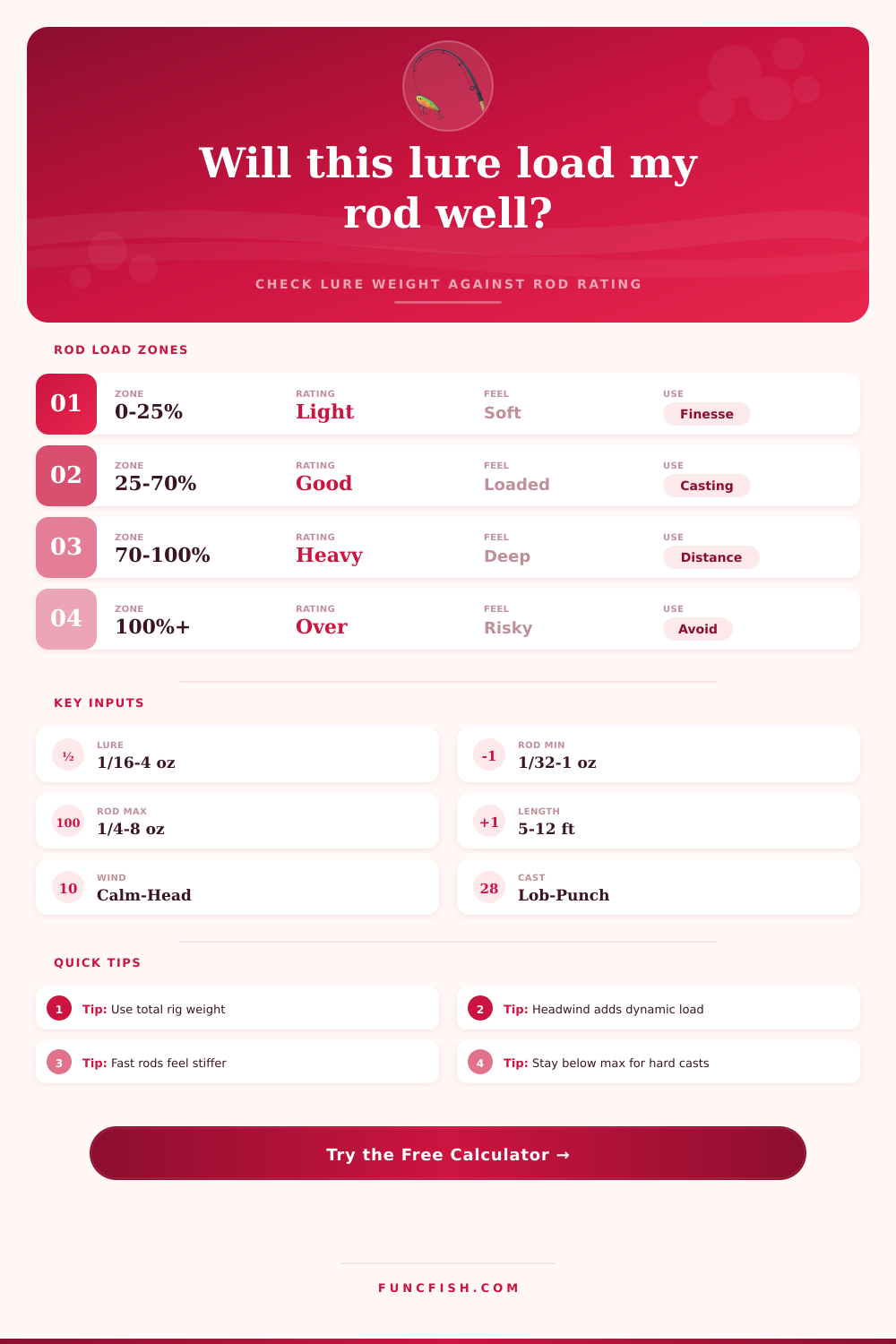
| Load zone | Window position | Likely feel | Practical use |
|---|---|---|---|
| Below rating | Under 0% | Does not load | Roll casts and close pitches only |
| Light load | 0-25% | Tip only | Finesse and soft delivery |
| Working load | 25-70% | Blank stores energy | Normal casting and control |
| Deep load | 70-100% | Rod bends deeply | Smooth distance casts only |
| Over rating | Above 100% | High blank stress | Change lure or rod |
| Action | Bend factor | Load feel | Calculator effect |
|---|---|---|---|
| Extra fast | 0.78 | Stiff tip recovery | Requires more lure to feel loaded |
| Fast | 0.88 | Crisp upper third | Good for jigs and soft plastics |
| Moderate fast | 1.00 | Balanced bend | Baseline load curve |
| Moderate | 1.12 | Deeper bend | Feels loaded with lighter lures |
| Slow | 1.24 | Parabolic bend | Smooth casting, softer hooksets |
| Profile | Air drag | Line effect | Load note |
|---|---|---|---|
| Compact jig / spoon | Low | Minimal bow | Static weight predicts well |
| Crankbait / plug | Medium | More air resistance | Adds load during power casts |
| Spinnerbait / blade | High | High drag face | Needs margin below max rating |
| Float rig | High | Long leader drag | Feels heavier than scale weight |
| Bucktail / surf plug | High | Wind sensitive | Headwinds raise dynamic load |
💡Practical checks
Tip: If a lure sits near the top of the printed rating, use smooth acceleration instead of a hard snap cast. Dynamic load can exceed static lure weight quickly.
Tip: A compact 1/2 oz jig and a 1/2 oz spinnerbait do not load the blank the same way. Broad profiles add drag and usually need more margin.
The correct lure for a fishing rod require more than just looking at the weight numbers for the fishing rod. Fishing rod blanks has different weights and are meant to bend under a specific amount of the weight of the lure. Factors like the weight of the lure, the load of the fishing rod, the action of the fishing rod, line weight, and even the effect of the wind will play a role in how well a fishing rod will load when you are using a specific type of lure.
When the fishing rod properly load with the lure the fishing rod will feel good when you are casting and the fishing rod will store the energy during the cast. When the fishing rod does not load correctly with the lure the tip of the fishing rod will feel stiff or there will be a strain on the fishing rod blank that may damage the fishing rod over time. The calculator that is available above will mathematically calculate the load of your fishing rod once you enter the variables for your fishing rod setup.
Choose the Right Lure Weight for Your Rod
The calculator will compare the fishing rod weight with the minimum and maximum weights of the fishing rod, and the calculator will make adjustments according to the action, power, and other variables of your fishing rod. The fishing rod calculator will tell you if the weight of your lure is within a light load zone, a working load zone, or a deep load zone for your fishing rod, as well as any dynamic stress that may be placed upon the fishing rod while you are casting. The weight of the lure is the first factor in the calculation.
For instance, a compact jig and a spinnerbait may weigh the same amount of half an ounce but load a fishing rod in a different way due to the spinning nature of the bait. The fishing rod will have to work harder to move the spinnerbait due to the amount of air that it will catch. Furthermore, there are different styles of casting that will place more load upon the fishing rod than others.
A smooth lob will load the fishing rod in a different way than a snap cast, for instance. The action of the fishing rod is another important factor in loading the fishing rod correctly. Fast tip fishing rods will bend in one specific area of the fishing rod blank, while a moderate or slow action will bend the fishing rod at a lower portion of the fishing rod.
Fishing rods with a fast tip will require more weight to load the fishing rod, while a moderate or slow fishing rod will feel as if it is loaded even with a lighter weight of bait. Power is the same factor as action. For instance, using a medium-heavy fishing rod will allow the percentage of the weight of the lure to be higher than an ultralight fishing rod due to the power and construction of the fishing rod.
The line that you use will impact the load of the fishing rod in two ways. If you use braided fishing line, the rod will load easily because braided fishing line will transmit every movement of the line, and will add very little stretch. If you use monofilament or fluorocarbon line, it will stretch and the load of the fishing rod will change with that stretch of the fishing line.
These lines will change the load on the fishing rod. Furthermore, the drag of the fishing line will impact the load when the lure is moving through the guides. Wind will change the load that is placed upon the fishing rod when you are casting.
A headwind will place an additional force upon the fishing rod required to move the lure forward with the fisherman’s cast. The fishing rod load will increase with the impact of the wind and the dynamic load upon the fishing rod blank. Furthermore, the fishing rod load will change the maximum weight that is safe to use with that fishing rod.
A lure that weighs within the weight specifications of the fishing rod for no-wind will place too much dynamic load upon the fishing rod if there is a headwind. The static tip deflection is another specification that the fishing rod will have. This will be the distance that the tip of the fishing rod will drop when the lure is hanging from the tip of the fishing rod.
This is not a measurement that will be taken during a cast with the fishing rod. Yet, it is a measurement that will tell you if the fishing rod blank is engaging. If the drop of the tip is very low it means that the lure is too light for that fishing rod.
If the static tip deflection is higher it means that the fishing rod blank is working. Many people make mistake with fishing rods. Some people may use the weight specifications for the fishing rod as the target that they are aiming for with their fishing rod.
Using the heaviest lure that is listed may seem like the best choice for distance casts but leaves little margin for error. Other people may use the lightest weight for finesse fishing but the fishing rod may not load enough to allow it to carry the lure. These common mistakes can be avoided using the fishing rod and lure load calculator.
With time and experience using the fishing rod and lure weight calculator you will begin to notice patterns in how different fishing rods will load with different weight of lure. For example, fast action fishing rods may be required for long distances but will require a heavier margin below the maximum weight that the fishing rod can take. Slow parabolic fishing rods will have a lower load of the lure but will allow for very hard snap casts to load the fishing rod.
Furthermore, the same caution that goes into using a heavy lure with a broad profile will be used with those fishing rods. All of these patterns will be useful and transferable to other rods and fishing styles. The result of the fishing rod and lure calculator will be a starting place to begin fishing with your rod.
However, it is always wise to take a few casts with the fishing rod to feel how the fishing rod blank feels and loads with your lure. If it feels too stiff or loads too deeply into the forward stroke of the cast you should change your lure or your casting style. Otherwise, the fishing rod will have too much strain upon it.
Using the fishing rod and lure weight calculator will remove the guesswork from fishing and allow you to begin to fine tune your casting and fishing technique.