Running Ledger Length Calculator
Calculate the complete running ledger span, free-running section, hooklink clearance, lead link, and stop load for carp, river, surf, pier, and boat bottom rigs.
📌Running ledger presets
⚙Ledger length inputs
Running ledger length results
Your calculated running ledger setup will appear here.
Calculation breakdown
🎣Slider and line reference
Run Ring
Fish Finder
Boom Slider
Inline Sleeve
📊Running ledger reference tables
| Ledger style | Hooklink range | Run section | Lead link | Primary use |
|---|---|---|---|---|
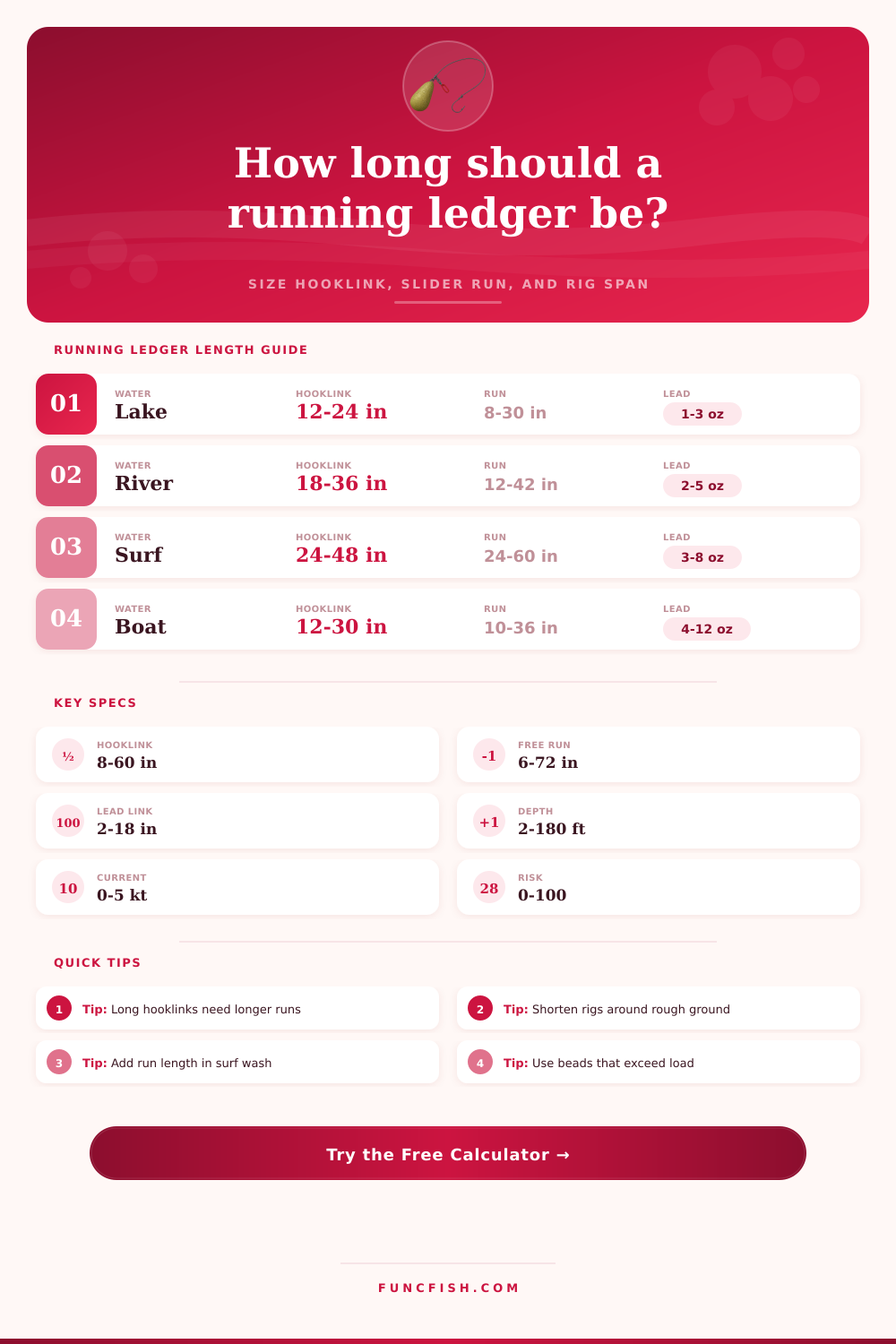
| Classic free-running ledger | 12-30 in / 30-76 cm | 12-42 in / 30-107 cm | 3-8 in / 8-20 cm | Stillwater and cautious bites |
| Semi-fixed running ledger | 4-12 in / 10-30 cm | 4-18 in / 10-46 cm | 2-6 in / 5-15 cm | Feeder and bolt-style rigs |
| Fish-finder slide rig | 24-48 in / 61-122 cm | 24-60 in / 61-152 cm | 4-12 in / 10-30 cm | Surf, pier, and beach fishing |
| Anti-tangle boom ledger | 10-30 in / 25-76 cm | 10-36 in / 25-91 cm | 4-14 in / 10-36 cm | Boat drops and tide |
| Running paternoster | 12-36 in / 30-91 cm | 8-30 in / 20-76 cm | 8-18 in / 20-46 cm | Cleaner lead separation |
| Species group | Typical hooklink | Suggested run | Lead range | Length note |
|---|---|---|---|---|
| Carp | 8-18 in / 20-46 cm | 12-36 in / 30-91 cm | 1.5-4 oz / 43-113 g | Longer run for wary lake fish |
| Barbel and chub | 18-36 in / 46-91 cm | 18-42 in / 46-107 cm | 2-5 oz / 57-142 g | Balance flow pressure and snags |
| Catfish and rays | 24-60 in / 61-152 cm | 24-72 in / 61-183 cm | 4-12 oz / 113-340 g | Use high-rated beads and stops |
| Pike deadbait | 18-36 in / 46-91 cm | 12-36 in / 30-91 cm | 1-3 oz / 28-85 g | Keep indication responsive |
| Surf bass or redfish | 24-48 in / 61-122 cm | 30-60 in / 76-152 cm | 3-8 oz / 85-227 g | Extra run helps in wave surge |
| Condition | Run adjustment | Lead link change | Stop load | Tangle note |
|---|---|---|---|---|
| Clean lake bed | Baseline | Baseline | Normal | Longer hooklinks are practical |
| Soft silt or mud | Add 10-20% | Add 1-3 in | Normal | Lift bait clear of the lead |
| River flow | Add 5-25% | Add 2-5 in | Higher | Shorten if weed catches the link |
| Surf wash | Add 20-35% | Add 2-6 in | Higher | Use a slide with low friction |
| Rough ground | Reduce 15-35% | Shorten | Higher | Keep the lead from wedging |
🚩Ledger length notes
The calculator treats the hooklink and bait as a swing radius, then adds slider body, lead link, free-run, line angle, current, and bottom allowances to estimate total rig span.
If the total span becomes awkward to cast, reduce hooklink length first, shorten the lead link second, and keep enough free run for bite indication.
Lengths are rig-building estimates for the terminal setup only. They exclude shock leader length above the upper stop and any spare tag ends used for knots.
Carp are going to bite when you least expect it, in an instant of calm followed by full-throttle violence. If you don’t give them enough slack before they feel weight on the line, your gonna lose ’em. Seems easy enough, but even a few extra inches of lead can prevent you from getting clear. A short free-run could spook a skittish carp while it’s taking bite.
This geometry is something you don’t have to speculate about; simply input your circumstances and fish type into the calculator above and it’ll spit out exactly what you need. The principle of a running ledger is that it provides a cushion for the fish to suck the bait down without feeling weight of lead. Somewhere there has to be a cut-off point. When the lead start moving with the fish, your bite signal becomes hit-or-miss and you start chasing shadows on the end of the rod different than feeling a clear pull.
How to Set Up Your Fishing Rig
The running length is buffer zone. This lets the hooklink swing free while keeping the sinker in place. Not enough run and the fish will trip the rig, but too much and the rig will snag up in weed or something else before you get time to hit it.
Surprisingly, water depth matter too. Your line angle is steeper in shallow water than deep, pulling that lead up a bit and altering the bait’s bottom sit. Your clearances vary if you’re fishing a 30 foot spot out in the middle of the lake versus the three foot margin. The tool will automatically take those angles into consideration and adjust its overall span to keep your hooklink down where it should be. On the bed, not overtop of it.
Physics doesn’t care what you see with your eyes; it only sees the rod tip. It is easy to forget that vertical geometry exist. As well as depth, what you do depends on the behaviour of species. For example, carp are notoriously cautious; they will test a bait for minutes before committing. To make them feel comfortablely feeding in open water, they need generous free runs and long hook links.
Conversely, pike attack instantly with explosive speed. The strike is instantaneous and a pike deadbait rig needs far shorter run. You want the fish to feel some resistance almost immediately. Then, you want to set the hook deeply before it has a chance to shake off the bait. Novice anglers commonly mix these approaches up.
There was a twist. The static measurement is one part but it doesn’t account for the added dynamic of current. That means the river constantly wants to pull your line sideways. This will tighten the angle between your main line and hooklink and pull your lead upstream. If your hooklink is too long and “whips” around on the cast then you’ll get tangles. Keep your rig as compact as possible against the current by shortening components accordingly. That’s where the reference tables comes into play with this tool; they do a great job of laying out how river flows demand different dimensions than stillwater lakes.
The hardware make all the difference. You may think any old swivel will do. However, if it’s cheap, it adds enough friction to prevent the lead from sliding freely. This defeats the entire purpose of having a running rig in the first place. Specialized sliders or smooth beads reduce this resistance so that the line can slip right through with no issues while the sinker remain stationary. Worn beads or overly tight stop knots will cause the whole system to fail so you lose a fish for no reason at all.
The distance isn’t everything, it’s the quality of the distance between them when they’re under load. Making a good ledger rig is controlled chaos. You want to have just enough control to stick the fish if it takes the bait but also give the bait some hint of its naturaly action. No single length are the magic bullet for everything. Choose a length that best fits your target species and water. Take the numbers as guidance, not a hard and fast rule book. Adjust accordingly as you see how things work out from the business end of your rod. Shorten up the run if the line gets too slack before you get any bites. Give em a little more room if you’re missing strikes. The math creates structure and the experience will fill in the gaps. Having that balance dialed in could of been the difference between a frustrating day on the water and a successful one.