⛵ Sailboat Outboard Motor Size Calculator
Find the right horsepower for your sailboat based on displacement, hull type, and usage conditions
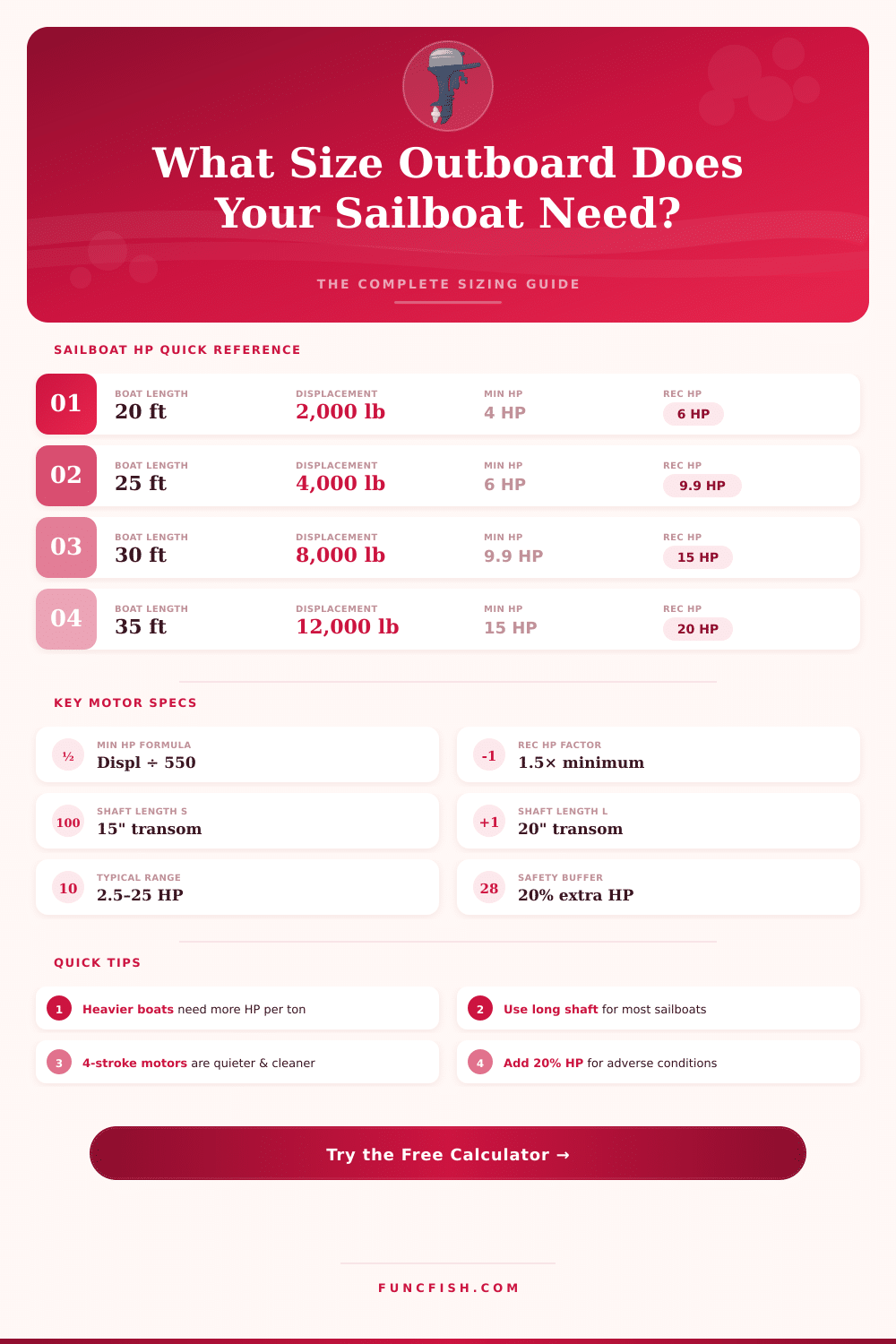
| Boat Length | Displacement (lb) | Displacement (kg) | Min HP | Recommended HP | Shaft Length |
|---|---|---|---|---|---|
| 18 ft | 1,200–1,800 lb | 545–816 kg | 2.5 HP | 4–6 HP | Short (15") |
| 20 ft | 1,500–2,500 lb | 680–1,134 kg | 4 HP | 5–8 HP | Short/Long |
| 22 ft | 2,500–3,500 lb | 1,134–1,588 kg | 5 HP | 6–9.9 HP | Long (20") |
| 25 ft | 3,500–5,500 lb | 1,588–2,495 kg | 6 HP | 9.9–15 HP | Long (20") |
| 28 ft | 5,500–8,000 lb | 2,495–3,629 kg | 9.9 HP | 15–20 HP | Long (20") |
| 30 ft | 7,000–10,000 lb | 3,175–4,536 kg | 12 HP | 15–20 HP | Long/XL (25") |
| 33 ft | 9,000–13,000 lb | 4,082–5,897 kg | 15 HP | 20–25 HP | Long/XL (25") |
| 35 ft | 11,000–15,000 lb | 4,990–6,804 kg | 18 HP | 20–30 HP | XL (25") |
| 40 ft | 14,000–20,000 lb | 6,350–9,072 kg | 20 HP | 25–40 HP | XL (25") |
| 45 ft | 18,000–28,000 lb | 8,165–12,701 kg | 25 HP | 30–50 HP | XXL (30") |
| Shaft Type | Shaft Length | Transom Height | Typical Sailboat | Notes |
|---|---|---|---|---|
| Short (S) | 15 in / 38 cm | Up to 15 in | Dinghies, small day sailers | Rare on sailboats |
| Long (L) | 20 in / 51 cm | 15–20 in | 20–30 ft sailboats | Most common size |
| Extra Long (XL) | 25 in / 64 cm | 20–25 in | 30–40 ft cruisers | Needed for deep transoms |
| Ultra Long (XXL) | 30 in / 76 cm | 25–30 in | 40+ ft ocean cruisers | Specialized, less common |
| Motor Type | Weight | Efficiency | Noise Level | Maintenance | Best For |
|---|---|---|---|---|---|
| 4-Stroke | Heavier | High | Low | Low | Most sailboats |
| 2-Stroke | Lighter | Moderate | Higher | Moderate | Small/light boats |
| High-Thrust 4-Stroke | Heaviest | High | Low | Low | Full keel, heavy boats |
| Electric Outboard | Varies | Very High | Very Low | Minimal | Short trips, eco-focus |
Choose the right size of outboard motor engines for your boat, this seems easy, but quickly becomes tricky. Outboard motor engines operate as the heart of boat they give the power that moves everything forward. If the engine is too weak, the boat will struggle to reach normal cruising speed and will not be able to handle bad water or big loads.
Too strong engine is heavy and costly, and it bads fuel and reduces control. For best output, fuel efficiency and safety, match the motor size to the size of your boat.
How to Pick the Right Outboard Motor Size for Your Boat
Wrong outboard motor engines cause bad activity, fuel waste or even risks. But the ideal size is not a seceret.
The best motor type and size depends on the kind of boat, its technical data, limits of the maker, usage for boating and fishing, water conditions and the place of use. Good outboard motor engines help to enjoy time on water without problems. Every boat has maximum motor output listed.
Stay in the maximum on the transom; that is the safest way.
For little boats like dinghies or inflatables, 2.5 to 5 horsepower commonly suffice. They give the necessary force for short journeys, tenders and lightweight fishing. Little fishing boats or casual ships usually work with engines under 20 HP.
They provide enough for calm lakes and gentle rivers. Engines of 20 to 75 HP work for big fishing boats.
Conditions of water matter a lot. Calm lakes accept more little power. Rivers and open seas require stronger engine for safety and excellent control.
Outboard motor engines come with short 15-inch, long 20-inch, extra-long 25-inch and ultra-long 30-inch shaft lengths.
Weight is other important point. Ensure that the engine is not too heavy. New four-stroke outboard motor engines with same weight as the maximum size of the build of the boat would be ideal.
For instance, 1999 40 HP two-stroke weighed around 175 pounds, but new 40 HP four-stroke weighs around 225 pounds. Four-strokes now are usual, more silent and cheap than two-strokes, but weigh more than equivalent two-strokes. According to maker, 10 and 15 HP models occasionally weigh the same, but have different tuning to reach the ratings.
For 20-foot boat, engines of 60 to 75 HP work well. 90 HP engine on tested boat reached 24 mph for cruise. Bigger engine not always helps, once 115 HP only gave 3 mph more than 90 HP, because of the extraweight.