Salmon Lifespan Calculator
Estimate salmon age, total lifespan, remaining time, and confidence from species, anadromous or resident pattern, ocean years, freshwater years, length, weight, spawning stage, and habitat productivity.
📌Salmon life-history presets
⚙Salmon lifespan inputs
Salmon lifespan estimate
Calculator output appears here after choosing a salmon profile.
Detailed lifespan breakdown
🧬Salmon life-history comparison grid
Chinook
Coho
Sockeye
Pink
Chum
Atlantic
📊Species lifespan reference table
| Species | Typical lifespan | Freshwater years | Ocean years | Life-history note |
|---|---|---|---|---|
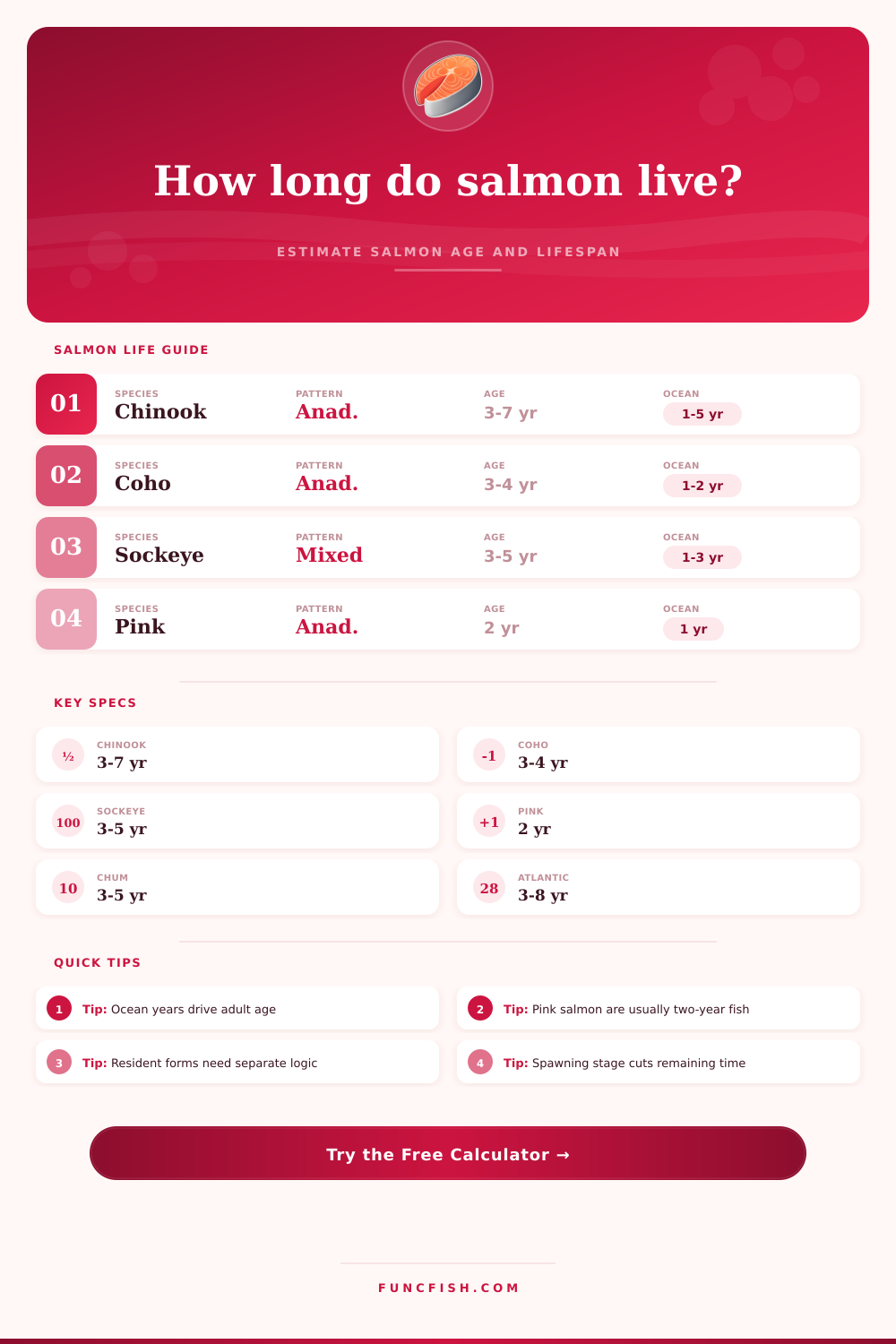
| Chinook salmon | 3-7 years, occasionally older | 0.2-2 years before sea entry | 1-5 years at sea | Largest salmon; long ocean residence can produce older adults. |
| Coho salmon | 3-4 years common | About 1 year in streams | 1-2 years at sea | Often returns after one full ocean year plus freshwater rearing. |
| Sockeye salmon | 3-5 years common | 0-3 years, often lake rearing | 1-3 years at sea | Kokanee are resident sockeye and skip the ocean phase. |
| Pink salmon | Usually 2 years | Short freshwater phase | About 1 year at sea | Strong two-year cycle; unusual ages lower estimate confidence. |
| Chum salmon | 3-5 years common | Short freshwater phase | 2-4 years at sea | Fry often move seaward quickly, with lifespan driven by ocean residence. |
| Atlantic salmon | 3-8 years, sometimes more | 1-4 years as parr and smolt | 1-4 sea winters | Can survive spawning and return as a repeat spawner. |
🌊Pattern and spawning-stage table
| Pattern or stage | How it affects lifespan | Pacific salmon adjustment | Atlantic salmon adjustment | Confidence cue |
|---|---|---|---|---|
| Anadromous river-ocean | Age is freshwater years plus ocean years. | Strong fit for all listed Pacific species. | Strong fit for sea-run Atlantic salmon. | High when ocean years match species range. |
| Resident / landlocked | Ocean years should be zero and growth is usually smaller. | Best fit for kokanee sockeye; weak fit for pink or chum. | Fits landlocked Atlantic salmon where present. | Lower if the species rarely has resident forms. |
| Adult return migration | Most lifespan has already elapsed. | Remaining time is usually weeks to months. | May survive and kelt after spawning. | High when size and stage agree. |
| Active spawning | Remaining time becomes very short. | Pacific salmon are normally semelparous. | Some Atlantic salmon survive as kelts. | Stage choice dominates remaining-time output. |
| Post-spawn / kelt | Past spawning, survival depends on species. | Rare to impossible for Pacific salmon. | Valid for Atlantic repeat spawners. | Very low for Pacific species. |
📏Length and weight reference table
| Species | Adult fork length | Typical adult weight | Calculator condition check | Size note |
|---|---|---|---|---|
| Chinook | 28-48 in / 71-122 cm | 10-50 lb / 4.5-23 kg | Weight compared with length curve | Large size can imply more ocean years. |
| Coho | 20-32 in / 51-81 cm | 5-15 lb / 2.3-6.8 kg | Lean fish lower confidence slightly | Jacks and smaller adults can return early. |
| Sockeye | 18-31 in / 46-79 cm | 4-12 lb / 1.8-5.4 kg | Kokanee treated as resident form | Lake growth can change freshwater years. |
| Pink | 16-25 in / 41-64 cm | 3-6 lb / 1.4-2.7 kg | Outlier sizes lower confidence | Two-year age cycle is the main anchor. |
| Chum | 24-40 in / 61-102 cm | 8-20 lb / 3.6-9.1 kg | Large adults usually need ocean years | Often spends little time rearing in freshwater. |
| Atlantic | 22-40 in / 56-102 cm | 6-30 lb / 2.7-14 kg | Repeat spawners may be larger | Sea-winter count drives adult age. |
🌿Habitat productivity reference table
| Productivity | Growth signal | Survival signal | Lifespan adjustment | Confidence effect |
|---|---|---|---|---|
| Low productivity / stressed | Slow growth, smaller size at age | Higher juvenile and migration stress | Shortens expected total by about 0.4 year | Lower unless age is known |
| Moderate productivity | Average length and condition | Typical survival for the species | No major adjustment | Baseline confidence |
| High productivity | Good growth and body condition | Better juvenile and ocean entry survival | Adds about 0.3 year | Raises confidence if size agrees |
| Excellent productivity | Strong growth for age | Best survival and migration condition | Adds about 0.5 year | High when measurements are real |
📝Reading the estimate
Age tip: Ocean years usually explain the largest difference among adult salmon. If ocean years are unknown, use the species range first and treat the result as a planning estimate.
Stage tip: Spawning stage changes remaining time more than it changes total age. Pacific salmon generally end their lifespan after spawning, while Atlantic salmon can sometimes kelt and return again.
A salmon age calculator is a tool that will provide age estimates for a salmon. Salmon age estimates is helpful to determine if a salmon run in a certain area are healthy or if humans can sustainably harvest it. Additionally, the salmon age calculator allow individuals to determine if the salmon that a certain river system produces is of the same age group as those that once lived in that same river system.
Furthermore, the salmon age calculator allows an individual to provide an age estimate for a salmon without having to memorize the table of the various species of salmon. The salmon age calculator collect several different pieces of biological information regarding the salmon to calculate the age of that specific salmon. For instance, one of the parameters for which an individual will need to provide information is the number of years that the salmon spent in freshwater.
How to Use a Salmon Age Calculator
Freshwater years represent how long the salmon spent in its life as an egg, alevin, fry, and parr before it began to travel to the ocean. Additionally, another parameter is the number of years that the salmon experience while in the ocean, known as ocean years. Another parameter is the migration pattern of the salmon.
For instance, salmon can either be anadromous or resident in their habitat. These species have different range of ages. Additionally, another parameter is the age of the salmons habitat, which allow for adjustments in the estimate if the salmon lived in either stressed or rich habitat condition.
Finally, another parameter is the spawning stage of the salmon. For instance, Pacific salmon die after they spawn, but some Atlantic salmon are able to survive their spawning event and return to the ocean. In addition to the parameters of the salmon itself, size measurement of the salmon are also used in the age calculator.
For instance, the individual using the salmon age calculator collects length and weight measurement of the salmon in order to understand if the salmon is lean or heavily for its length. A salmon that is much lighter than expected of salmon of that length may be of a younger age than length suggest. In contrast, a salmon that is heavier than expected may have spent more years at sea than the ocean year parameter indicate.
Beyond collecting information about the salmon, there are also a few different output of the salmon age calculator. For instance, the age calculator can output the lifespan of the salmon, the age of the salmon, the length of time that the salmon has remaining until it dies (or spawns), and the confidence in the accuracy of the salmon age calculator’s measurement. The confidence percentage for the salmon age calculator may drop if the ocean years for the salmon are outside of the expected range for that species, if the migration pattern of the salmon is incorrect for the species, or if the spawning stage of the salmon do not match the sex of the salmon.
A high percentage of confidence for the age calculator does not mean that the age of the salmon is exact, but it does suggest that each of the parameters entered into the calculator are within the expected range for the species of salmon that is being assessed. In addition to being able to enter the various parameters for the salmon into the calculator, an individual can also utilize the calculator more effective by running the same salmon through the calculator twice with different assumption. For instance, an individual could change the ocean year input or the habitat quality that is entered into the calculator.
This helps individuals to understand which parameter have an impact upon the outcome of the calculator versus those that do not change the outcome of the calculator. For example, pink salmon species have a cycle of existence of only two year. As such, changing the ocean years for pink salmon will not have any impact upon the outcome of the calculator.
In contrast, chinook salmon species may live anywhere from two to five years, so altering the ocean years will have an impact upon the outcome of the calculation. Another output of the calculator is the remaining time for the salmon to die. For instance, if a salmon is on a spawning migration, the calculator may report that the salmon has only a few week or months left in its life.
Individuals utilize this lifespan to plan their effort to observe the salmon populations. For instance, because Atlantic salmon may live beyond their spawning period, the remaining years for salmon that is determined by the calculator will be longer for Atlantic salmon than pink salmon, for instance. Additionally, each species of salmon possesses different biological rule to the salmon age calculator, so that individuals dont have to commit the information to memory for each species.
Beyond the parameters that are required to calculate the age of the salmon, there are also additional factor that may impact the accuracy of the calculator. For instance, length of the salmon that is visually estimated from a boat may have more error than length that is measured on a sampling board. To account for this error, there are observation confidence setting within the salmon age calculator.
Although lowering the observation confidence will not impact the age calculation of the salmon, it will lower the confidence percentage for the estimated age of the salmon. Lowering this percentage will inform others that the length of the salmon was measured less accurately than if the observation confidence is not lower. Beyond being able to calculate the age of a salmon, the value of the salmon age calculator is in the ability to compare the result of that salmon to another salmon population.
For instance, another individual could enter the same parameters for the same salmon into the calculator each season, allowing for individuals to see if the ages of salmon from a given river once was four years old, but now is three years old. Despite the various pieces of information that an individual using the salmon age calculator can collect, it is not a replacement for biological expertise with salmon. For instance, an individual must still use their professional judgment to determine if the salmon is typical of its river system.
The salmon age calculator may collect and calculate each parameter for the salmon, but it is up to the individual to use their expertise in salmon biology to determine the true age of the salmon. They’re going to need to use actualy good data. It could of been easier if the data was better.
The results depends on how you enter things. Youll see that some errors dissapears when you check twice. It is alot of work.
Some people think the calculator is better than a human, but they are wrong. The calculator is more useful based off how you use it. Its a moddern tool.