
Not all shark teeth are equal. Knowing what distinguishes one from another will lead you right to it. Many new collectors get discouraged because they think dark spots is charcoal or that tooth fragments are mere debris. But each tooth is a uniquely evolved weapon designed for different prey. Learn how to see the subtle differences between teeth without having to rely on someone else’s expertise, and you’ll stand out from your weekend beach bum friends.
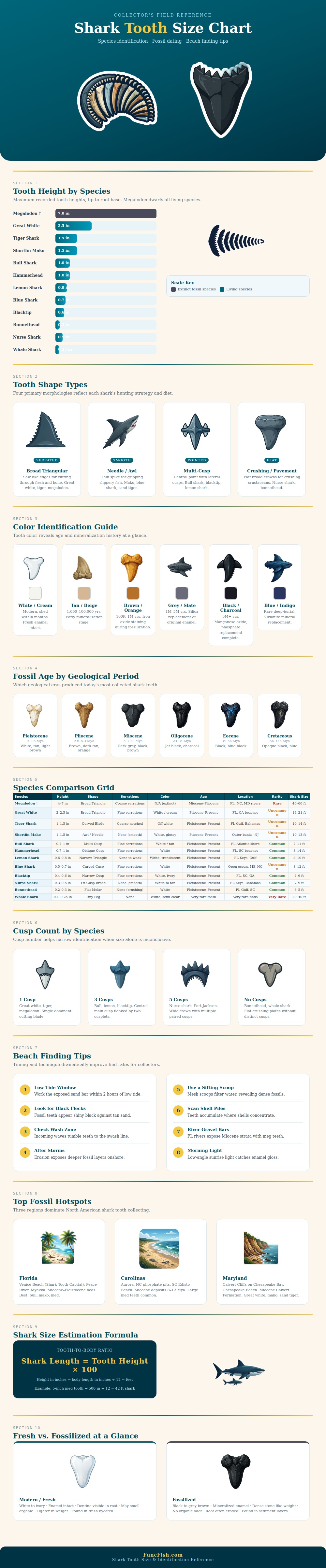
Shark sizes vary greatly even in today’s world, and even more so with the ancient behemoths, which is what makes these comparisons so interesting. As chart above illustrates, scale is pretty humbling. An average sized great white tooth may only measure two inches high. However, when you compare it to a seven inch long megalodon tooth, that average sized tooth doesn’t seem so big after all.
How to Tell Shark Teeth Apart
This isn’t to say that size is everything. Just as there are little teeth from big sharks, there are big teeth from small ones too based off jaw placement and age of the animal. Instead focus less on length and more on shape. Sharks’ teeth also tell us about their diets.
Sharks use needle-like teeth with a smooth surface to grip the slippery skin of their prey as they run down fast fish such as tuna. See those pointed tooth shapes on blue shark and mako. By comparison, teeth with broad, triangular blades edged in serrations is what you’ll find in predators who feast on larger mammals. The serrations slice up meaty portions easly. Flat teeth designed for grinding and crushing shellfish belong to bottom feeders such as nurse sharks.
And then there is color, biology and geology. When a tooth is dropped, if it was fresh out of the mouth, chances are good it would of been bright white because it still had its enamel coating. Over time, biological materials will get replaced by mineral elements. Teeth stained orange to brown contain iron oxides; those that are black has been colored by manganese. The darker the color the older the tooth. A shiny, jet-black tooth has been in the ground longer then a tan one. Without any science tools, you know how old your specimen is based on that color change.
To find these, you have to be lucky and there at the right time. Low tide on an incoming tide is best as there will be new sand laid out. Storms are also good. Gravel bars of rivers is often overlooked, but Florida‘s rivers expose old beds littered with megalodon teeth. A mesh sifter can separate the sand from fossils, making them easy to spot as black flecks on a white background. The easiest place to look is in that top layer where the water has concentrated it. Don’t dig down too much.
Pick up any fossilized tooth, and you’re clutching time in your hand. It has been weathered by water and time, transformed to minerals. It’s lighter than it used to be; bones have changed shape. Begin with the easy-to-identify forms and don’t fret over scarcity yet. If you can differentiate between smooth (needle) teeth and serrated (blade), you’ll soon spot them quicker. Look down at sand and let your eyes guide you. That little dark dot could pay off your day’s worth of digging.