Spinning vs Baitcasting Distance Calculator
Estimate side-by-side casting distance from rod load, lure weight, line diameter, spool behavior, brake setting, wind, release angle, and caster skill.
📌Scenario presets
⚙Cast setup
Distance comparison
Full breakdown
📋Reel and line friction grid
Spinning 2500
Spinning 4000
Baitcaster 100
Baitcaster 200
📊Distance reference tables
| Setup | Typical distance | Metric equivalent | Best reel tendency |
|---|---|---|---|
| Ultralight trout spoon, 1/16-1/8 oz | 45-80 ft | 14-24 m | Spinning |
| Bass finesse worm, 1/8-1/4 oz | 55-100 ft | 17-30 m | Spinning or BFS |
| Bass jig or Texas rig, 3/8-3/4 oz | 85-150 ft | 26-46 m | Baitcasting |
| Inshore jig, 1/4-1 oz | 90-170 ft | 27-52 m | Either |
| Surf plug, 1-3 oz | 150-300 ft | 46-91 m | Long spinning |
| Heavy cover frog, 1/2-3/4 oz | 60-120 ft | 18-37 m | Baitcasting |
| Line type | Distance behavior | Typical diameter | Reel match |
|---|---|---|---|
| Braid | Low stretch, thin, high guide noise | 0.006-0.014 in | Both |
| Monofilament | Floats, forgiving, more memory | 0.008-0.018 in | Both |
| Fluorocarbon | Dense, stiff, more spool memory | 0.009-0.020 in | Baitcasting |
| Copolymer | Middle stretch and memory | 0.008-0.017 in | Both |
| Wire leader rig | Leader drag lowers flight | Leader based | Baitcasting |
| Lead-core | High mass and high drag | Heavy | Trolling |
| Rod power | Lure window | Metric window | Distance note |
|---|---|---|---|
| Ultralight | 1/32-1/8 oz | 1-4 g | Loads tiny lures |
| Light | 1/16-1/4 oz | 2-7 g | Good finesse distance |
| Medium light | 1/8-3/8 oz | 4-11 g | Clean small jig window |
| Medium | 1/4-3/4 oz | 7-21 g | All-purpose casting |
| Medium heavy | 3/8-1 oz | 11-28 g | Strong baitcaster zone |
| Heavy | 1/2-2 oz | 14-57 g | Power and cover rigs |
| Surf heavy | 1-4 oz | 28-113 g | Long rods and payload |
💡Distance calculation checks
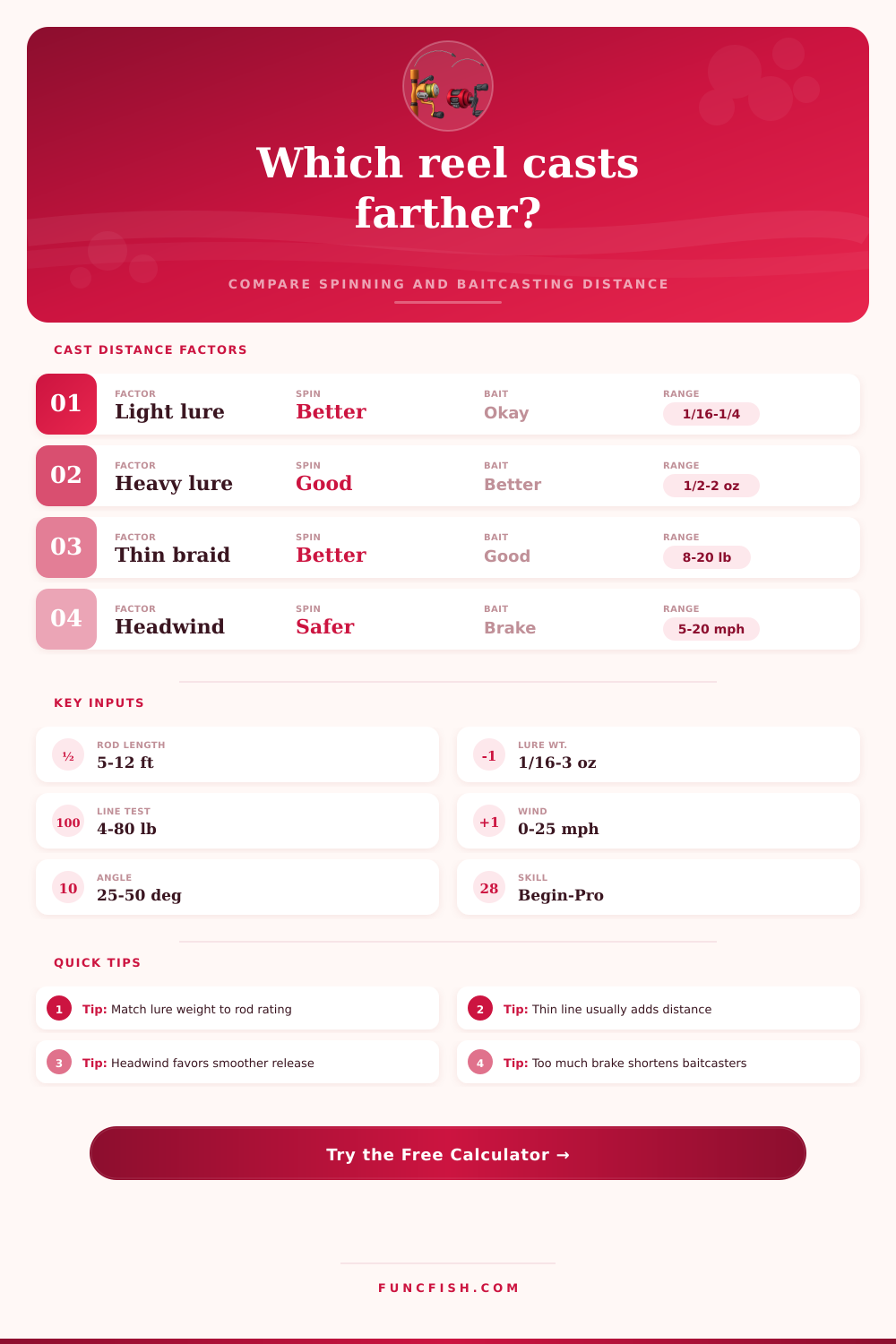
Tip: A baitcaster often wins with heavier, compact lures only when brake and spool tension are low enough for clean spool speed.
Tip: Spinning reels usually keep the advantage with light lures, thin braid, and headwinds because the spool does not need to accelerate.
When comparing two anglers who is fishing in the same area, the distance that the lure travels is not necessarily a product of the strength of the anglers arms. Instead, the distance that the lure travels is often a function of the type of reel that the anglers is using. Each of the two most common types of fishing reels (spin and baitcast) perform the same rod, the same lure, and the same lines in slightly different ways, which can lead to difference in the distance of the cast.
A number of factors influence the distance that the line and lure travel. Factors such as the length of the rod, the weight of the lure, the diameter and material of the fishing line, and even the speed and direction of the wind can all have an impact upon the distance of the cast. For instance, the length of the rod impacts the leverage of the angler’s arms, the weight of the lure impacts whether or not the rod fully load or only slightly twitches, the diameter and material of the fishing line can impact the amount of drag on the line, and the wind can impact the travel of both the lure and the line.
Which Fishing Reel Casts Farther and Why
Additionally, the angle at which the line is released can impact the trajectory of the cast, as can the skill of the angler in relation to the distance at which the angler can effectively accelerate the lure. Each of these factors can interact with each other, which is why two anglers using the same type of fishing gear may travel their line to different distances. The type of spinning reel is different than the baitcasting reel in that the spinning reel’s fixed spool does not have to rotate in order to release the line.
For this reason, spinning reels has an advantage in situations in which the anglers are using light fishing lures and thin fishing lines. In situations in which the lines are heavy enough to quickly pull the line forward, however, the spinning reel may struggle. The spinning reels’ coils of line can slap against the lip of the spool or the baitcasting reel, creating friction that reduce the distance to which the line and lure can travel.
Baitcasting reels, in contrast, spin along with the line that is being cast. Therefore, baitcasting reels are able to travel heavier payloads of line and lure further; however, only if the angler sets the brakes of the baitcasting reel appropriately. If the angler sets the baitcasting reel’s brakes too high, the line will slow before it is fully cast.
If the brakes are set too low, the line may create a “bird’s nest” around the spool that also prevent the cast from traveling as far as it could otherwise. One of the factors that can impact the distance of the cast is the concept of wind. Specifically, a headwind will impact a light lure more than it will impact a heavy lure.
Additionally, a headwind will also impact the amount of “belly” in the line. A crosswind will impact the distance of the lure in that it will cause the lure to drift sideways in its travel, causing it to land shorter than it would without any crosswind. A tailwind will help both types of fishing reels, but only the one that has a line that is already being released from the reel.
The calculator takes into account the direction and speed of the wind, since these factors can impact the distance to which the cast travels. The power and action of the rod can also impact the distance that the line travels. Medium-heavy rods with fast actions will typically allow more distance with baitcasting reels.
Lighter, more moderate rods will allow more time for the spinning reel to release the line. The profile of the lure can complicate matters. For instance, compact jigs will travel farther than spinnerbaits or crankbaits of the same weight, simply because of the drag that the blades on those products can create.
The skill of the angler can also have an impact upon the performance of the two types of fishing reels. For instance, anglers who compete in fishing tournaments may be able to increase the performance of their baitcasting reels in comparison to spinning reels. For example, these tournament fishermen may have skills in relation to the control of the spool of line with their thumbs.
Beginner anglers, in contrast, may find that their distance with baitcasting reels is lessened due to the tendency to set the brakes of those reels too high for safety. Setting the brakes of a baitcasting reel too high, however, will also reduce the distance of the cast. Beginner anglers may, therefore, find that they can travel their line farther with a spinning reel.
The type of fishing line that is used can impact the distance to which the anglers line and lure can travel. For instance, braided lines are thin and limp, which reduces the resistance with which the line can be peeled off of the spinning reels or baitcasting reels. Fluorocarbon lines are more dense than braided lines, which can introduce “memory” into the spinning reels, leading to friction on the line during travel.
Monofilament lines sit somewhere in the middle in relation to both braided lines and fluorocarbon lines. Thus, none of these line types have a dramatic impact upon the performance of the line, but there are difference between each type. Overall, the calculator will provide the user with an estimate of the distance to which the line and lure will travel.
The calculator will also indicate which type of fishing reel is likely to be the better choice for the individual anglers. The calculator will also provide a range banding for the results of that calculation, which can help to indicate the repeatability of the cast. A cast that is repeatable is more useful than one that is not.
Thus, the range banding indicates how often the result of the cast will be the same. The control index for those results accounts for factors like wind, angle, brake settings, and skill. The calculator provides a reliable baseline for the water conditions that are likely to be encountered.
However, water conditions may also include factors like backlashes and guide slap. Anglers will typically not cast their lines as far as possible with either type of reel. Thus, the caster will use the results of the calculator to determine which type of fishing reel is best suited to the type of lure that is being used, and the fishing conditions in which the angler will be fishing.
By understanding these variables and how they may impact the performance of the different types of fishing reels, an angler can make adjustments (to the brakes of the reel, the fill of the spool, etc.) to ensure the desired results in the water. Thus, each of these factors is a consideration in how fishing reels perform in relation to each other. Neither type of fishing reel can be considered universally the longer of the two.
Instead, each type of reel may be the longer of the two based off the number of variables.