Shock Leader Knot Bulk Calculator
Estimate the outside diameter, tied length, guide clearance, and cast-through risk of a shock leader connection before it batters rod guides or slows a hard cast.
📌Scenario presets
⚙Knot bulk inputs
Shock leader knot bulk results
Calculation breakdown
🧵Knot family bulk data
FG Knot
PR Knot
Alberto
Double Uni
📏Shock leader knot bulk reference
| Knot type | Estimated peak OD | Typical length | Guide passage note |
|---|---|---|---|
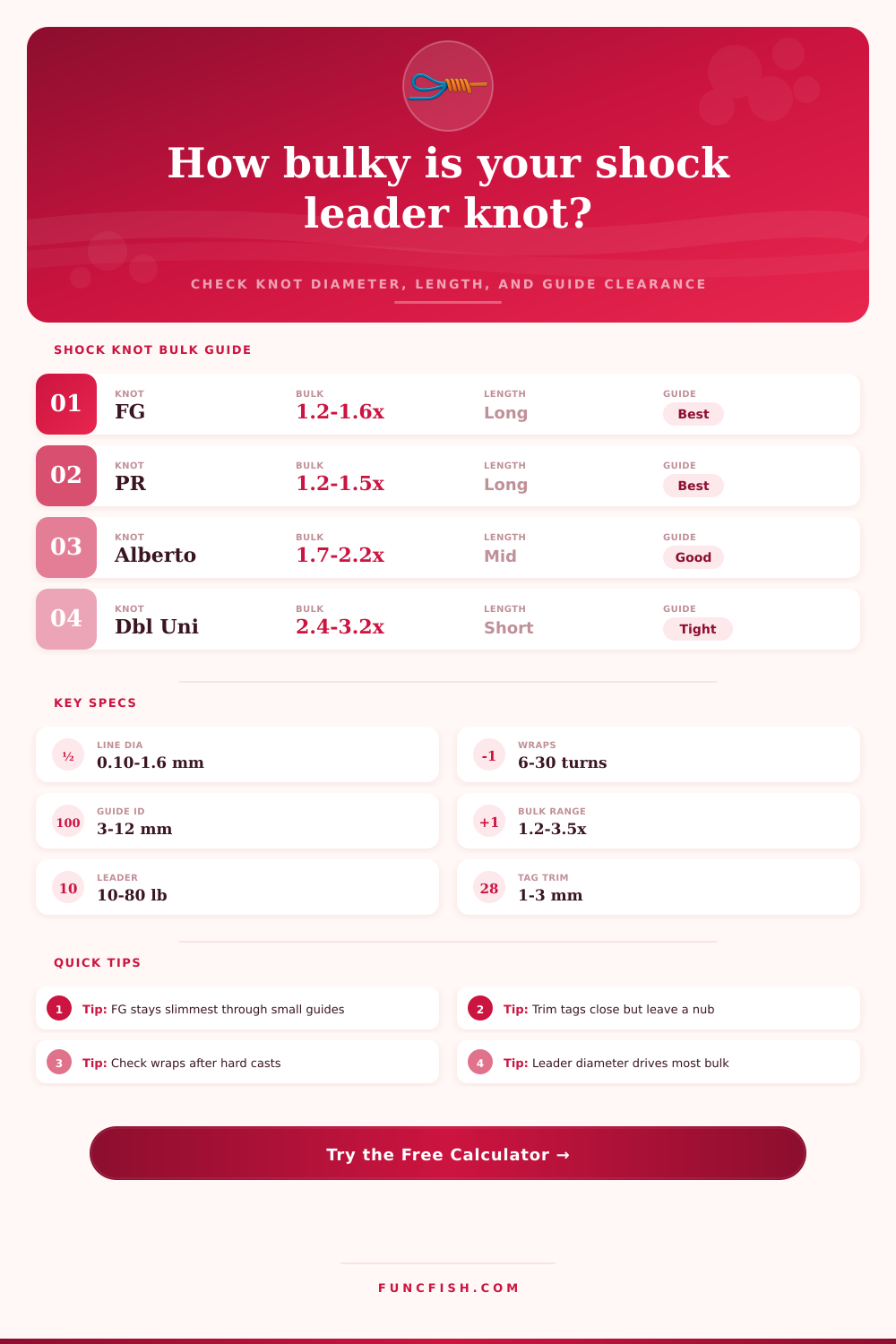
| FG knot | 1.2 to 1.6 times leader diameter | 22 to 45 mm / 0.9 to 1.8 in | Slimmest common cast-through braid connection |
| PR bobbin knot | 1.2 to 1.5 times leader diameter | 35 to 70 mm / 1.4 to 2.8 in | Very smooth, but longer than most hand knots |
| Alberto knot | 1.7 to 2.2 times leader diameter | 12 to 25 mm / 0.5 to 1.0 in | Reliable mid-bulk leader knot for normal guides |
| Albright special | 1.8 to 2.4 times leader diameter | 13 to 28 mm / 0.5 to 1.1 in | Works better when the leader loop is dressed flat |
| Slim beauty | 1.9 to 2.4 times leader diameter | 14 to 30 mm / 0.6 to 1.2 in | Moderate bulk with good straight pull alignment |
| Double uni | 2.4 to 3.2 times leader diameter | 11 to 24 mm / 0.4 to 0.9 in | Short but tall; can click sharply through small guides |
| Blood knot | 2.0 to 2.7 times leader diameter | 10 to 22 mm / 0.4 to 0.9 in | Best when diameters are fairly similar |
| Triple surgeons | 2.7 to 3.5 times leader diameter | 9 to 18 mm / 0.4 to 0.7 in | Fast tie, but too bulky for many cast-through leaders |
🎣Gear and species comparison grid
| Use case | Common main line | Shock leader | Preferred low-bulk knot |
|---|---|---|---|
| Surf pompano or whiting | 15 to 30 lb braid / 0.18 to 0.28 mm | 30 to 50 lb mono / 0.55 to 0.75 mm | FG or Alberto |
| Distance sinker casting | 12 to 20 lb mono / 0.30 to 0.40 mm | 50 to 80 lb mono / 0.70 to 1.00 mm | FG with braid main, Albright with mono |
| Striped bass surf plugs | 30 to 50 lb braid / 0.28 to 0.36 mm | 40 to 60 lb mono or fluoro | FG, PR, or well-dressed Alberto |
| Inshore redfish or snook | 10 to 30 lb braid / 0.15 to 0.28 mm | 20 to 40 lb fluoro / 0.40 to 0.60 mm | FG or Alberto |
| Catfish heavy bottom rig | 30 to 65 lb braid / 0.28 to 0.42 mm | 50 to 80 lb mono / 0.75 to 1.05 mm | FG if cast through guides, double uni if outside guides |
| Offshore popping | 50 to 100 lb braid / 0.36 to 0.55 mm | 80 to 150 lb mono / 1.0 to 1.6 mm | PR or FG |
| Pike or musky casting | 30 to 80 lb braid / 0.28 to 0.48 mm | Wire or hard mono bite leader | Alberto or crimped transition outside guides |
| Trout and walleye finesse | 6 to 15 lb braid / 0.08 to 0.18 mm | 6 to 15 lb fluoro / 0.18 to 0.35 mm | FG, blood, or slim beauty |
📊Guide clearance and risk bands
| Guide ID to knot OD ratio | Clearance band | Expected feel on cast | Adjustment to consider |
|---|---|---|---|
| 5.0x or more | Excellent | Usually smooth with minimal guide tick | Current knot bulk is suitable for cast-through use |
| 3.5x to 4.9x | Good | Light tick may be felt under power | Keep tags smooth and inspect after hard sessions |
| 2.5x to 3.4x | Borderline | Noticeable guide slap or speed loss likely | Use FG or PR, shorten tag nub, or increase guide ID |
| Under 2.5x | High risk | Knot may hammer small guides and loosen wraps | Do not reel bulky knot into small runners for hard casts |
🔢Diameter estimator table
| Material | Light line estimate | Medium line estimate | Heavy leader estimate |
|---|---|---|---|
| Braided PE | 10 lb about 0.12 mm / 0.005 in | 30 lb about 0.28 mm / 0.011 in | 80 lb about 0.48 mm / 0.019 in |
| Nylon mono | 10 lb about 0.30 mm / 0.012 in | 30 lb about 0.55 mm / 0.022 in | 80 lb about 1.00 mm / 0.039 in |
| Fluorocarbon | 10 lb about 0.28 mm / 0.011 in | 30 lb about 0.52 mm / 0.020 in | 80 lb about 1.02 mm / 0.040 in |
| Hard mono or wire | Use package diameter when possible | Coatings raise the effective OD | High stiffness makes tags feel larger in guides |
💡Practical calculation notes
Diameter note: If you know the actual package diameter, use it. Line-test diameter varies by brand and construction, so the estimator is a fallback for planning guide clearance.
Guide note: A slim knot can still catch if the leader tag points forward, glue forms a ridge, or coils are crossed. The finish setting adds a penalty for those raised spots.
That’s the sound of surf fishing: the piercing snap of a knot against a guide eye. Most of the time, it mean one thing, you’ve now damaged your line, bent an expensive rod tip, or cost yourself some distance. But there’s more to a knot than its breaking strength; anglers tend to overlook sheer size of the connection being made. A knot that can holds 50 pounds but has a three millimeter bulge in it won’t survive a long cast anyway.
Once you know your line diameters and wrap counts, the knotting calculator above do the math for you, allowing you to visualize exactly how much room your rig takes up within those narrow guides. The main thing with bulk is difference in diameters. Thin braid meets thick fluorocarbon or even thick monofilament. That’s just new geometry where there wasn’t any previously.
How Knot Size Affects Your Casting Distance
The FG knot remains popular as it provides a smooth taper to the join. It keep most of the peak multiplier right around one point three times the leader size. So if your leader is a millimeter wide the widest part of this knot will be like one point three millimeters. It is small, until you are trying to shove it up a six-millimeter guide in a hurry on a hard cast. The PR bobbin knot also achieves some slimness but it takes some equipment and practice. They both strives to reduce amount of drag spike caused by a stiff object going through a ceramic ring under load.
Some other knots make efficiency at the expense of slinky-ness. For example, while a double uni is super-strong and quick-tie, its bulk multiplier is more like two point seven five times the leader diameter. So you end up with a fat tube-shaped cylinder that stands high off the water, clacks loudly when running over your guides and generaly isn’t bad unless you’re skipping balsa worms around in a boat. In the surf, every inch of line counts and guides is often narrow (to keep the rod responsive), making that additional bulk an air brake.
The chart on the page illustrates all this well, explaining how easy the knot is to tie versus knot length and maximum outside diameter. Then there are the tags. How do you know if your tags are too long? More so than you’d think. A well-dressed coil is still liable to catch on a guide lip, especially if it’s got a couple millimeters of tag end protruding from the leader at a right angle to it.
And what about when you trim tags flush or even leave a small rounded nub? That changes effective profile of the whole knot. Speaking of which, how about the finish? Burnishing will smooth those fibers down and remove some surface area, whereas glue creates ridges that add extra friction. The calculator accounts for this with options for glue or rough finishes. These let you adjust settings to get an accurate risk score based off these kinds of details rather than just checking diameter.
The hidden factor here is material stiffness as well. For the same strength, fluorocarbon is both stiffer and more dense compared to monofilament. So, it will retain its form less when coiled tightly. This means a fluorocarbon leader knot may feel bulkier in practice, even though it have the same diameter as an equivalent monofilament. The culprits here are wire leaders which often need specialty sleeves or crimps that significantly increase volume. You typically address this by relocating the connection point completely out of guide train to avoid damaging it.
We’ve all been taught to pull on our knots to see if they’re good. So what does it do? It do nothing for castability. Movement is what matters. You might think a knot looks nice but then there’s a bunch of crossed coils and unseen ridges that show up at twenty feet per second line speed. One way to prevent this is to check the clearance ratio. Anything under three times the outside diameter of the knot compared to inner diameter of your guide puts you in the danger zone. So strive for higher ratios to ensure those guides lasts longer and your casts remains long.
A knot is never a one size fits all deal. It’s a tradeoff between ease of use, slimness, and security. The ultimate answer is none of them, just the best one for you and your specific setup with regard to weight of lure and rods. Take time to measure ahead of time, because otherwise you’ll deal with more frustration later on. When you’re able to land softly, rather than jamming it halfway up your line, you’ll be catching more fish. And finally, let’s make that sharp crack off the guide something you don’t have to do anymore, but rather a memory of a past time from your days of learning how to cast.