Sinker Weight by Depth Calculator
Estimate a practical fishing sinker weight from water depth, current, drift, line angle, rig style, line diameter, bait drag, and sinker shape.
📌Scenario presets
⚙Depth and rig inputs
Sinker weight recommendation
Full breakdown
📋Sinker shape reference
Easy to add in small steps, but rolls and lifts sooner in current.
Balanced sliding weight for live bait, Carolina rigs, and general bottom work.
Good vertical and river choice when you want steady contact without digging in.
High holding power in sand and surf, so less weight can stay put.
📊Depth and weight reference tables
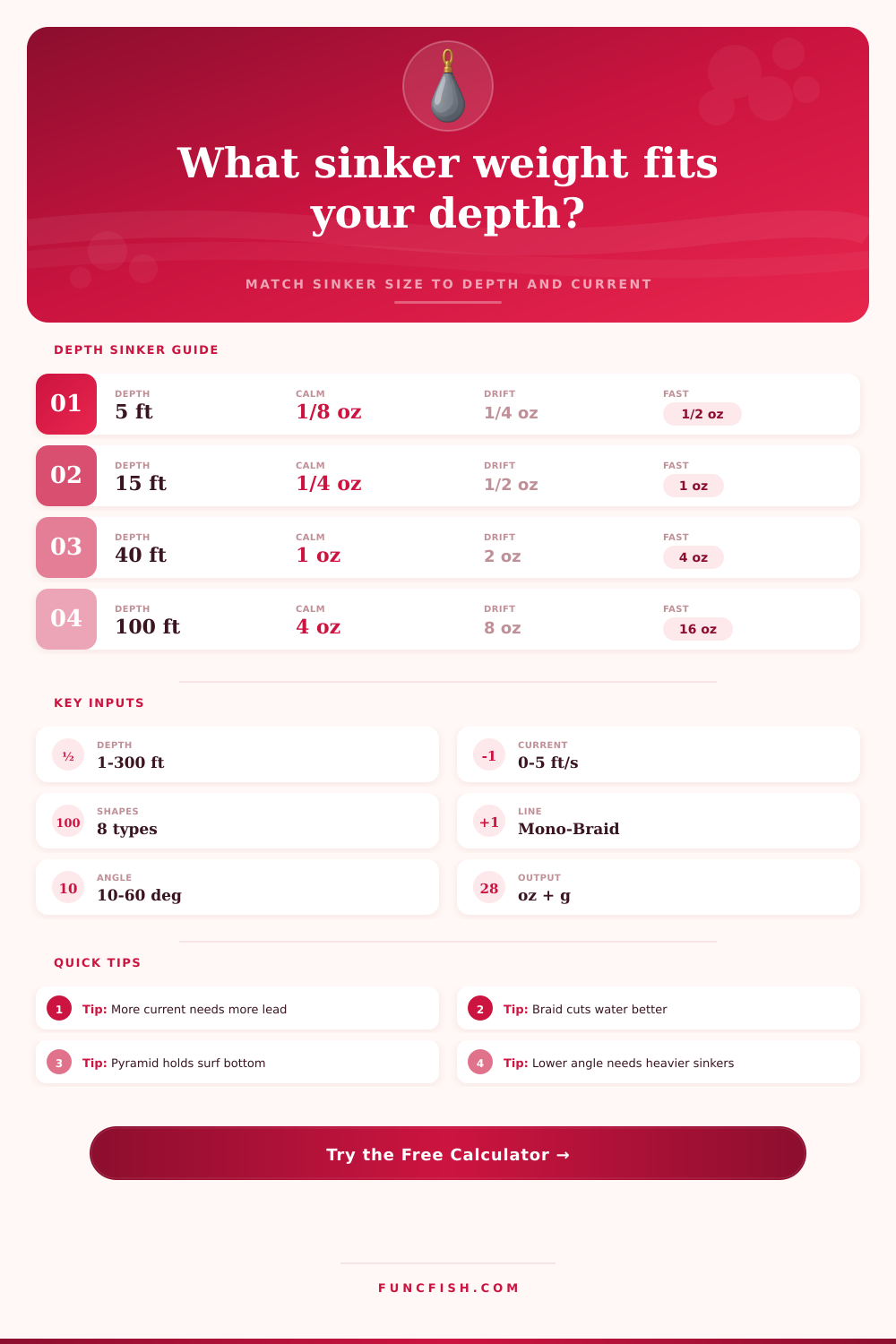
| Fishing depth | Calm water | Moderate drift | Fast current |
|---|---|---|---|
| 3-8 ft / 1-2.4 m | 1/16-1/4 oz | 1/8-3/8 oz | 1/4-3/4 oz |
| 8-20 ft / 2.4-6 m | 1/8-1/2 oz | 1/4-1 oz | 1/2-2 oz |
| 20-50 ft / 6-15 m | 1/2-2 oz | 1-4 oz | 2-6 oz |
| 50-120 ft / 15-37 m | 2-6 oz | 4-10 oz | 8-16 oz |
| 120-300 ft / 37-91 m | 6-16 oz | 10-24 oz | 16-48 oz |
| Rig type | Usual weight | Best depth use | Contact goal |
|---|---|---|---|
| Drop shot | 1/8-3/4 oz | 6-50 ft | Tick bottom |
| Split shot drift | 1/32-1/4 oz | 1-12 ft | Natural drift |
| Slip sinker | 1/4-3 oz | 5-60 ft | Bait movement |
| Carolina rig | 1/4-2 oz | 4-35 ft | Bottom sweep |
| Surf rig | 2-8 oz | 3-25 ft | Hold sand |
| Offshore bottom | 4-48 oz | 40-300 ft | Vertical hold |
| Line material | Water drag | Typical diameter | Weight effect |
|---|---|---|---|
| Monofilament | High | 0.008-0.024 in | Needs more weight |
| Fluorocarbon | Medium high | 0.007-0.022 in | Sinks, still thick |
| 8-strand braid | Low | 0.004-0.015 in | Uses less weight |
| 4-strand braid | Medium | 0.005-0.018 in | Rougher in current |
| Wire leader | Medium | 0.010-0.030 in | Short section only |
| Fly tippet | Low | 0.004-0.009 in | Fine weight steps |
💡Practical checks
Tip: If your line angle keeps opening wider than the target angle, move one standard sinker size heavier before changing the rig.
Tip: In surf or fast rivers, a shape with better hold can fish lighter than a round sinker with the same ounce rating.
Choosing a correct sinker weight require accounting for many different variables. Choosing the correct sinker weight is necessary to keep the bait on a bottom of the water. If the sinker weight is too light for the water conditions, the current will move the bait, and the line will sweep sideways.
The calculator can provide you with a sinker weight necessary for you’re fishing scenario by using the math within the calculator to account for the depth, drag, and weight shape of the sinker. Using the calculator allow you to remove the guesswork involved in choosing the sinker weight. The calculator will show you the starting sinker weight that will work for the condition that you will face while fishing.
How to Choose the Right Sinker Weight
Depth is one of the factor that will have an impact on sinker weight, but it isnt the only factor that will play a role in determining the correct sinker weight. If you are fishing at a great distance from where you will be sitting on the boat, the drag on the fishing line will change the sinker weight that is require. The fishing line will be angled away from the bait, and this angle require a different sinker weight due to the increased load on the sinker.
The calculator will show how much additional sinker weight is required due to the angle of the fishing line. Current speed and boat drift are two more factor to consider when calculating sinker weight. If the current in the water is moving at a speed of one foot per second, you will require a much heavier sinker weight than if the water is standing still.
This is because the fishing line will catch the moving water like a sail. Another factor to consider is the drift of the boat. The boat and the wind may be moving at a different rate from the current that move along the bottom of the boat.
The calculator allows you to enter the speed of the current and the drift of the boat. The calculator will then provide a combined force that will tell you whether the sinker will stay on the bottom or if it will move along the bottom. The material of the fishing line can have an impact on the sinker weight that is required for your fishing scenario.
If you are using braided fishing line, it will have less resistance in the water than monofilament line. This means that a setup with braided line will require less sinker weight than a setup with monofilament line. The calculator allows you to enter the diameter of the fishing line.
The diameter of the line will impact the amount of water that push against the line. A thicker monofilament line will require more sinker weight than a thin braided line. The shape of the sinker and the type of bottom that you are fishing on will also have an impact on sinker weight.
A pyramid-shaped sinker will dig into sand so that the bait remain in place. A round split shot sinker will roll away from the target if the current push the sinker. The calculator will provide a hold credit for the shape of the sinker and the type of bottom that you will encounter.
For example, the sinker weight required for sandy bottoms will differ than the sinker weight required for rocky bottoms. The calculator will provide a range of sinker weights to accommodate different types of bottoms. In addition to the sinker weight, drop time is another measurement that the calculator will provide to you.
Heavier sinker will take less time to reach the bottom of the water than lighter sinkers. However, if the sinker is too heavy, it may bury itself in the mud. The calculator will provide an estimation of the time in seconds for the sinker to reach the bottom of the water.
This will allow you to set a scenario for the sinker to reach the bottom of the water before the current sweeps it away. If it takes too long for the sinker to reach the bottom of the water, you can adjust for this by altering the sinker weight or the sinker shape to one with a higher sink coefficient. Your specific goal for the bait to make contact with the bottom of the water will change the sinker weight that you use.
If you want the bait to barely tick against the bottom of the water, you should use a light sinker weight. If you want the bait to remain in place in a surf or river with a strong current, you should use a heavy sinker weight. The calculator allows for you to preset your desired contact between the bait and the bottom of the water.
This will allow the calculator to provide a sinker weight that will allow for your desired contact with the bottom. Finally, the real world conditions will play a role in adjusting the sinker weight. The wind, tides, and weed lines will change the sinker weight that you calculate with the calculator.
The calculator will show you a range of sinker weights, and you can start in the middle of the range. If the angle of the fishing line or if the bait stops moving natural, you can change the sinker weight. Using the correct sinker weight will help you to lose fewer fishing rig.
If you use the correct sinker weight, the bait will remain in the area where the fish live.