Sinking Tip Grain to Depth Calculator
Estimate the grain weight, T-material class, sink rate, and running depth needed to keep a fly near the target zone.
📌Scenario presets
⚙Sinking tip settings
Sinking tip depth forecast
Full breakdown
📋Tip material reference grid
Fast Poly
T-8
T-11
T-14
📐Sizing and rating tables
| Tip material | Grains per foot | Typical sink rate | Useful tip lengths | Common use |
|---|---|---|---|---|
| Fast poly tip | 4-6 gr/ft | 3.5-4.5 in/sec | 5-10 ft | Trout and light streamers |
| T-7 | 7 gr/ft | 5.0-5.8 in/sec | 7-12 ft | Light single-hand setups |
| T-8 | 8 gr/ft | 5.8-6.6 in/sec | 8-12 ft | Bass, trout spey, shallow swing |
| T-10 | 10 gr/ft | 6.8-7.5 in/sec | 8-13 ft | Moderate depth streamers |
| T-11 | 11 gr/ft | 7.4-8.2 in/sec | 10-15 ft | Steelhead and salmon swings |
| T-14 | 14 gr/ft | 8.5-9.4 in/sec | 10-15 ft | Deep runs, heavy flies |
| T-17 | 17 gr/ft | 9.4-10.2 in/sec | 10-16 ft | Heavy sink tips and big water |
| T-20 | 20 gr/ft | 10.0-11.0 in/sec | 10-18 ft | Very deep or fast saltwater |
| Rod class | Comfort tip grains | Upper caution | Common line pairing |
|---|---|---|---|
| 5 wt single hand | 70-115 gr | 130 gr | Poly, T-7, short T-8 |
| 6 wt single hand | 90-150 gr | 170 gr | T-7 to short T-10 |
| 7 wt single hand | 120-190 gr | 220 gr | T-8 to T-11 |
| 8 wt single hand | 160-250 gr | 280 gr | T-10 to T-14 |
| 9 wt single hand | 190-310 gr | 340 gr | T-11 to T-17 |
| 10 wt single hand | 240-380 gr | 420 gr | T-14 to T-20 |
| 6 wt switch / trout spey | 110-210 gr | 250 gr | T-8 to T-11 |
| 7 wt spey | 150-300 gr | 360 gr | T-10 to T-14 |
| 8 wt spey | 200-400 gr | 480 gr | T-11 to T-17 |
| Scenario | Target depth | Typical tip | Leader length | Adjustment note |
|---|---|---|---|---|
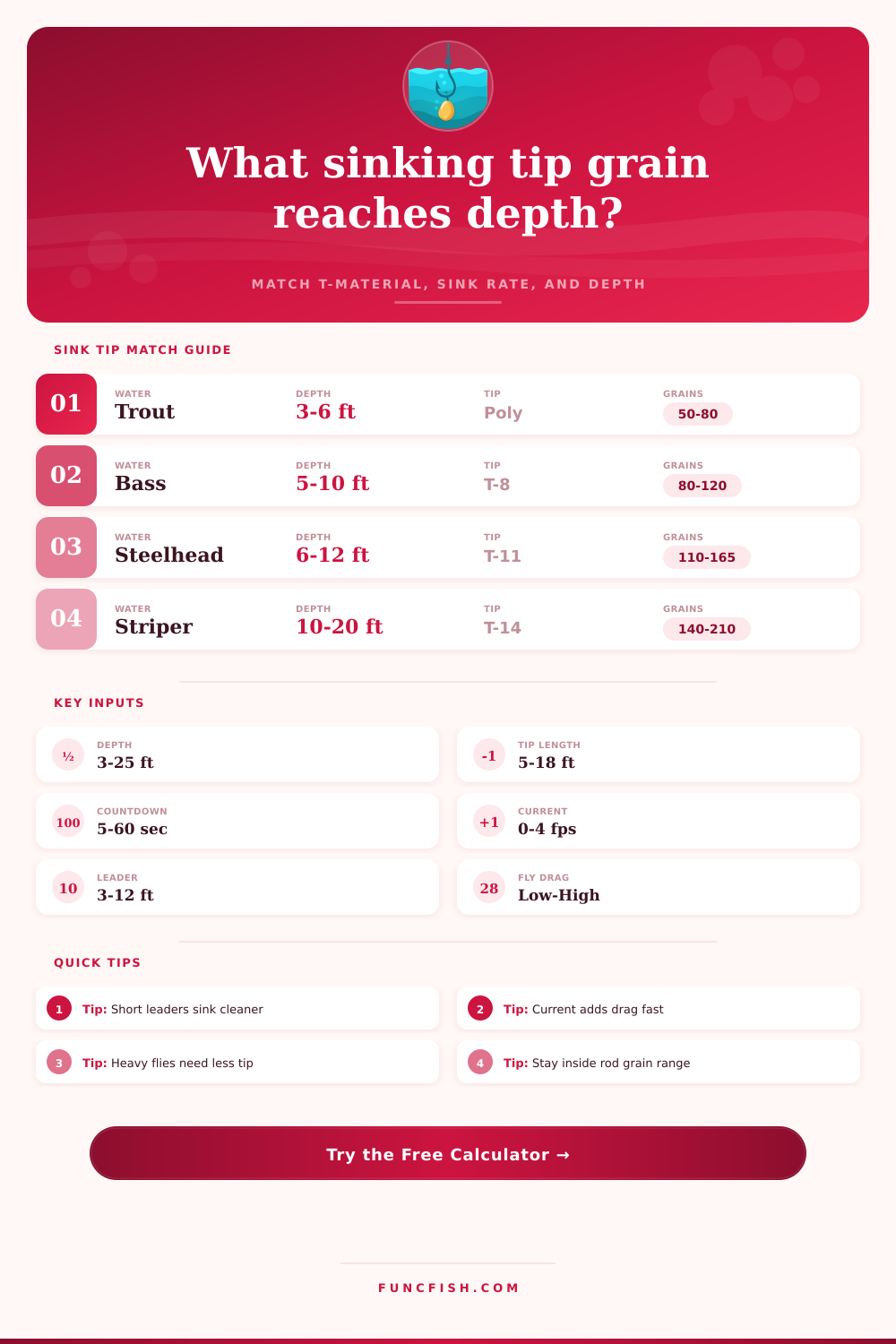
| Trout pocket water | 3-6 ft / 0.9-1.8 m | Poly or T-7 | 3-5 ft | Short leader helps the fly follow the tip |
| Bass bank strip | 5-10 ft / 1.5-3.0 m | T-8 or T-10 | 4-6 ft | Bulky deer hair needs more sink rate |
| Steelhead swing | 6-12 ft / 1.8-3.7 m | T-11 or T-14 | 3-5 ft | Fast current reduces effective sink time |
| Striper channel | 10-20 ft / 3.0-6.1 m | T-14 to T-20 | 4-7 ft | Surf lift often needs one heavier class |
💡Practical checks
Tip: Keep the leader short when measuring sink-tip depth. Long leaders var the fly ride above the tip, especially with bulky streamers.
Tip: If the calculator lands above your rod grain window, shorten the tip first, then choose the next lighter material before forcing the cast.
An angler’s nightmare is using heavy fly that refuses to sink. Instead of diving down to fishing depth, the fly hang high above where fish are holding. Instead of diving down to fishing depth, line dangles up out of water. Most times it has nothing to do with the cast or the rod. It’s nearly always due to lack of understanding about how drag, sink rate and grain weight interact under the strain of current.
A common misconception is that heavier lines dives deeper. And they do… In calm water. But moving water pushes back on line. Bulky flies develop lift. Long leaders act as barriers that prevent lure from getting deep. The real question is how much grain it has. It is not about what line class guess make sense for your application.
Why Your Fly Will Not Sink Deep Enough
Instead of offering blanket recommendations, the chart (above) lets you plot out factors relevant to your situation. In other words, instead of selecting a T-14 because “it must be pretty darn heavy,” you’re thinking: Is that going to get me down 12-feet in moderate current on a jiggy looking fly, or should I go heavier material with a shorter tip? Just enter your approximate water flow, leader length, and depth target to handle all the complicated math. This way, you don’t have to second-guess sink rates or different manufacturer coefficients.
Vertical presentation: The leader length matter here too. Most of us tie on six to nine feet of tippet without even realizing it. That additional length make the fly more buoyant. It also provides drag that will cause the fly to fall slowerer. So if you are fishing tight pockets, where trout is suspended close to bottom, that longer leader might be holding your fly up couple of feet from where you thought it was.
By shortening your tippet to three or four feet, sink tip can work freely and do what it does best. This will change the whole dynamic of retrieve. You need the heavy line pulling the fly down, not battling with a rope of buoyant monofilament.
Depth has just as much to do with the fly’s profile. An unweighted, sparse streamer parting water offers very little resistance. Even a subtle poly tip will carry it to surprising depths. Conversely, a fly with big jiggle eyes or a bulky deer hair pattern create noticeable lift and movement of water. That same presentation depth may require double amount of grain when compared to sleek minnow mimic. To address this, simply choose your fly style on the calculator and let it adjust the desired sink rate based off those settings. Sinking a brick is not the same as sinking a feather, though they both weigh the same in air.
Another variable that tricks anglers is the water speed. A tip will sink at its rated rate in still water. When fishing in a current like a river, line also has to deal with side pressure. That horizontal pressure cause it to spend less time falling towards the bottom. The heavier you go, the better you can combat that resistance and continue sinking. For example, if you’re fishing in fast channels in winter runs on rivers, you want a heavy enough tip to plow through current or else you’ll be swept off with the surface layer of water.
How much weight you need to match the water matters here. You need enough weight to get down, but not so much that it hinders your ability to throw a good cast and feel very slight take up. The table above will give you an idea of general grains for each class of rod. Use those and then stay within reason. Don’t go past what works best but also don’t undermatch your line and power by going too light.
Knowing how all this interacts makes you less a guesser and more of a precise presenter. It’s no longer about throwing the heaviest line you own. It is about using just enough power to put the fly exactly where it needs to be, letting gravity do the rest.