Slow Pitch Jig Fall Rate Calculator
Estimate slow pitch jig fall speed, seconds to the target zone, line angle, drift offset, and strike-window quality from jig weight, shape, line diameter, depth, current, and slack.
📌Slow Pitch Presets
⚙Fall Rate Inputs
Calculation Breakdown
📊Jig Profile Data
📐Fall Rate Reference Tables
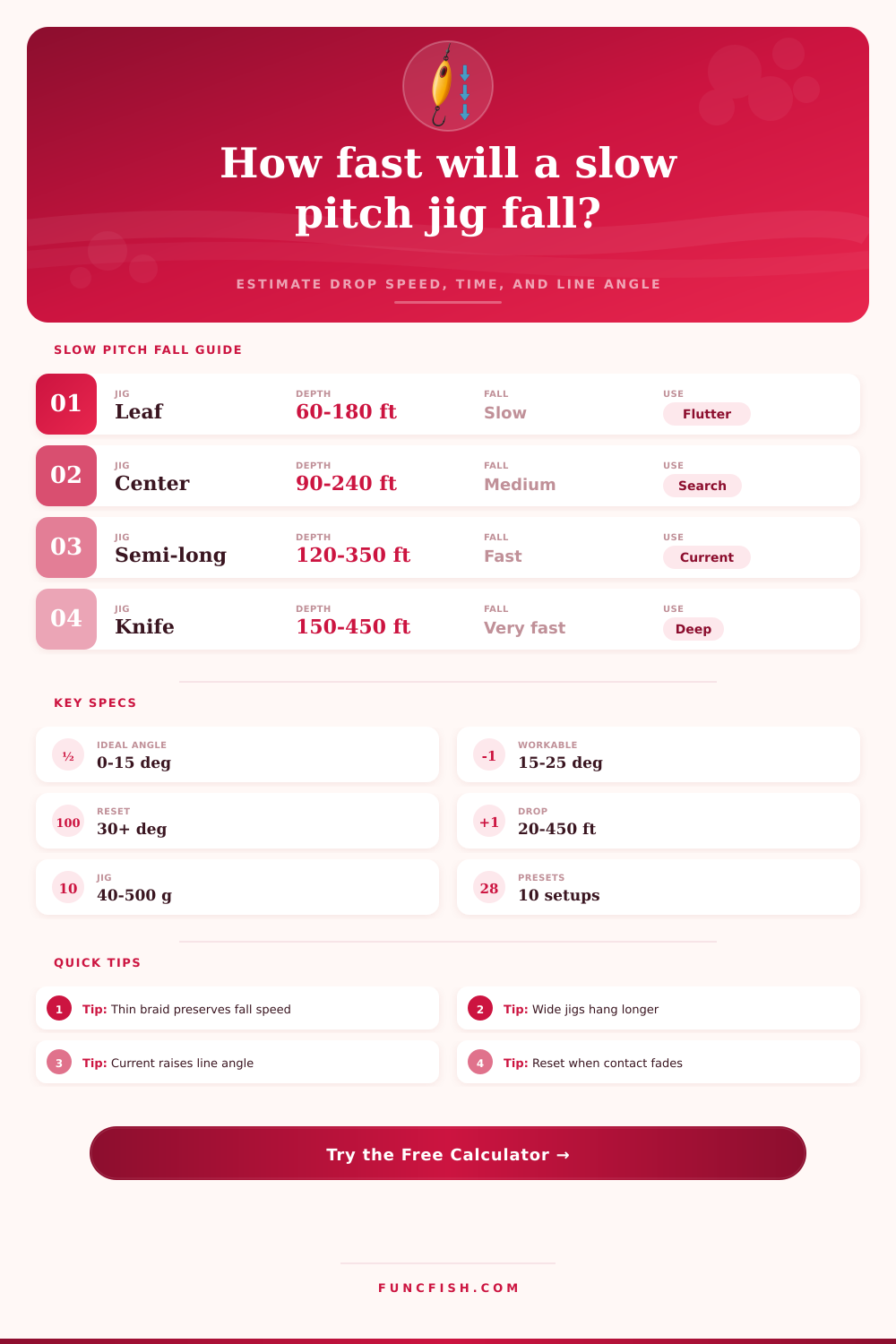
| Slow pitch jig type | Typical weight | Corrected fall feel | Best use |
|---|---|---|---|
| Wide leaf flutter jig | 60-180 g / 2.1-6.3 oz | Slow, broad slide, long hang | Suspended snapper, calm reef edges, negative fish |
| Center-balanced slow jig | 80-250 g / 2.8-8.8 oz | Medium flutter with predictable contact | General slow pitch, mixed reef, sonar marks |
| Short wide wobble jig | 100-220 g / 3.5-7.8 oz | Erratic but drag-heavy fall | Shallow to mid-depth ambush fish |
| Semi-long asymmetric jig | 150-350 g / 5.3-12.3 oz | Fast enough for tide, still kicks sideways | Yellowtail, amberjack, deep snapper, current |
| Long fall slow jig | 180-400 g / 6.3-14.1 oz | Long glide, delayed contact | High-lift rods and fish following above structure |
| Slim knife style jig | 200-500 g / 7.1-17.6 oz | Fast fall with limited hang | Deep marks, strong current, tuna, cod, tilefish |
| Line angle | Fall reading | Contact quality | Adjustment |
|---|---|---|---|
| 0-10 degrees | Nearly vertical fall | Excellent jig feedback and bite feel | Keep the setup, tune slack for flutter |
| 10-18 degrees | Clean slow pitch window | Good contact with slight scope | Fishable; shorten slack near structure |
| 18-28 degrees | Scoped but workable | Delayed contact, wider drift path | Add weight, drop PE size, or reset up-current |
| 28-35 degrees | Sweeping more than falling | Weak bottom and strike feedback | Change jig shape or increase weight strongly |
| 35+ degrees | Poor slow-pitch presentation | Contact loss likely | Reset the drift or reduce line in water |
| Target species | Typical depth | Common jig range | Fall-rate priority |
|---|---|---|---|
| Snapper and seabass | 30-120 m / 100-395 ft | 80-250 g / 2.8-8.8 oz | Flutter time and contact balance |
| Grouper near reef | 40-160 m / 130-525 ft | 120-350 g / 4.2-12.3 oz | Fast contact recovery near structure |
| Amberjack and yellowtail | 50-180 m / 165-590 ft | 150-400 g / 5.3-14.1 oz | Strong fall with sideways kick |
| Tuna on marks | 60-220 m / 195-720 ft | 180-500 g / 6.3-17.6 oz | Reach the mark before it moves |
| Cod, tilefish, deep bottom fish | 100-300 m / 330-985 ft | 250-600 g / 8.8-21.2 oz | Minimize scope and time to bottom |
✅Calculation Notes
Fall rate is not just jig weight. The calculator corrects weight for jig face area, profile drag, water density, line diameter, leader drag, current, and slack feed.
Use angle as the field check. If the result shows a high line angle, a pretty flutter fall may still be sweeping past the target instead of pitching vertically.
Some call them marks on sonar. Some see what appears to be dinner just under there feet as they stand there on the gunwale with a beefy jig in their hands. The tide is running. You cast outward, drop your bait and set the hook. The moment the tip stops down and the rod start coming up again is when slow pitch fishing either works or doesn’t work.
It’s not the retrieve. It is not even really the jig itself. It is all about what that lure does in 3-dimensions as it floats through the water column in the flow of current. The faster it descends the harder it is to guess what depth it will hit. You’re fishing blind. You are hoping it gets bit. You aren’t making it get bitten.
How to Control Your Jig’s Fall Rate
The calculator make those complicated water flow equations so you can concentrate on the fish. Weight is not all there is to fall rate. Most anglers believe it’s as simple as heavier things sink quicker then lighter things. While that is true in a vacuum, in the ocean it’s far less true. For starters, water is dense and moving currents oppose anything that doesn’t have a spherical shape. There are forces on your line, called drag. There are also forces fighting gravity on your leader. Combine that with thin braid, a hard-running tide and then slap on a big leaf on your jig and you’ve got a recipe for some seriously messy math.
The tool corrects the raw weight by accounting for drag coefficients and projected area. It takes into account what is realy happening underwater and tells you. So you could have a two-hundred-gram jig in your hands feeling heavy, but falling like a feather because the water is grabbing hold of its wide face. This is why the inputs are important.
Think about line size for a moment. It may look skinny, but it’s not. Heavy braid behaves like a parachute on your jig in heavy current or deep water. Line drag actualy factors into the calculator’s last calculation of fall rate. Not only will switching from PE 1.0 to PE 2.0 affect your knot strength, but it will also alter your fall rate to the point where you’re probably missing more strikes below boat and getting swept past fish instead of pitching directly down into their faces if the number indicates an excessive line angle. Because the line is being pulled so hard to one side by the tide, there’s no way to make contact with the fish. The bite happen right underneath the boat and goes unnoticed.
This is clearly explained in the reference table on the page, outlining how just a few degrees additional angle can drastically reduce your feel for the bite.
The other layer where gut intuition falls short is Slack Management. Feeding slack encourages the flutter action that triggers strikes from hesitant fish. No slack and you lose contact with bottom. So you don’t know if you hit a rock or if a bass is simply shaking its head. Finding the sweet spot here takes some fiddling around. The tool help you dial in the correct amount of line to let out per cycle. This ensures the right drop time for your desired depth. That provides a rhythm which allows you to work with a metronome rather than being frantic as you lift off the reel. It matches up with the natural hang time of the jig.
To know the right fall profile, you have to understand species behavior. A snapper likes to hang on the bottom and slowly flutter that jig. Because they’re lazy hunters, a knife jig that falls fast can zip right by ‘em before they commit to attack. On the other hand, tuna like speed and irregular movements in open water. To keep pace with their own momentum, they require a faster presentation. This provides the trade off to help you dial-in your selection of a slim knife style for deep current runs vs. Use a wider leaf for calm reefs. Before you even hit the dock, the calculator allows you to play out those options.
There’s also a subtler factor: Water temperature. In cold water, because it’s denser, there is more resistance. What’s a perfect-falling jig on a summer day can be too slow to fall correctly in the winter. The jig hangs longer and tells the spooked fish where you are. Density changes keeps the estimate correct throughout the year. It’s learning how to read conditions instead of fighting them.
Slow pitch is all about precision and patience. It is a delicate dance on a slender thread called the ocean. Adjusting the fall rate makes it less about throwing out there and hoping and more about having a meaningful conversation with the water. Knowing the characteristics of your jig lets you eliminate any guesswork about depth. You gain control over the interaction. Below you know that the fish are there and awaiting your offer. Deliver the offer at the correct place and time and you’ll connect. Understanding how the fall works puts the fish in check. It’s how you bring the chaos under control.