Smoking Wood Quantity Calculator
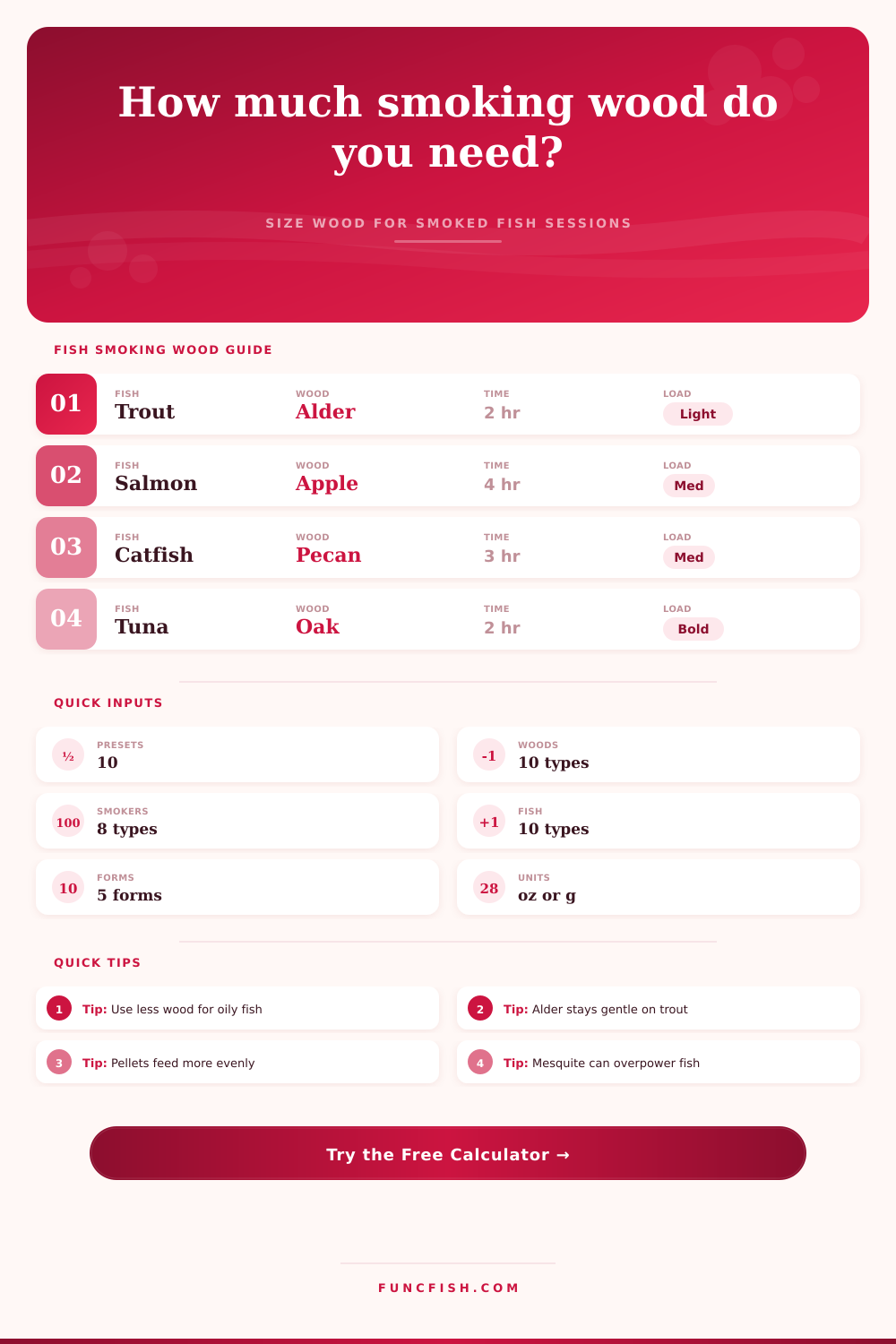
Estimate how much smoking wood to load for fish by weight, smoker style, wood species, wood form, smoke time, chamber size, airflow, humidity, and target smoke strength.
📌Smoking session presets
⚙Fish, smoker, and wood inputs
Smoking wood estimate
Calculation breakdown
🪵Smoking wood species grid
📊Wood species reference
| Wood species | Smoke strength | Good fish match | Typical caution |
|---|---|---|---|
| Alder | 1.0 gentle | Trout, salmon, whitefish | Can seem faint on oily fish |
| Apple | 1.18 mild-sweet | Salmon, walleye, snapper | Needs time for deep color |
| Cherry | 1.25 rounded | Mackerel, trout, catfish | Darkens surface quickly |
| Maple | 1.12 soft | Walleye, trout, halibut | Subtle in leaky smokers |
| Pecan | 1.38 nutty | Catfish, bluefish, salmon | Builds stronger over long runs |
| Oak | 1.55 firm | Tuna, halibut, salmon | Reduce for delicate fillets |
| Hickory | 1.75 strong | Bluefish, catfish, oily fish | Can turn bitter if overloaded |
| Mesquite | 2.05 intense | Tuna, strong oily fish | Use short exposure on fish |
📋Smoker style factors
| Smoker style | Wood factor | Best form | Refill pattern |
|---|---|---|---|
| Electric cabinet | 0.74 | Chips or pellets | Small tray refills |
| Pellet smoker | 0.62 | Pellets | Hopper feeds steadily |
| Kettle grill | 1.05 | Chunks | Add by coal cycle |
| Offset smoker | 1.45 | Splits or chunks | Frequent clean-fire checks |
| Drum smoker | 0.95 | Chunks | Mostly front-loaded |
| Gas smoke box | 1.18 | Chips | Box refill as smoke fades |
| Charcoal cabinet | 1.08 | Chunks | Small staged additions |
| Cold smoke chamber | 0.88 | Dust or pellets | Continuous thin smoke |
🐟Fish smoke absorption guide
| Fish profile | Absorption factor | Smoke tolerance | Wood direction |
|---|---|---|---|
| Trout or char | 0.88 | Delicate | Alder, maple, apple |
| Salmon or steelhead | 1.00 | Balanced | Alder, apple, cherry |
| Catfish | 1.12 | Medium | Pecan, cherry, hickory blend |
| Mackerel | 1.28 | Bold | Cherry, oak, pecan |
| Tuna or bonito | 1.18 | Bold | Oak, mesquite sparingly |
| Walleye or perch | 0.82 | Delicate | Maple, apple, alder |
| Halibut or flatfish | 0.86 | Delicate | Oak-light, maple, pear |
| Bluefish | 1.36 | Heavy | Hickory, oak, pecan |
🧮Wood form conversion table
| Wood form | Ounces per cup | Approx grams per cup | Typical use |
|---|---|---|---|
| Chips | 2.6 oz | 74 g | Tray or foil packet |
| Chunks | 4.8 oz | 136 g | Charcoal and drum cooks |
| Pellets | 5.2 oz | 147 g | Pellet tray or hopper |
| Sawdust | 3.4 oz | 96 g | Cold smoke generator |
| Small splits | 6.8 oz | 193 g | Offset fire management |
💡Calculation tips
Match wood strength to fish oil level: delicate white fish usually need a smaller total wood load than salmon, mackerel, catfish, or bluefish at the same chamber size.
Stage the load instead of dumping it all at once: the calculator splits wood by refill plan so smoke stays thin and steady instead of thick at the start and empty at the end.
When it’s just you and the fire after a lengthy smoke, you might start panicking when the smoke goes away. Why? Because you ran out of wood and now your fish is drying up instead of soaking up more smoke flavor.
The wood calculator does that math for you. You enter how heavy your fish is and what level of smoke you want. Then it tells you how many sticks to add to your kettle. You’ll know exactly how many stick will fit in your kettle.
How to Use the Wood Calculator
Everybody just assumes that all smoking wood are the same. It’s not. You know what? Mesquite isn’t the same thing than alder. Alder behaves differentally in terms of burn rate and smoke density. Alder has a gentler flavor. It’s good for some of those more delicate fish such as char or trout. Mesquite is heavy. It put out a strong smoke. Now if you put mesquite on your trout, it’s going to be bitter and harsh tasting.
The calculator also takes into account the species of fish. Heavy hickory works fine on bluefish. For walleye you want the subtle apple or even maple. That’s because each fish species have its own unique protein structure and oil content. This influence the way the fish absorbs the compounds in the smoke. The type of wood makes just as much difference than the kind.
For example: Chips catch fire quickly and burn intensely. They are good for gas grills or quick smokes. Chunks burn evenly and longer then chips. They are best for kettle grills and offset smokers. Pellets is handy but they need their own feeder. The calculator takes all this into consideration.
Simply enter your fish weight and desired intensity then it gives you the amount of fuel required. Are you running low on smoke mid-way through a long session? If you’re burning chips you’ll be out soon. The app recommends enough to get you where you want to go, for how long you intend to smoke.
One variable that wrecks many smokes: airflow. If there are any open vents or leaks in your cabinet, the smoke move too fast through the chamber. In this case, you’ll need additional wood to concentrate the smoke. For example, you can enter your draft conditions into the calculator. It will work with both tight electric cabinets and windy outdoor situations.
Experience usually guides you on these things but the math gives you a place to start. The tool also puts an insurance margin above your estimate. That’s because we’re dealing with outdoor variables. Always have some extra wood handy. Trying to relight a fire late at night isnt easy.
The result: it will tell you what the load size recommendation is, as well as total weight. Where the magic happens is in the balance. Trust the warning. A delicate fish, a heavy load? Listen to the machine. Volume isn’t all that matters here. Intensity matters too.
Is there not enough smoke? Add more wood. Is it harsh on the fish? No taking away wood now. Use the reference charts to get some ideas about which woods goes with which proteins. Follow their lead but know cooking remains an art. Even if the science is precise.
Control and patience are what smoking is all about. With the calculator, there’s no fear that you’ll run out of fuel. There’s data to give you a starting point. When you step away from the smoker, knowing exactly how much wood is burning and how long it will last brings peace of mind in the kitchen. You know how long they’ll last. That brings peace of mind into the kitchen.
The smoke should remain constant. The prep work was worth it. And the fish will reflect that, not as a mistake.