Snap Strength by Line Calculator
Estimate the real line strength left after knot efficiency, abrasion, age, drag setting, rod angle, and sudden shock load.
📌Scenario presets
⚙Line strength settings
Snap strength forecast
Full breakdown
📋Line material data grid
Mono
Fluoro
Braid
Wire
📐Snap strength reference tables
| Line material | Typical knot efficiency | Stretch behavior | Snap risk note |
|---|---|---|---|
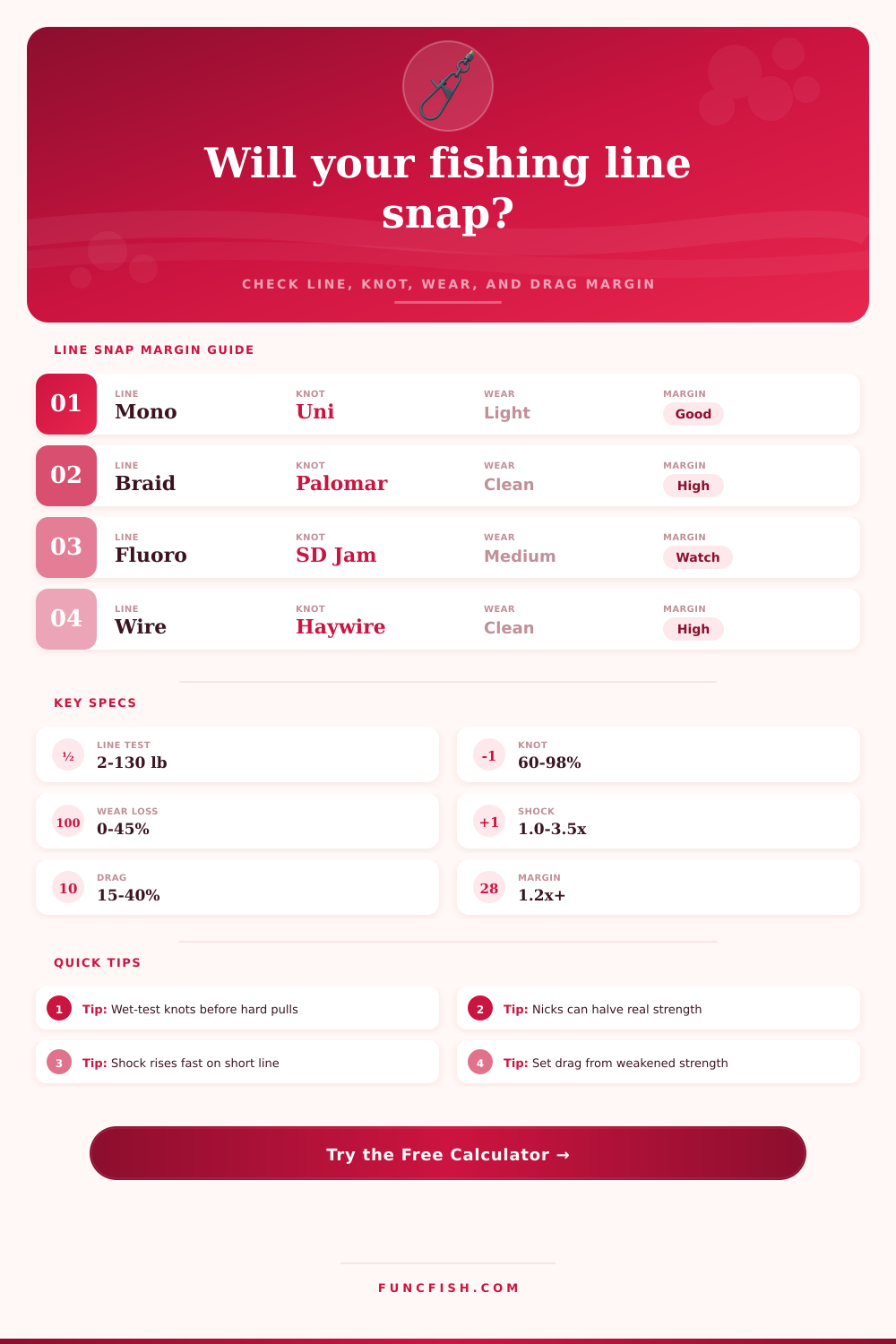
| Nylon mono | 82-96% | High stretch | Forgives shock but ages in sun |
| Fluorocarbon | 75-92% | Medium stretch | Strong abrasion but knot sensitive |
| 4-carrier braid | 78-92% | Very low stretch | Needs good drag and clean guides |
| 8-carrier braid | 80-94% | Very low stretch | Smoother, still sharp under shock |
| Copolymer | 80-94% | Medium-high stretch | Balanced shock and abrasion |
| Lead-core | 70-86% | Low stretch | Core damage lowers real rating |
| Single-strand wire | 90-98% | Minimal stretch | Kinks create sudden weak spots |
| Fly tippet | 76-94% | Fine diameter | Small knots and wind knots matter |
| Knot / connection | Best match | Efficiency band | Failure signal |
|---|---|---|---|
| Palomar | Braid, mono | 88-98% | Slipped tag or crossed loop |
| Improved clinch | Mono, light fluoro | 75-90% | Curled end after break |
| Uni knot | Mono, fluoro, braid | 80-94% | Coils bite unevenly |
| Double uni | Line connection | 72-88% | Unequal wraps cut one side |
| FG knot | Braid to leader | 82-96% | Braid slips on hard load |
| Alberto | Braid to leader | 78-92% | Leader exits kinked |
| Snell | Hooks, bait rigs | 84-96% | Snell wraps overlap |
| Haywire twist | Single-strand wire | 90-98% | Twist cracks or kinks |
| Scenario | Shock multiplier | Drag target | Line-out note |
|---|---|---|---|
| Steady fish pull | 1.00-1.15x | 25-33% | Long line cushions load |
| Head shake surge | 1.25-1.70x | 22-30% | Short line makes spikes worse |
| Hard hookset | 1.50-2.40x | 20-28% | Braid transmits the hit quickly |
| Power cast | 1.80-3.20x | Not drag led | Lure weight drives snap-offs |
| Snag pull | 1.10-1.60x | Straight pull | Rod angle can overload the tip |
| Boat-side lift | 1.30-2.00x | 20-25% | High-sticking removes cushion |
🐟Species and rig load reference
| Use case | Common line test | Normal drag range | Snap margin target |
|---|---|---|---|
| Panfish ultralight | 2-4 lb / 0.9-1.8 kg | 0.5-1.2 lb | 1.6x or higher |
| Stream trout | 4-6 lb / 1.8-2.7 kg | 1.0-2.0 lb | 1.5x or higher |
| Bass spinning | 8-15 lb / 3.6-6.8 kg | 2.5-5.0 lb | 1.3x or higher |
| Walleye jigging | 6-12 lb / 2.7-5.4 kg | 1.8-3.5 lb | 1.4x or higher |
| Surf casting | 15-30 lb / 6.8-13.6 kg | 4.0-8.0 lb | 1.5x plus shock leader |
| Catfish bottom rig | 20-50 lb / 9.1-22.7 kg | 6.0-14 lb | 1.4x or higher |
| Inshore kayak | 10-30 lb / 4.5-13.6 kg | 3.0-8.0 lb | 1.3x or higher |
| Offshore trolling | 30-80 lb / 13.6-36.3 kg | 8.0-24 lb | 1.25x with smooth drag |
💡Practical checks
Tip: Use a scale to set drag from the weakened strength, not the printed line rating. Knots, abrasion, and leader connections are usually the real limit.
Tip: If casting causes snap-offs, add a shock leader or reduce lure weight before increasing drag. Casting load can exceed fighting load by several times.
The strength of fishing line isnt always equality to the test rating of the fishing line. The actual strength of the fishing line is often less than the test rating of the fishing line due to an effect of knots, wear on the line, and loads placed upon the line in a short period of time. It is often believed that if a fishing line is rated at 20 pounds, it will hold 20 pounds of pressure.
However, a fishing line that is rated at 20 pounds may only be able to hold 12 pounds of pressure if it has been used throughout the fishing season or if it has been dragged across rocks. Several differents factors determines the actual breaking point of the fishing line. One factor of the strength of the fishing line is the material that is used to manufacture the line.
Why Fishing Line Breaks and How to Protect It
The type of material that is used will determine the amount of stretch that the fishing line can absorbs before the force on the fishing line increase. Another factor that will decrease the actual strength of the fishing line is the type of knot that is used. The specific type of knot will determine the amount of the original strength of the fishing line that the knot retains.
The third of the factors that will decrease the actual strength of the fishing line is the condition of the line. The fishing line may have been exposed to the sun, rocks, or the wind while it was tied in knots. Another factor that can impact the strength of the fishing line is the drag setting and the angle of the rod.
These two factors will determine the amount of the power of the fish that is transferred to the fishing line. Finally, the scenario in which the fishing line is being used will impact the strength of that line. The more violently the movement of the fish that is being caught, the less strength that the fishing line will exhibit.
The way in which you use your fishing rod and fishing reel will have an impact based off the strength of the line. For instance, if you use a heavy hook set with a short leader and low stretch fishing line, the load that is placed upon the line will be higher than if you were applying steady pressure to the line. In the same manner, if you use a fishing line in different ways during your fishing trip, the line may survive a fight with one fish but break when fighting with another fish.
You can use a calculator to determine the effect of these differant factors to see if the drag on the fishing line will remain within a safe range. For instance, changing the angle of the fishing rod or the distance of the line from the reel will lead to a change in the outcome of the calculation of the strength of the fishing line. The species of the fish that is being caught and the type of water in which those fish live will also impact the strength of the fishing line.
For instance, a trout fish is often caught in fast-moving water while a catfish is caught in slow-moving water. The trout fish will require a higher safety factor for the fishing line than the catfish. Offshore fishing trolling techniques will also increase the load upon the fishing line.
Additionally, high sticking the fishing rod when fishing for species like tuna fish will require a higher safety factor than individuals with low fishing rod angles. Many individuals lose their caught fish due to there lack of understanding of the true strength of their fishing lines. For instance, an individual with a 20 pound test fishing line that is used for long periods of time or has been tied into a knot may only be able to handle 12 pounds of pressure.
Therefore, if an individual sets their drag on one-third of the rating of the fishing line, they are placing the fishing line close to it’s breaking point. In such a case, the individual should of checked the strength of the line prior to the fishs fight and adjust the drag setting to ensure that the fishing line remains within the safety margin. An individual can take steps to protect their fishing line and avoid losing any of their caught fish.
One of the best strategies is to determine the safety factor that should be used prior to making the first cast of the fishing trip. After you determine the safety factor, the angler can adjust the drag using the calculator to ensure that the load placed upon the fishing line is within the limits of its true strength. Additionally, should the safety factor be determined to be too thin, the angler can cut back to a fresh portion of the fishing line, a stronger knot can be used, or the angler can adjust the drag to a lower setting.
These steps will eliminate the guesswork that some anglers have to use when setting up their fishing trip and will help to ensure that the fish are not lost due to the failure of the fishing line.