Spinner Blade to Weight Ratio Calculator
Estimate blade area per lure weight, lift balance, running-depth tendency, torque load, and recommended weight range for inline spinners, spinnerbaits, jig spinners, and trolling blades.
📌Spinner ratio presets
⚙Blade, weight, and retrieve inputs
Spinner blade ratio results
Calculation breakdown
📊Blade and lure data snapshot
Round shape starts easily and rides shallow at slow to medium speed.
Oval shape splits the difference between thump, flash, and depth.
Narrow blade tracks deeper and tolerates faster retrieve speeds.
Cupped inline blade gives reliable rotation on small trout spinners.
🔀Comparison grid
Large Colorado blade with light head creates lift and thump for slow presentations.
Indiana or tandem willow-Colorado setup gives moderate lift without blowing out.
Willow blade and heavier head keep the lure down at speed with less torque.
Oversized blade needs more weight or slower speed to avoid climbing too high.
📘Reference tables
| Blade family | Lift coefficient | Drag feel | Spin start | Typical use |
|---|---|---|---|---|
| Colorado | 1.30 high lift | Heavy thump | Very easy | Slow roll, stained water, shallow cover |
| Indiana | 1.05 medium lift | Moderate pulse | Easy | All-around spinnerbaits and river spinners |
| Willowleaf | 0.72 low lift | Low drag | Moderate | Clear water, deep retrieve, fast burn |
| French | 0.96 inline lift | Steady vibration | Easy | Trout and salmon inline spinners |
| Hatchet | 1.18 pulsing lift | Hard thump | Moderate | Dirty water and night presentations |
| Hex trolling | 0.86 flash lift | Medium drag | Moderate | Harnesses, salmon trolling, flash rigs |
| Blade size | Approx length | Approx width | Area range | Common lure weight |
|---|---|---|---|---|
| 00 to 0 | 0.45-0.60 in / 1.1-1.5 cm | 0.20-0.28 in / 0.5-0.7 cm | 0.07-0.14 in² | 1/64 to 1/16 oz / 0.4-1.8 g |
| 1 to 2 | 0.70-0.95 in / 1.8-2.4 cm | 0.32-0.45 in / 0.8-1.1 cm | 0.18-0.36 in² | 1/16 to 1/8 oz / 1.8-3.5 g |
| 3 to 4 | 1.10-1.45 in / 2.8-3.7 cm | 0.52-0.70 in / 1.3-1.8 cm | 0.48-0.85 in² | 1/4 to 1/2 oz / 7-14 g |
| 5 to 6 | 1.65-2.05 in / 4.2-5.2 cm | 0.80-1.00 in / 2.0-2.5 cm | 1.10-1.80 in² | 1/2 to 1 oz / 14-28 g |
| 7 to 8 | 2.35-2.75 in / 6.0-7.0 cm | 1.15-1.35 in / 2.9-3.4 cm | 2.20-3.10 in² | 3/4 to 2 oz / 21-57 g |
| Ratio class | Area per oz | Area per gram | Running behavior | Adjustment |
|---|---|---|---|---|
| Very low | Under 1.0 in²/oz | Under 0.023 cm²/g | Sinks easily, low thump | Use bigger blade or slower fall |
| Low | 1.0-1.8 in²/oz | 0.023-0.041 cm²/g | Deep tracking, fast retrieve friendly | Good for current and clear water |
| Balanced | 1.8-3.2 in²/oz | 0.041-0.073 cm²/g | Stable mid-depth spinner balance | Useful starting point for most rigs |
| High | 3.2-5.2 in²/oz | 0.073-0.119 cm²/g | Strong lift and slow-roll vibration | Add weight for depth or speed |
| Very high | Over 5.2 in²/oz | Over 0.119 cm²/g | Rides high, may roll or blow out | Reduce blade size or add head weight |
| Species setup | Blade style | Weight range | Speed window | Ratio target |
|---|---|---|---|---|
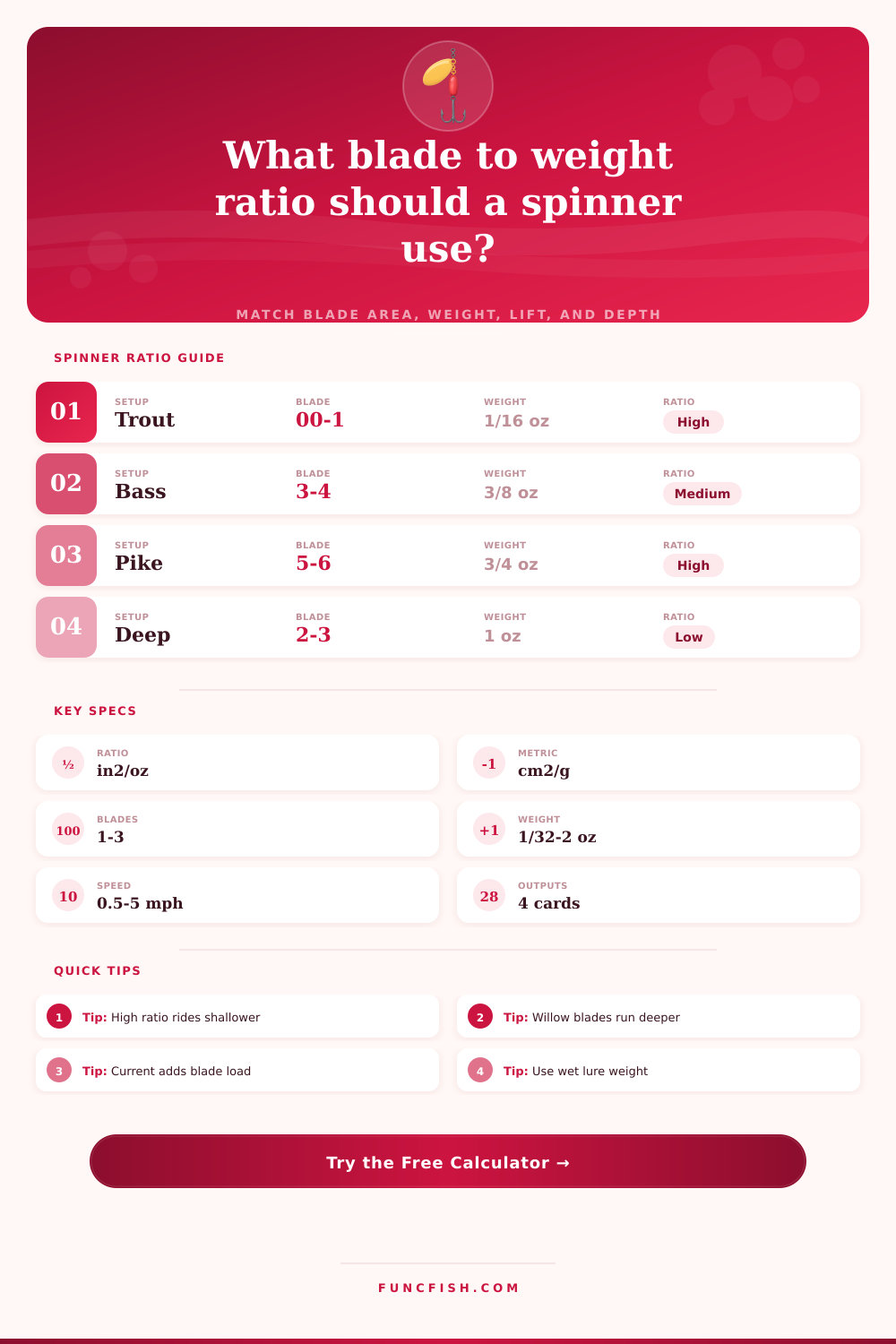
| Trout in creek current | French or Colorado 0-2 | 1/32-1/8 oz / 0.9-3.5 g | 0.8-2.0 mph / 1.3-3.2 km/h | High startup, moderate lift |
| Panfish pond edge | Colorado 00-1 | 1/64-1/16 oz / 0.4-1.8 g | 0.5-1.5 mph / 0.8-2.4 km/h | High ratio, easy spin |
| Bass spinnerbait | Indiana or tandem 3-5 | 1/4-3/4 oz / 7-21 g | 1.5-3.2 mph / 2.4-5.1 km/h | Balanced lift |
| Walleye jig spinner | Willow or Indiana 2-4 | 1/8-1/2 oz / 3.5-14 g | 0.8-2.5 mph / 1.3-4.0 km/h | Low to balanced |
| Pike and musky | Large Colorado or bucktail 5-8 | 1/2-2 oz / 14-57 g | 2.0-5.0 mph / 3.2-8.0 km/h | High thump with enough ballast |
| Salmon trolling | French or hex 3-6 | 1/2-2 oz / 14-57 g | 1.5-3.5 mph / 2.4-5.6 km/h | Low lift, reliable rotation |
💡Calculation tips
Reel it back to you without any resistance or cast it up there through the weeds and you find trouble. More times than not, that’s due to the wrong ratio and not necessarily how pretty the bait looks. It’s more about balancing weight of the water the blade displaces against the weight of the rest of the rig. If those two forces aren’t syncing up then it sits on top too much or sinks down too fast. That’s where the calculator comes in.
Plugging in your lure weight and blade size lets you get the ratio without having to guess at conversions or coefficients. But knowing how that ratio impacts anything is slightly more nuanced than pushing ‘calculate.’ It’s about lift versus ballast.
Balancing Your Lure for Better Fishing
Even when spinning a bait slowly, a wide Colorado blade create a lot of water lift. Pair it with a tiny 1/16 ounce head and the lift wins. It floats up. Your depth control goes out the window. Put enough weight on it to keep it down and you’ve killed the spin altogether. The lack of power from lightweight rig can’t compete with the water resistance.
But that’s where most folks mess up. They assume flash comes from big blades. Big is not necessarily better when fishing in clear water. A big blade on a lightweight lure has one flaw: it sits too high in the water. Smallmouth bass and walleye likes to position just off of bottom structure. You have to get your bait down there. That’s what narrow willow leaf blades do. They has very little drag and lower lift. They slice through the water, allowing you to carry more weight on head without killing the spin. They rotate enough without breaking the spin, and they dive enough without going too deep to lose the bottom.
Then take into account the substance. Brass is heavier than plastic or even steel. So a brass blade with equal size to a stainless blade will be heavier. When it gets in flow of water it starts turning faster due to this increased weight. That increases its momentum to reach planing speed quickly. This is important on slow retrieve days in cold water where fish are less active. If you can’t make the blade turn at 0.5 miles per hour then you might as well have a shiny pebble behind you.
These shape elements goes into the tool. It recognizes that an inline blade shaped like a French blade behaves different than a flat hatchet thumper. Now add current and everything changes. At any given reel speed, the current will hit the lure harder than if you were retrieving it in still pond while fighting an upstream river. So you may have to split shot or go down one size on a blade to be in strike zone. As you drift downstream, your baits will tend to sink deeper, so you may need to increase lift rather than decrease it to keep them visible.
The page has a reference table that shows which class of ratios line up with various presentation styles per species. High startup efficiency is required for trout spinner. A pike bait needs thump and durability. Do not overlook the body drag. Something as simple as a bulkier bucktail or full silicone skirt will resist forward movement of the blade and create drag. It is like a brake on the lure. What you figured out on paper as a sweet ratio suddenly has the tail at odds with head, and the lure just stalls in the water. Compensate for this by trimming the skirt down some or going up a size on the blade to offset the additional resistance.
But in the end, no magic formula or magical lure ever caught a fish. Fishing is a matter of changing variables until it makes sense based off the conditions. How much do I need to weigh my bait to get it to stay in the strike zone? Not so much as to cause drag, but enough to make sure it stays up there long enough for me to see and work it. After you learn to relate blade area to lure mass, you stop throwing blind. You begin to engineer your presentation. The more you connect with the balance, the more your rod tip is going to let you know what to expect.