
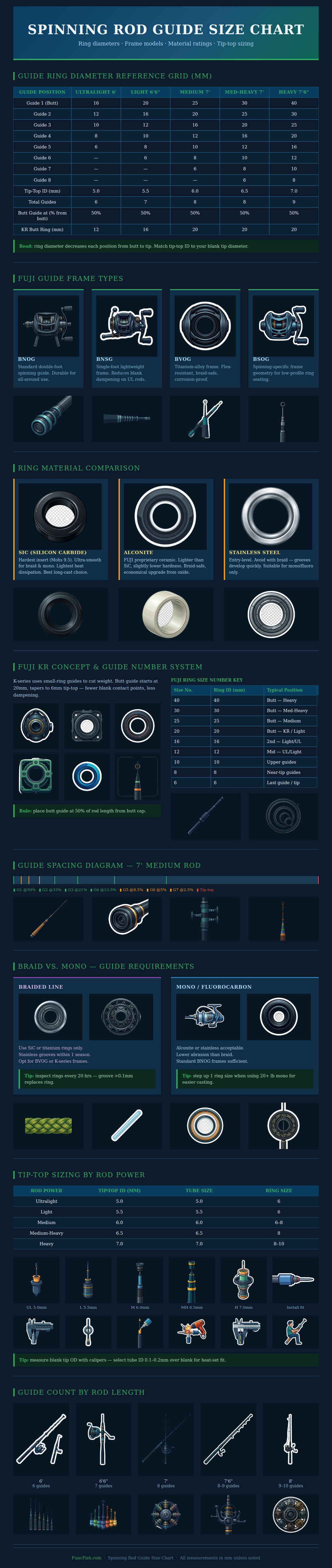
A good cast is not achieved by throwing harder. A good cast require the right balance, the right timing, and guides placed correcty along rod blank. Many anglers pay no attention to their guides at all and worry about reel drag and line weight. It’s the guides that dictate how energy flows from the cast to the line and if you have wrong guides, you will be frustrated.
Guide ring diameters needs to taper gradually from the butt of the rod to the tip top as shown in chart. That’s physics not aesthetics. It’s not by chance either that guide sizes decreases toward the top. That is why you see a 16 millimeter ring on an ultralight six-footer. A hefty 40-millimeter ring are required at the butt section for big fish on a seven-and-a-half-foot heavy-duty rod. Allowing larger rings provides for better angles to keep line off the blank with less friction and wear from prolonged casting. As you work up the rod the rings should diminish down to a smaller diameter. This keeps the line on a nice smooth arc rather then pinching hard against itself. Oversized guides toward the tip will rob the line of momentum due to wind resistance and hurt your casting distance.
How to Choose Fishing Rod Guides
Choosing your materials is another tough nut to crack for newcomers. Hardness and heat dissipation is most important. When your braid finally breaks on a long cast, the material you’re breaking it against need to absorb that energy. Cheap stainless steel inserts can’t do this. They rapidly grove into a miniature hook that bites into that pricy braided line. It’s not uncommon for folks to purchase high-end rods only to equip them with entry level guides that fail under pressure. If you go the braid route, use titanium alloys and harder ceramics. This stuff absorb that energy better. Monofilament users can uses a standard aluminum oxide frame because it is soft and does not create much heat.
There is a pattern for guide placement. According to the chart, the bottom guide (butt guide) should of be positioned at exactly fifty percent of the rod’s length from the handle. By doing this, you keep the rod’s action profile. If you move your initial guide one inch up or down, the blank will flex different than when loaded with a fish. Moddern K-series designs employ smaller rings to reduce vibration dampening, and having fewer guides mean better sensitivity and less weight. You don’t want to see the rod bend. You want to feel it.
Lastly, don’t forget about sizing. Typically, you’ll want a six-millimeter inner diameter tube to match your rod’s size. For instance, most medium power rods uses a six-millimeter ID. This works fine until you try forcing a heavy line into a narrow gap. That results in instant drag and eventual breakage. So do yourself a favor and take precise measurements of your blank tip when placing an order. Too-tight fit leads to cracking at install time; too-loose fit results in spinning inside the ferrule. It makes all the difference in terms of long-term durability.
Your rod isn’t simply a stick. It’s a system. Each millimeter of diameter and each ring matter for transferring energy throughout the tool. When you check out your stuff, run your fingers up and down the guides. Is it smooth? Are there any grooves on the rings? Does the taper make sense? Doing so will help your line last longer and your casts go farther. How you land starts long before letting loose the lure.