Spool Arbor Knot Turns Calculator
Estimate how many line turns to wrap around a reel spool arbor before the arbor knot is cinched, including line material, wet grip, spool diameter, drag, and safety margin.
📌Scenario presets
⚙Arbor knot settings
Arbor wrap forecast
Full breakdown
📋Line material grip grid
Mono nylon
Fluorocarbon
Slick braid
Dacron backing
📏Arbor and turn reference tables
| Reel type | Typical arbor diameter | Starter turn range | Best line pairing | Coverage note |
|---|---|---|---|---|
| Small spinning | 0.45-0.75 in / 11-19 mm | 2-4 mono, 5-6 braid | Mono, fluoro, fine braid | Narrow wrap stack |
| Medium spinning | 0.75-1.10 in / 19-28 mm | 3-5 mono, 5-7 braid | Mono backing under braid | Balanced starter layer |
| Baitcaster | 0.60-0.95 in / 15-24 mm | 3-4 fluoro, 5-6 braid | Fluoro or mono backing | Keep knots low |
| Round conventional | 0.90-1.40 in / 23-36 mm | 3-5 mono, 6-8 braid | Mono or textured arbor | Wide first layer |
| Large arbor fly | 1.60-2.60 in / 41-66 mm | 4-6 backing | Dacron backing | High line use per turn |
| Offshore lever drag | 1.40-2.40 in / 36-61 mm | 6-9 braid with aid | Hollow braid and tape | High drag safety |
| Line material | Friction behavior | Minimum practical turns | Preferred arbor aid | Calculator adjustment |
|---|---|---|---|---|
| Monofilament nylon | Compresses and bites well | 2 turns | Bare or textured spool | Baseline friction |
| Copolymer mono | Slightly slicker than nylon | 2-3 turns | Bare or tape | Small friction reduction |
| Fluorocarbon | Hard surface, lower bite | 3 turns | Textured arbor | Extra safety suggested |
| 4-carrier braid | Thin, can dig but slips on metal | 5 turns | Tape or mono backing | High-turn bias |
| 8-carrier braid | Round and very slick | 6 turns | Tape or rubber band | Strong slip penalty |
| Dacron backing | Textured and compliant | 3 turns | Bare fly arbor | Grip bonus |
🎣Species and drag setup reference
| Fishing setup | Typical line test | Common drag at spool | Usual material | Arbor turn target |
|---|---|---|---|---|
| Panfish and ice | 2-6 lb / 0.9-2.7 kg | 0.5-1.5 lb / 0.2-0.7 kg | Mono or fluoro | 2-4 turns |
| Trout stream | 4-8 lb / 1.8-3.6 kg | 1-2.5 lb / 0.5-1.1 kg | Mono or fluoro | 2-4 turns |
| Bass spinning | 8-15 lb / 3.6-6.8 kg | 2-5 lb / 0.9-2.3 kg | Mono, fluoro, braid | 3-6 turns |
| Surf casting | 20-50 lb / 9-23 kg | 5-12 lb / 2.3-5.4 kg | Braid with backing | 5-8 turns |
| Catfish bottom rig | 20-40 lb / 9-18 kg | 5-10 lb / 2.3-4.5 kg | Mono or braid | 4-7 turns |
| Offshore trolling | 50-100 lb / 23-45 kg | 12-30 lb / 5.4-13.6 kg | Braid or mono | 6-9 turns |
💡Practical checks
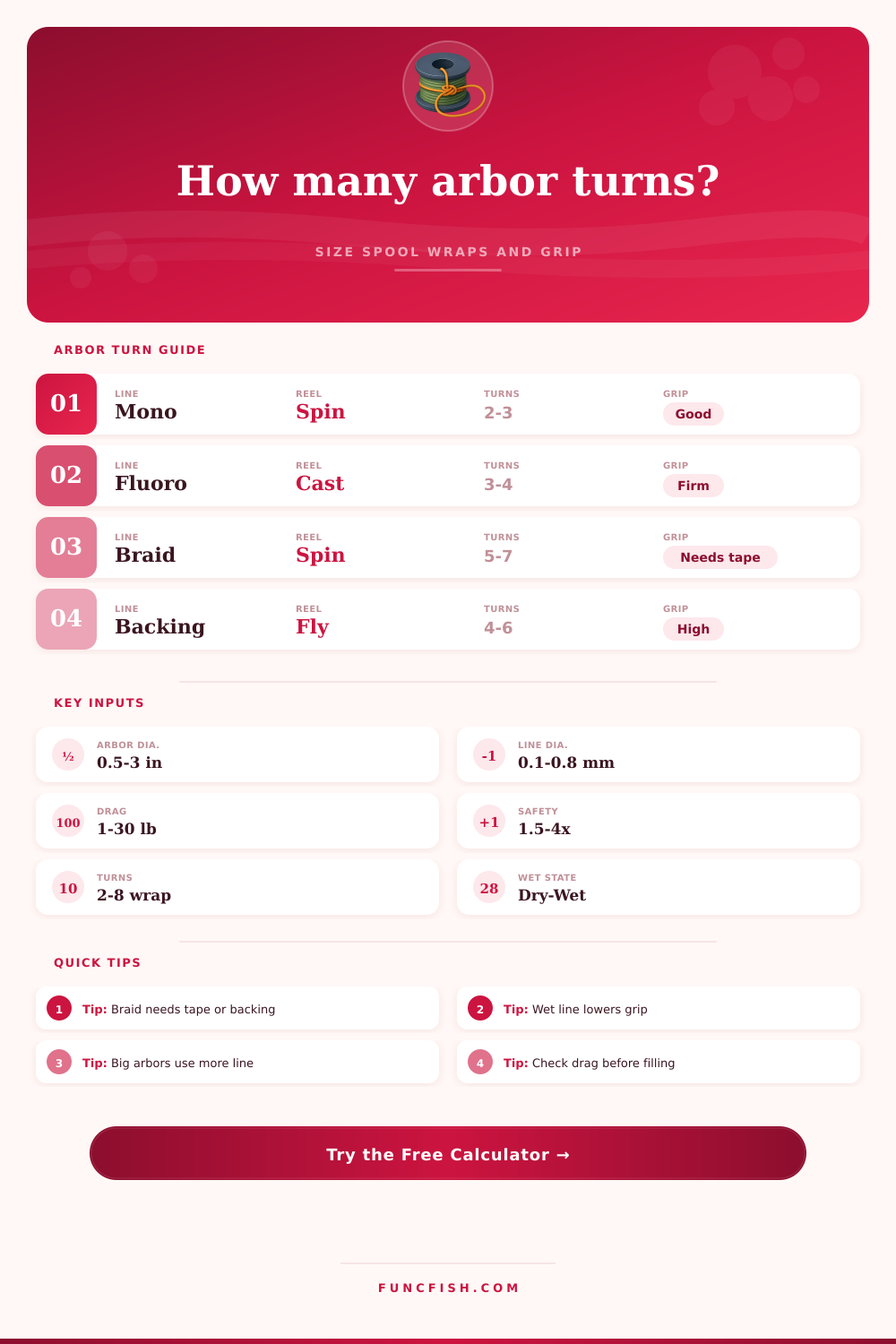
Tip: Slick braided line can spin around a bare metal spool even when the arbor knot is tight. If the calculator shows a low margin, add tape or a few yards of mono backing.
Tip: Large arbors consume surprising line per turn. Check the starter line used before filling small-capacity reels with expensive braid or thin backing.
The arbor knots is the connection between the fishing line and an spinning reel. The arbor knot has to be secure so that the fishing line does not slip on the arbor when the drag tension pull on the line. If the arbor knot slip on the reel arbor, then the line wont move when the drag pulls on the line.
You must find the correct number of wrap in the arbor knot. The number of wraps that is necessary for the arbor knot to secure to the arbor depends upon the material of the fishing line, the surface of the arbor, and a amount of drag that the fishing line will experience when being use to fish. The material of the fishing line will impact the amount of friction that the line has against the arbor.
How Many Wraps for an Arbor Knot
If the fishing line is monofilament then it is a compressible material and will compress against the arbor. Therefore, monofilament lines only require two or three wraps to securing to the arbor. If the fishing line is fluorocarbon then it is a harder material than monofilament line.
Therefore, fluorocarbon lines require more wraps than monofilament lines because of the lack of compliance of the fluorocarbon line. Lastly, braided fishing line is a round and slickly material. If it is eight carrier braided line it is even more slicker.
Braid lines may slip on an arbor that is made of bare metals. You can counteract this by using tape on the arbor or by using a rubber band on the arbor to ensure that the line dont slip. Another factor that will influence the number of wraps that is necessary in the arbor knot is the amount of drag that is placed on the line.
A light spinning reel that has two or three pounds of drag will require fewer wraps than a heavy offshore fishing reel that has ten or fifteen pounds of drag. You must allow for a safety margin in the number of wraps of the arbor knot. The first run of a fish may happen when the arbor knot slip.
The arbor knot is more likely to slip when the fishing line is wet because wet line has less grip on the arbor than dry line. Line conditioners will make the fishing line even more slippery so these will decrease the grip of the fishing line on the arbor. The diameter of the arbor will influence the amount of line that will be use in the number of wraps.
If the arbor is larger in diameter then each wrap will use more line. On a large fly fishing reel it will take several feet of line to complete four wraps of line to six wraps. A small spinning fishing spool will use much less line for the same number of wraps.
However, the small spinning fishing spool has a smaller margin for error. The width of the arbor will also impact the number of wraps of line. If the line wraps are too thick on the arbor then the first layer of line will form a hump on the arbor.
The later wraps will not lie flat on the arbor against the first layer of line. The style of the arbor knot will also impact the number of wraps. Single arbor knots rely upon the tension of the tag end to secure the line.
Uni-to-arbor knots or double stopper knots will transfer the tension of the line to the standing fishing line. Because these knots will transfer the tension of the line more efficient the number of wraps will be less for these knots than for a single arbor knot. Many anglers will make mistakes with the number of wraps for the arbor knot.
For example, someone that always use three wraps for their arbor knot may experience problems with braided line slipping on a bare arbor. Conversely, someone that always tape the arbor may waste the capacity of the spool when using monofilament line. You have to determine whether the material of the fishing line, the arbor surface, and the drag on the line create enough holding power for the arbor knot.
Your goal with the arbor knot should be to create a connection between the line and the arbor that can hold the drag pressure that is placed upon the line, use the least amount of line possible, and leave the arbor flat with no hump or thick first wrap of lines.