
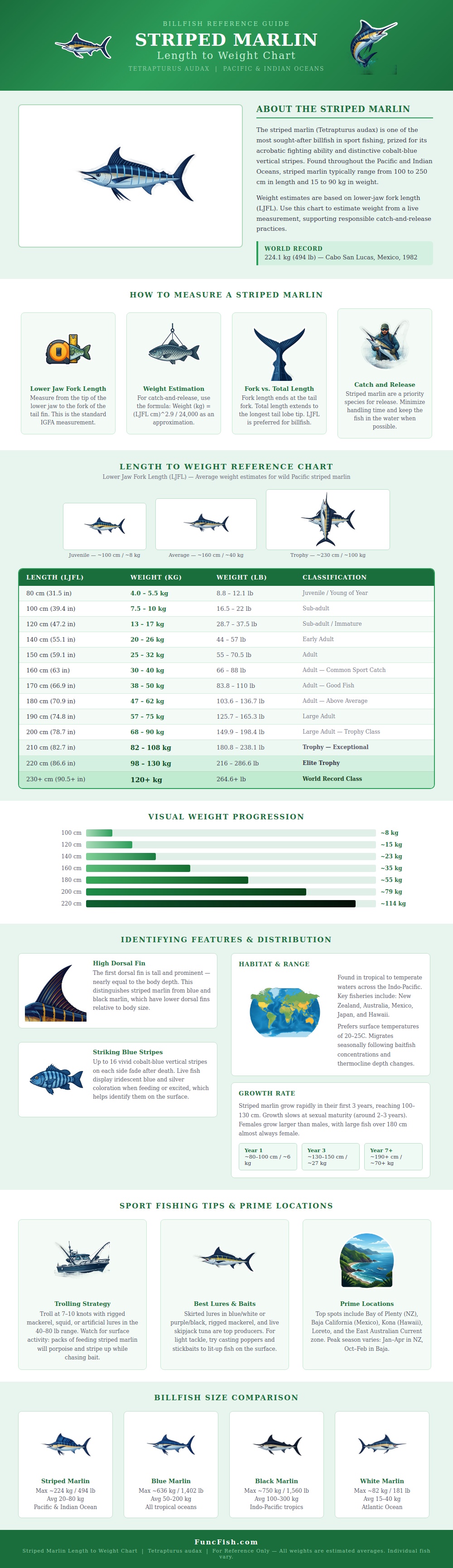
When fishing for striped marlin, there is nothing like feeling the line go tight, followed by quick hook set and often violent leap, spraying the deck with water. Immediately, you are attempting to guess size of fish. How high is its dorsal fin? What must it weigh? This is a mental math equation most people cannot get right; a fish that looks twice as long might weigh four times more. Once past sub-adult stage, the gains increase very quick.
“Once you know that it’s an exponential growth curve, then you understand what fight will be like. When it’s a smaller one, like a hundred centimeter fish (around 8 kg), you’re fighting about eight kilogram of strength. That’s doable on lightweight tackle so you can go at them a little harder. When they gets up into the adult size in the 160 centimeter range, all of a sudden you’ve got something closer to thirty-five kilograms. It is not just because it weighs more, but also because of its ability to use raw power over time, endurance. So you want to use heavier line and bigger drag setting. If you’re fishing light tackle, knowing that boundary helps you decide whether to cut the line or keep fighting.
How to Catch Striped Marlin
How you take your measurements is far more important then most people think. To maintain consistency, International Game Fish Association uses the fork length of the lower jaw. Doing so eliminates any variables such as damaged tail. Simply measure from bottom of the lower jaw (not including the bill) to where the tail forks. It’s precise and it’s repeatable. A lot of guys make mistake when measuring by adding the bill or rounding up to the maximum length of their longest tail lobe. Those few inches will lead to huge discrepancies when trying to estimate weights. A difference of just ten centimeters at big end of scale can mean a 20 kilo difference. Take proper measurements for accuracy.
Before you go ahead and try to measure that fish make sure you ID it. First off striped marlin have distinctive vertical blue stripes and also a very tall 1st dorsal fin which makes them unique amongst the billfish family. If the stripes are faded out, they’re dead. This is why identifying while alive is so important in order to keep good records for conservation purposes. To help identify if your fish is striped you want it to be alive and to see those shiny markings. Blue and black marlin swim in the same ocean, but their fin height and number of stripes shows that they are not those fish. Wrongfully assuming that a striped marlin is something else can cause damage to gear and improper handling. Avoid stress and save time knowing what you’re up against before it come to the surface.
The odds of running into them depend based off habitat. These fish generally inhabit water between 20 and 25 degrees Celsius on the surface and migrate following bait schools. The Bay of Plenty in New Zealand and Baja California have prime areas, but other times of year can also be good depending on how far north or south the fish travel. Lure rigs includes squid or mackerel lures. Trolling them at speeds from seven to ten knots works well because it mimics way prey moves naturaly. Surface activity gives away where the fish are eating. If you see fish chasing and then coming up and porpoising when they hit the bait, that’s your cue.
These is trophy fish and should of be caught and released. Leaving them in the water and reducing their out of water time dramatically increases their chance of survival. Most fish caught by sports anglers are far smaller than the world record, which exceeds two hundred kilograms. Handling with respect will allow big females to stay in the population and produce another generation. It’s good for the long term health of the stock.
A bigger fish is always more exciting then a 30-kilo adult, but it doesn’t matter how big they are; catching them gives you the same rush. It’s all about knowing your stuff and respecting their strength. By learning their size to weight ratio, you’ll be able to properly prepare and fight smarter. Next time that big dorsal fin pops out of the water, you’ll have an idea of what type of fight you’re in for.