
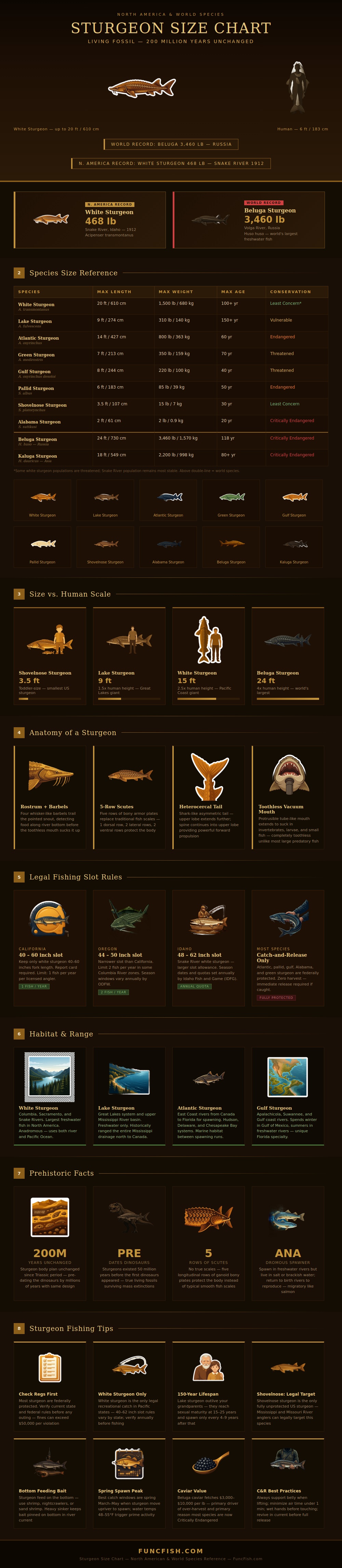
When you set the hook into a sturgeon you know it is a fish of substance, solid and heavy in the water. They has been around longer then the dinosaurs as they pre-date them. They haven’t evolved much either, their body shape is from back in the Triassic period and they are a living fossil.
Below is a chart depicting what they are relative to a person. It will give you an idea of how big these fish realy get. How you fish sturgeon depends on size. In Russia, the Beluga sturgeon gets to be twenty-four feet long and weighs three thousand pounds. That’s four times as tall as most people. On the Pacific Coast, the White sturgeon gets up to fifteen feet or longer. Know those sizes because how you handle them and what equipment you use will depend on their size. The Lake sturgeon that get up to nine feet seem slow but they are still stronger and larger then most people.
How to Fish for Sturgeon
The hard part is catching them, because they’re built to be tough. They have no normal scales on their body. Instead there is a layer of five rows of bony, armored-looking plates from the tip of their pointy snout all the way to their sharklike tail. The mouth is a toothless tube used for sucking up whatever it can off the bottom. So it doesn’t run around chasing bait out in the open. Finally those feeler things called barbels are very sensitive. They allow them to locate food in the dark muddy bottoms where they live as bottom feeders.
So you’ll need to adjust your approach with heavy sinkers to hold some sort of bait like nightcrawlers or shrimp down near the bottom and right into the teeth off the current. It gets more complicated because there are different conservation rules based off species. In fact while certain river White sturgeon populations is healthy, others are endangered. Sturgeons in the Atlantic and Gulf waters is protected under federal law and catch-and-release may be all that is allowed. To avoid getting fined (which can be over $50,000) always be sure to review latest regulation before heading out fishing. The chart breaks down the differences between vulnerable species and those of no concern.
For another unique experience there’s the Shovelnose sturgeon. It never grows more than three-and-a-half feet long which makes it the smallest of all the US sturgeon. Luckily for many angler, they are not federally protected throughout the US. That being said, you should of still be careful handling them.
The best season to fish for these guys is spring from March through May during which the water temps will be 48-55 degrees F. When the temps hits those ranges, sturgeon move nearer to shore on their way up for their breeding run. After catch, proper care will help the fish live to be released. Avoid exposing the fish to air longer than a minute and support the belly when removing from the water. Wet your hands first (the slime is there to protect the fish from parasites and infections). Allow the fish to swim free with the current on its own power.
It’s not much work but will allow these ancient creatures to continue forward for our childrens time. That is just as important than the sport we use to connect with history.