Surf Leader Shock Ratio Calculator
Estimate surf shock leader strength, shock ratio, safe casting load, knot-limited holding power, and leader length from sinker weight, bait payload, cast style, line class, spool wraps, and beach conditions.
📌Surf shock leader presets
⚙Leader and casting settings
Use the actual lead, including grip lead size when the wires dig into current.
Add clipped bait, lure, bait clip, wire trace, or heavy rig hardware.
Use a lower number for bulky knots, rushed knots, or stiff leader-to-braid joins.
Surf leader shock forecast
Full calculation breakdown
🧵Shock leader material grid
Shock Mono
Tapered Leader
Hard Mono
Fluorocarbon
Copolymer
Braid Leader
Wire Bite
Heavy Topshot
📊Sinker and leader sizing table
| Total casting payload | Baseline 10 lb/oz rule | Power cast leader | Common main line match | Notes |
|---|---|---|---|---|
| 2 oz / 57 g | 20 lb / 9 kg | 25-30 lb / 11-14 kg | 8-12 lb mono or 10-15 lb braid | Light surf, lure and small bait work |
| 3 oz / 85 g | 30 lb / 14 kg | 35-40 lb / 16-18 kg | 12-15 lb mono or 15-20 lb braid | Pompano, surf perch, school fish |
| 4 oz / 113 g | 40 lb / 18 kg | 45-55 lb / 20-25 kg | 15-20 lb mono or 20-30 lb braid | Standard beach bait rigs |
| 5 oz / 142 g | 50 lb / 23 kg | 60-70 lb / 27-32 kg | 18-25 lb mono or 30-40 lb braid | Grip leads, bars, heavier bait |
| 6 oz / 170 g | 60 lb / 27 kg | 70-80 lb / 32-36 kg | 20-30 lb mono or 40-50 lb braid | Long rods, rough surf, hard casts |
| 8 oz / 227 g | 80 lb / 36 kg | 90-100 lb / 41-45 kg | 30-40 lb mono or 50-65 lb braid | Large baits and strong sweep loads |
🎯Cast style multiplier table
| Cast style | Multiplier | Drop length tendency | Leader wrap target | Shock leader comment |
|---|---|---|---|---|
| Kayak drop or lob | 0.55-0.85x | Short, controlled | 2-4 wraps | Fight and abrasion matter more than launch shock |
| Overhead surf cast | 1.00x | 3-5 ft / 0.9-1.5 m | 4-6 wraps | Good baseline for most bait fishing |
| Off-the-ground | 1.12x | 4-6 ft / 1.2-1.8 m | 5-7 wraps | Higher compression during rod load |
| Brighton or side swing | 1.18x | 4-7 ft / 1.2-2.1 m | 5-8 wraps | Side load and timing increase peak force |
| Pendulum power cast | 1.32x | 5-8 ft / 1.5-2.4 m | 6-9 wraps | Needs the strongest casting margin |
| Field power cast | 1.38x | Matched to rules | 6-9 wraps | Use clipped payload and proven knots only |
🐟Surf species and gear comparison grid
| Target class | Typical payload | Main line class | Shock leader range | Ratio target |
|---|---|---|---|---|
| Pompano, whiting, surf perch | 2-4 oz / 57-113 g | 10-20 lb braid or 8-15 lb mono | 25-45 lb / 11-20 kg | 2.0-3.5x |
| School stripers, sea trout | 3-5 oz / 85-142 g | 15-30 lb braid or 12-20 lb mono | 40-60 lb / 18-27 kg | 2.0-3.3x |
| Bluefish, mackerel, tailor | 2-5 oz / 57-142 g | 20-40 lb braid or 15-25 lb mono | 40-70 lb plus bite trace | 1.8-3.0x |
| Red drum, black drum, rays | 4-8 oz / 113-227 g | 25-50 lb braid or 20-30 lb mono | 60-100 lb / 27-45 kg | 2.0-3.5x |
| Shore salmon, steelhead | 3-6 oz / 85-170 g | 15-30 lb mono or braid | 40-70 lb / 18-32 kg | 2.0-3.8x |
| Cod, bass, pollock rough ground | 5-8 oz / 142-227 g | 25-40 lb mono or 40-65 lb braid | 70-100 lb / 32-45 kg | 2.0-3.2x |
| Small shark or large ray bait rigs | 6-10 oz / 170-283 g | 40-80 lb braid or heavy mono | 80-150 lb topshot plus bite leader | 1.8-3.0x |
🔗Knot and leader matching table
| Connection | Typical efficiency | Guide travel | Best match | Calculation note |
|---|---|---|---|---|
| FG knot, braid to shock mono | 80-95% | Excellent when trimmed | Thin braid to 40-80 lb mono | Use realistic efficiency if tied in wind |
| Albright or Alberto | 70-85% | Good with moderate leaders | Braid to mono or fluoro | Bulk rises quickly above 80 lb leader |
| Double uni | 65-80% | Fair to bulky | Mono to mono, light braid joins | Reduce checked leader rating for hard casts |
| Shockleader knot | 75-90% | Good with mono main line | Mono main to heavy mono leader | Seat slowly and test before casting |
| Tapered leader blood knot | 75-88% | Very good | Distance rigs and clean beaches | Small front diameter lowers guide slap |
| Swivel stop connection | 90-100% | Does not pass guides | Short leaders and kayak drops | Not suitable for normal surf casting drop |
💡Calculation tips
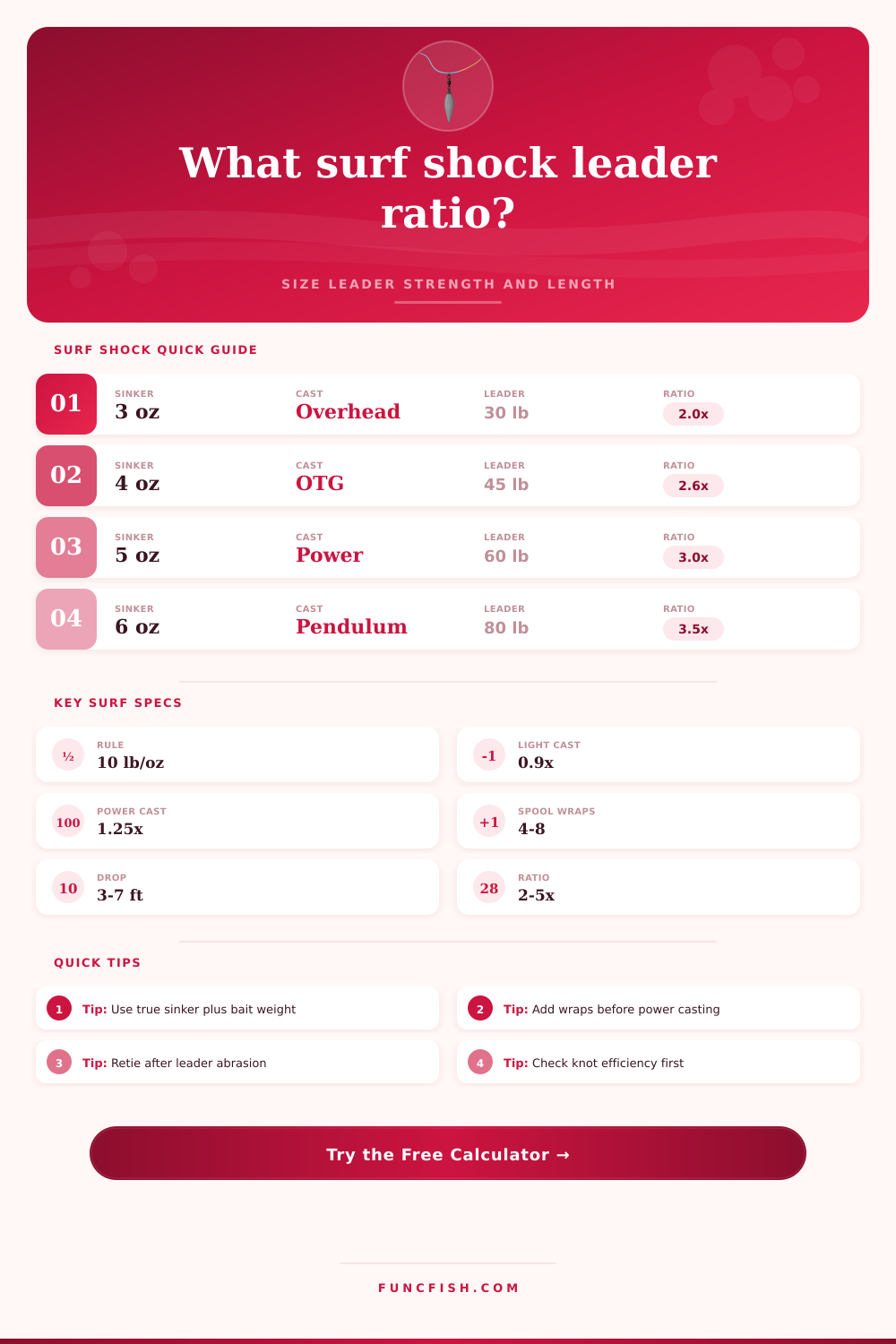
Count the whole payload. Shock leader sizing should use sinker plus bait, clipped rig hardware, wire bite trace, and any grip lead drag because the rod loads all of it during the cast.
Check both strength and length. A strong leader that starts outside the spool still leaves the main line taking the launch load; keep several wraps on the spool before any power cast.
On a long surf cast you feel shock as heavy sinker comes loose from your reel. It will most often occur as your rod is fully bent and about to launch the payload toward outer bar. Your main line feels moving weight force skyrocket far above still weight of lead in an instant. That’s where shock leaders come into play as a buffer protecting your more precious braided main line from harsh laws of physics when lobbing heavy stuff out there into big blue ocean.
When we size our leaders, most of us guess their size based off what we are trying to catch. For surf fishing that’s backwards. You have to size it for the cast first. Once you enter in the details of your bait payload, sinker weight and casting style into the calculator above, it do the math for you. So no more guessing if you can get away with a five-ounce pyramid on your forty-pound mono. No more wondering if something are going to break. It takes into account moving load which is ignored by static weight charts.
Why You Should Size Leaders for the Cast, Not the Fish
A pendulum power cast with a rod acting as a catapult multiplier is very different then a simple overhead lob. Use about 10-pound test for every ounce of weight. That’s the rough rule of thumb in calm conditions with moderate casts. But heavy bait rigs, wind, and current changes things. You want some margin if you’re battling a hard side sweep or have a grip lead digging into sand. The tool starts at this baseline and then multiplies it out depending on how you fish. A high overhead swing creates a different rod compression than an off-the-ground cast. The first one demand heavier leaders because there is greater load near the peak of the cast. It sounds like a little thing, but when you’re trying to get fifty yards of distance, it matters.
The silent killer on surf setups are knot efficiency. Not all knots hold one-hundred-percent line strength. Stiff leader materials and bulky connections will drasticly decrease their ability to hold. So if your FG knot only holds eighty percent of rated strength then that forty-pound leader you have on now becomes like having a thirty-two pound leader when it’s under load. This decay is accounted for in the final recommendation so you know you have some actualy safety margin and not just theoretical strength. Always weigh your knots on a scale if you can, but adjusting your expectations for how they’ll perform in real-world conditions isn’t a bad habit either.
They also frequently make mistakes when it comes to leader length. Just because you have a stout leader starting from beyond the spool doesn’t mean the load from your launch will be taken by the main line. To keep the transition point hidden, wrap the shock material around the spool several times before any power cast. This tool accounts for spool circumference, drop distance, and rod length. It provides a reliable number so you don’t have to much bulk in your guides or run out mid-cast.
But what about performance of that leader when it’s being stressed? How does it fare? Shock mono has good stretch that allows it to absorb the jolt of the launch. So this type of line are more forgiving if you’re using heavy sinkers and will hold up well under pressure. Fluorocarbon is stiffer and not as giving. It’ll stand up to abrasions better, but can be tougher on knots when you’re slinging for distance. For distance casts, tapered leaders minimize drag and help make tighter, neater knots. The beach conditions determines the right material. If you have clean sand, perhaps you can get by with lighter gear. Rocky breakwaters call for heavier lines with greater resistance to abrasion.
In the end, however, it’s all about the cast, not the catch; with surf fishing equipment. Oversizing your leader eliminate those heartbreaks when they’re busting in the breaker and fish are going crazy. It lets you bend that rod further then you dared before. There is no need to pull up short now because you know it won’t snap back. When you get your head around the relationship between knot strength, style and payload, putting together a solid rig isn’t so much a guessing game as simply learning mechanics. You can cast confidently, knowing you launched them into arms of a system capable of carrying the load. And then you could of dropped that chunk of lead onto the water and worry about nothing but what’s at the business end of that line.