Tapered Shock Leader Step Calculator
Plan a stepped tapered shock leader for surf casting by matching casting load, main-line diameter, knot style, material stretch, and safe leader length.
📌Scenario presets
⚙Leader settings
Tapered shock leader plan
Formula breakdown
🧵Material comparison grid
Nylon Mono
Hard Mono
Copolymer
Fluorocarbon
📊Calculated step layout
| Step | Strength | Diameter | Length share | Rig role |
|---|---|---|---|---|
| 1 | 15 lb | 0.22 mm | 3.2 ft | Main-line bridge |
| 2 | 30 lb | 0.39 mm | 4.1 ft | Taper middle |
| 3 | 40 lb | 0.46 mm | 4.7 ft | Butt shock |
📋Shock leader reference tables
| Casting load | Base rule | Controlled cast | Power cast |
|---|---|---|---|
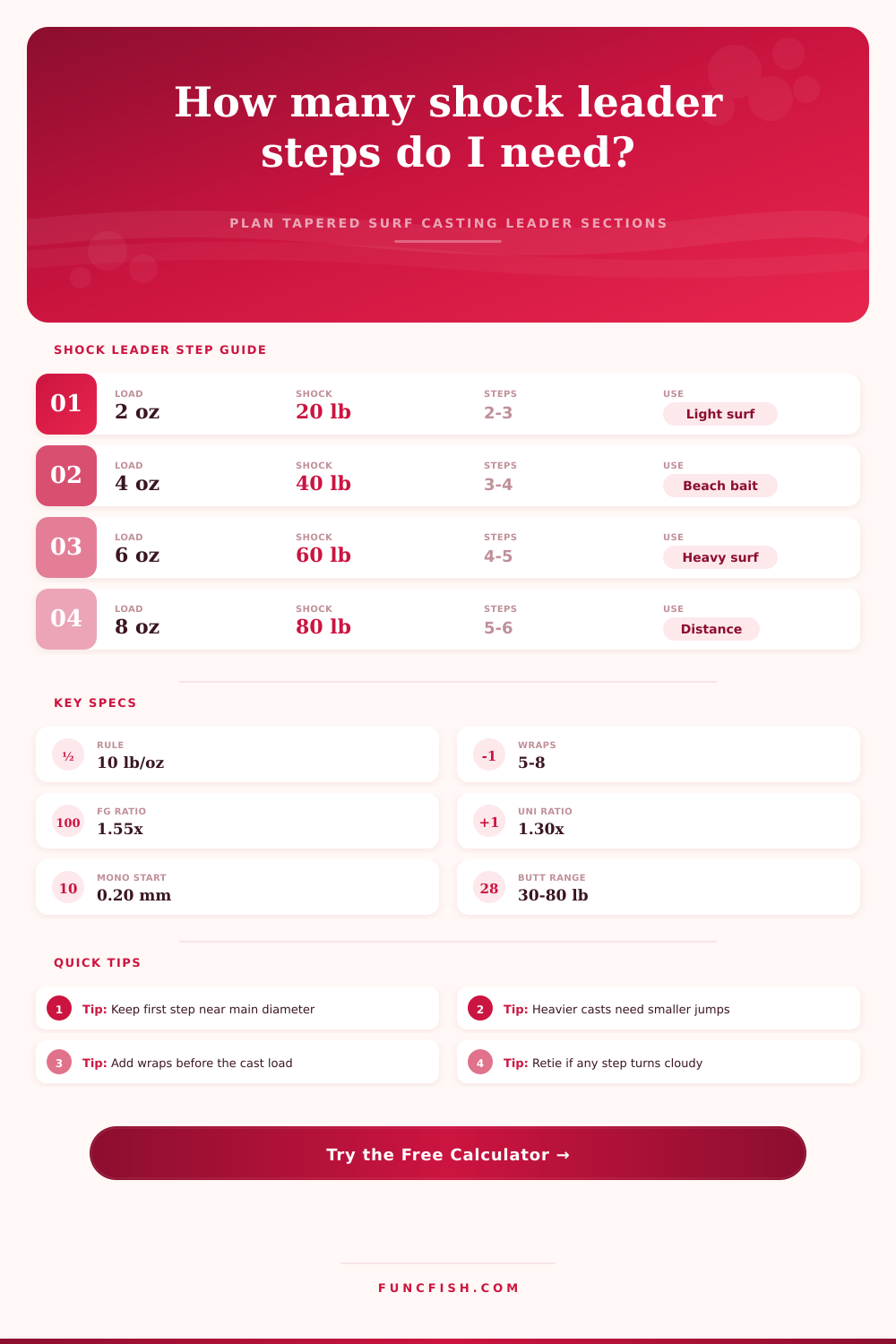
| 2 oz / 57 g | 20 lb / 9.1 kg | 22 lb / 10.0 kg | 26 lb / 11.8 kg |
| 4 oz / 113 g | 40 lb / 18.1 kg | 44 lb / 20.0 kg | 52 lb / 23.6 kg |
| 6 oz / 170 g | 60 lb / 27.2 kg | 66 lb / 29.9 kg | 78 lb / 35.4 kg |
| 8 oz / 227 g | 80 lb / 36.3 kg | 88 lb / 39.9 kg | 104 lb / 47.2 kg |
| Knot style | Max diameter jump | Approx efficiency | Best leader use |
|---|---|---|---|
| FG knot | 1.55x | 85-95% | Braid to mono taper |
| PR bobbin | 1.65x | 90-98% | Long braid connection |
| Improved Albright | 1.45x | 75-85% | Fast beach tying |
| Double Uni | 1.30x | 70-80% | Similar diameters |
| Blood knot | 1.25x | 65-75% | Mono-to-mono steps |
| Slim Beauty | 1.40x | 75-85% | Heavy mono bridge |
| Main line | Starter step | Typical butt | Step count |
|---|---|---|---|
| 10 lb / 0.18 mm | 16-20 lb | 30-50 lb | 3-5 |
| 15 lb / 0.22 mm | 20-25 lb | 40-60 lb | 3-5 |
| 20 lb / 0.30 mm | 25-30 lb | 50-70 lb | 3-4 |
| 30 lb / 0.38 mm | 35-40 lb | 60-80 lb | 2-4 |
| Scenario | Leader length | Butt feel | Step priority |
|---|---|---|---|
| Light surf spinning | Rod + drop + 5 wraps | Soft | Slim knot first |
| Clean beach bait | Rod + drop + 6 wraps | Balanced | Even taper |
| Rough ground bait | Rod + drop + 7 wraps | Abrasion strong | Long butt section |
| Distance casting | Rod + drop + 8 wraps | Firm | Small jumps |
💡Calculation checks
Tip: The common surf rule is about 10 lb of shock leader for each ounce of casting load. Add the cast-power multiplier before rounding up the butt section.
Tip: If the first leader step is much thicker than the main line, use an extra bridge step or a slimmer knot so the connection clears the guides cleanly.
There’s a certain risk with surf angling. You’ve got the correct tide; you’ve got the proper bait. When the sinker touch bottom, the line breaks. Why? Because you didn’t cinch the knot enough for a powerful cast. It’s a make-or-break point. Either you land your fish or lose your bait.
Your answer isn’t to tie heaviest line possible, as that will shorten your cast. What do you do? Tie a shock leader (a.k.a. Tapered leader). And this takes some accuracy. Enter your preferred casting weight and rod length into the calculator on the page. It calculates number of steps and their diameters for you. No more guesswork.
How to Make a Shock Leader
And while it may seem complicated, the reasoning makes sense. Here’s what you’re looking for: a piece of line that will stand up to the beating of striking the water and the pull of a fighting fish. It must also be able to taper enough so it do not block your main line from passing through the rod and reel guides. Otherwise, there is a chance that the leader will get caught either on the rod or the reel.
And that’s where the number of steps comes into play. Most folks attempt to join light braid to beefy mono in one shot with little success. What this does is break it down into bite-sized pieces. In other words, it tells you how many middle diameter leader to use to span the distance without any issue.
The system do vary depending on what material you choose. For instance, nylon monofilament (the standard) are tied easily and holds well under stress. It stretches, and absorbs some of the shock of a fish taking off with a run. Fluorocarbon has less give and is stiffer. That can sends shock straight to the weak links in your system. Your selection of material means selecting your system’s level of forgiveness. Hard mono or fluoro has greater abrasion resistance different than stretch if you’re fishing around rock. For long distance casting and clean sand, however, nylon transfers energy better to the sinker from the rod tip.
One thing that can spoil your build is what kind of knots you use. For instance a double uni knot ties easily, but cannot join lines of very different sizes. In other words if you use this knot trying to join a thin main line to a thicker butt section, you get a bulbous knot. It won’t fit thru the narrow tips of a sensitive surf rod. From the table above, we see how we could of used an FG knot which lets us have a much bigger diameter difference and yet remain slim. That’s important when making distance casts when every millimeter of bulk matters. You don’t want the connection to affect the aerodynamics of the cast.
The other thing you hear people struggle with is leader length. It’s very easy to make the leader too short. As you cast, your leader should coil up behind the sinker and come off the rod. So if your leader isn’t longer than your rod, it will tangle before your sinker comes through the guides. A general rule of thumb is take length of your rod and then add a little more for the rest of the drop shot rig. Then add some more for your reel. That way when something hits, you have the shock absorbing part on the business end.
Your requirements change depending off the casting load itself. A thicker butt section will hold up better as it slows down to a stop. The basic rule of thumb is about ten pounds of test strength per ounce of casting weight. That’s not a strict rule; it is just a place to start. Casting from the ground will require more, since the line is already under tension. A more gentle cast with an overhead swing will allow less. Your power style changes these numbers and that is what the calculator takes into account. It is not a theoretical max but something more like a realistic target.
That’s really what building a shock leader is all about; it’s about controlling energy. It absorbs the bad energy of fish runs and rock strikes while maintaining the good energy of sending your bait down the beach. The step-by-step taper allows for a gradual transition. It protects your mainline without losing distance. Tighten the knot and clean up the tag ends when tying the last one. Is there a smooth transition from thick to thin? That’s what you’re after.
A perfect cast feel with the sinker flying straight and true. You just know the system is dialed in and ready for whatever comes next.