Team Tournament Weight Calculator
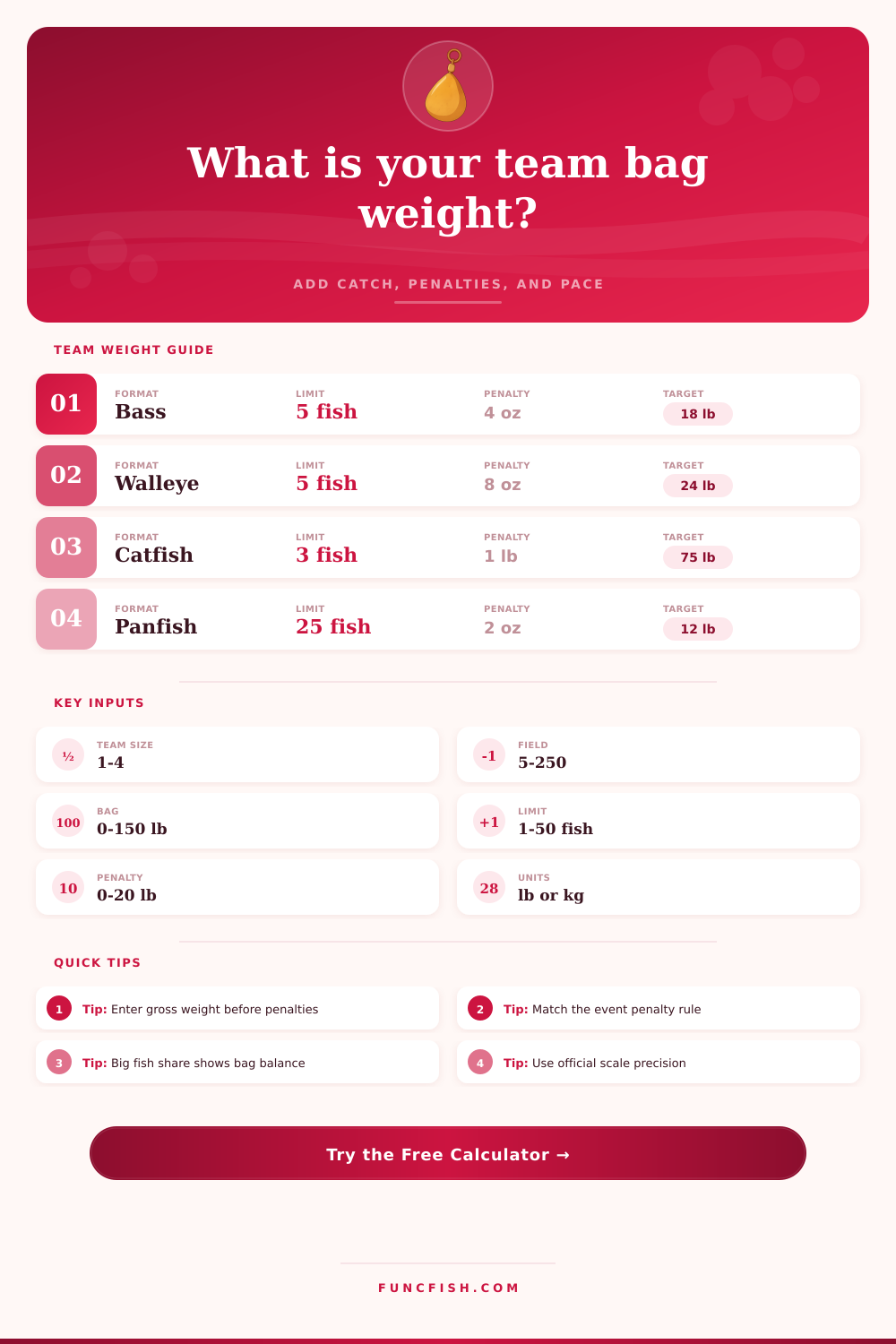
Convert a team catch into official net bag weight after dead-fish, short-fish, late, and scale precision adjustments, then compare it with limit pace and field targets.
📌Team weigh-in presets
⚙Team weight inputs
Official team bag summary
Full breakdown
📊Species and format benchmarks
Black Bass
Walleye
Catfish
Panfish
📋Reference tables
| Rule set | Dead fish penalty | Short fish penalty | Late penalty | Best fit |
|---|---|---|---|---|
| Club bass | 4 oz / 0.25 lb | 1 lb each | 1 lb per min | Local team trails |
| Strict bass | 8 oz / 0.50 lb | 2 lb each | 1 lb per min | Championships |
| School team | 4 oz / 0.25 lb | 1 lb each | 0.5 lb per min | Youth events |
| Walleye | 8 oz / 0.50 lb | 2 lb each | 1 lb per min | Live-release weigh-ins |
| Catfish | 1 lb each | 5 lb each | 2 lb per min | Heavy-bag events |
| Panfish | 2 oz / 0.13 lb | 0.25 lb each | 0.25 lb per min | High-count derbies |
| Format | Typical team limit | Strong bag | Winning pace | Balance check |
|---|---|---|---|---|
| Bass team | 5 fish | 15-18 lb | 19-24 lb | Big fish under 35% |
| Walleye team | 5 fish | 20-25 lb | 26-34 lb | Average over 5 lb |
| Catfish team | 3 fish | 45-70 lb | 75-110 lb | Anchor fish matters |
| Panfish derby | 25 fish | 10-13 lb | 14-18 lb | Limit efficiency |
| Surf team | 4 fish | 28-40 lb | 42-60 lb | Species spread |
| Pike slot team | 3 fish | 18-25 lb | 26-35 lb | Legal slot count |
| Scale precision | Increment | Equivalent | Use case | Rounding effect |
|---|---|---|---|---|
| Hundredth pound | 0.01 lb | 4.54 g | Common digital scale | Smallest swing |
| Nearest ounce | 0.0625 lb | 28.35 g | Manual weigh sheets | Visible ounce swing |
| Half ounce | 0.03125 lb | 14.17 g | Precise club events | Fine ounce swing |
| Tenth pound | 0.10 lb | 45.36 g | Older scales | Large tie swing |
| Nearest gram | 0.0022 lb | 1 g | Metric weigh-ins | Very fine swing |
💡Weigh-in checks
Tip: Enter gross bag weight before any penalty. The calculator subtracts dead fish, short fish, late check-in, and courtesy-cull credits from the selected rule set.
Tip: Big fish share helps show whether the team has a balanced limit or one anchor fish carrying the bag. A high share can affect tie-break expectations.
Team tournament weight are the number that determine if a team win money or does not win money in a tournament. Team tournament weight isnt the total team weight measured on a scale… Team tournament weight has to be calculate after penalties are applied.
Field size and penalties must be considered when calculating team tournament weight. The final team tournament weight will determine the money a team wins and if they won or lost a tournament. To properly calculate team tournament weight, you must understand the effect of specific penalties.
How to Calculate Team Tournament Weight
While most anglers knows the number of fish that are allow to be caught and weighed by a team, many anglers dont understand how penalties for dead fish or short fish can affect the final weight of the team. The calculator can be used to enter the specific rule for a tournament to determine how the penalties can impact the total weight of the winning team. The calculator will remove guesswork in determining if a late penalty will cost more than a dead fish penalty.
Another consideration of team tournament weight is the big fish share. If one angler on a team have more than 40% of the total weight of the team, that weight may appear to be high. However, if that one fish is the only one that meets the kicker for the tournament, the weight is fragile.
The calculator will compare the weight of the big fish with the total net weight of the team to show this ratios. If anglers do not consider this ratio, they may discover too late that there strategy to win the tournament was dependent on one fish. Field size can impact the weight that is require to win a tournament.
If there are forty-two boats in a tournament, the weight that is required to win is less than the weight that is required if there are ninety-six boats in the tournament. The size of the field can be seen in the projected pace for a team. The calculator can be used to determine if a teams current weight is a cashing weight before they leave the tournament water.
The weight of the fish also changes with the specific species of fish that are being weigh, and when the fish are caught during the fishing season. If a team catches pre-spawn fish, they will have more weight than if they catch fish that have dropped their eggs. Additionally, walleye will weigh more than bass caught in the same body of water.
You must enter the specific season and species into the calculator to properly determine the weight of the catch. A seventeen pound catch in July can compare to a seventeen pound catch in March, but only if the species and season are the same. Therefore, comparing the weight of the fish between two different month is a mistake in calculating team tournament weight.
The reference tables on the page will assist anglers with entering the correct rule set and scale precision for their tournament fish weigh-in. The reference tables show the different dead fish penalties for each tournament format. Additionally, the reference tables will show anglors how the rounding of the weight can change the tournament weight of the teams.
For instance, rounding to the nearest ounce isnt as same as rounding to the nearest hundredth of an ounce. These reference tables will assist anglers in making their calculations quick and consistantly when determining their teams tournament weight. It is a habit of anglors to enter the gross weight into the calculator prior to entering the weight of the team after penalties are applied.
Anglers often apply the penalties for dead fish in their mind when entering the weight, but they should of entered the gross weight and the total weight of the team before penalties are applied. By entering the gross weight of the team, anglors can determine the impact that a different penalty rule could have on the final weight of the winning team. The only number that matters to anglors is the final team tournament weight after each penalty and rounding rule are applied.