Telescopic Rod Section Length Calculator
Estimate section count, exposed section length, tube cut length, and collapsed margin for telescopic fishing rods built around a target travel length.
📌Rod presets
⚙Section sizing inputs
Rod section forecast
Full formula breakdown
📋Blank material section data
E-glass travel blank
S-glass reinforced blank
Carbon glass composite
IM6 graphite telescopic
IM8 high modulus carbon
Carbon with solid tip
Saltwater heavy wall carbon
Fixed-line nested carbon
📏Reference tables
| Rod category | Open length | Common closed length | Typical sections | Section note |
|---|---|---|---|---|
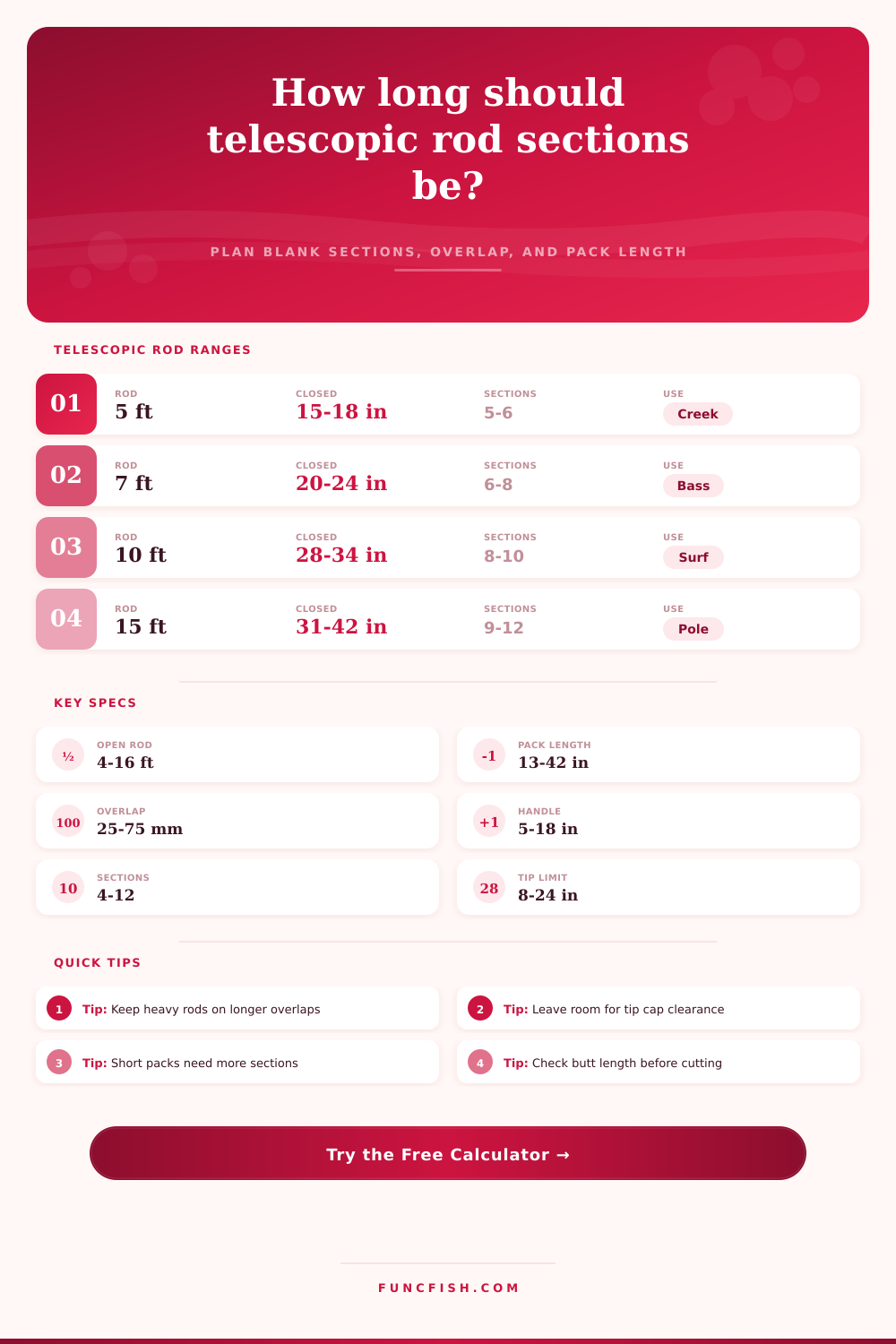
| Pocket creek telescopic | 4 ft 6 in to 5 ft 6 in | 13 to 18 in / 33 to 46 cm | 5 to 6 | Short handle and compact tip |
| Urban spinning travel rod | 6 ft to 6 ft 9 in | 17 to 22 in / 43 to 56 cm | 6 to 7 | Good balance for light lures |
| Bass telescopic spinning | 6 ft 8 in to 7 ft 4 in | 20 to 25 in / 51 to 64 cm | 6 to 8 | Longer butt improves control |
| Kayak inshore telescopic | 6 ft 6 in to 7 ft 6 in | 22 to 28 in / 56 to 71 cm | 6 to 8 | Fewer sections feel steadier |
| Surf telescopic rod | 9 ft to 12 ft | 28 to 36 in / 71 to 91 cm | 8 to 10 | Needs longer overlap under load |
| Fixed-line long rod | 10 ft to 16 ft | 24 to 42 in / 61 to 107 cm | 9 to 12 | Many slim nested sections |
| Power class | Minimum overlap | Tip section range | Closed length effect | Design note |
|---|---|---|---|---|
| Ultralight fast | 25 to 35 mm | 7 to 12 in / 18 to 30 cm | Very packable | Protect the fine tip |
| Light moderate-fast | 30 to 40 mm | 9 to 14 in / 23 to 36 cm | Compact | Common for stream rods |
| Medium-light fast | 35 to 45 mm | 10 to 16 in / 25 to 41 cm | Balanced | Good all-round travel taper |
| Medium fast | 40 to 55 mm | 12 to 18 in / 30 to 46 cm | Moderate | Keep joint stack consistent |
| Medium-heavy fast | 50 to 65 mm | 14 to 20 in / 36 to 51 cm | Longer pack | Use fewer, stronger joints |
| Heavy moderate | 60 to 80 mm | 16 to 24 in / 41 to 61 cm | Longest pack | Salt and surf loads need room |
| Closed carry target | Best open length band | Usual section count | Average exposed section | Fit warning |
|---|---|---|---|---|
| 13 to 16 in / 33 to 41 cm | 4 ft to 5 ft 6 in | 5 to 7 | 8 to 12 in / 20 to 30 cm | Handle allowance dominates |
| 17 to 22 in / 43 to 56 cm | 5 ft 6 in to 7 ft | 6 to 8 | 10 to 15 in / 25 to 38 cm | Check tip cap depth |
| 23 to 28 in / 58 to 71 cm | 7 ft to 8 ft 6 in | 6 to 8 | 12 to 18 in / 30 to 46 cm | Good kayak range |
| 29 to 34 in / 74 to 86 cm | 8 ft 6 in to 11 ft | 8 to 10 | 14 to 22 in / 36 to 56 cm | Use longer overlaps |
| 35 to 42 in / 89 to 107 cm | 10 ft to 16 ft | 9 to 12 | 18 to 30 in / 46 to 76 cm | Transport tube gets long |
| Design allowance | Common range | Metric range | Where it appears | Why it matters |
|---|---|---|---|---|
| Fixed grip and butt | 5 to 18 in | 13 to 46 cm | Behind first telescoping tube | Does not add to nesting span |
| Tip plug and cap | 0.4 to 1.2 in | 10 to 30 mm | End of collapsed blank | Protects the smallest section |
| Joint overlap | 1 to 3 in | 25 to 75 mm | At each sliding joint | Prevents loose extension |
| Nesting clearance | 0.1 to 0.4 in | 3 to 10 mm | Between tube walls | Allows collapse without binding |
| Tip section limit | 8 to 24 in | 20 to 61 cm | Smallest extendable section | Controls fragile top length |
🎣Rod and technique comparison grid
Trout stream
Short 5 ft rods favor 5 or 6 sections, light overlap, and a short grip that leaves more room inside the closed length.
Bass spinning
Seven foot travel rods usually feel best with 6 to 8 sections and a middle cut length near the closed tube span.
Kayak inshore
Compact storage matters, but fewer stronger sections help with boat-side pressure and repeated short casts.
Surf casting
Long surf telescopics need heavier overlap and more closed margin because the lower joints carry high casting load.
Jetty bait
Heavy bait rods should avoid very short sections. Use the calculator warning if middle cuts approach the nesting limit.
Fixed-line rods
Long pole-style rods use many slim sections, small overlaps, and a protected tip section to keep the pack length manageable.
Carp margin
Margin rods can accept a longer closed length to reduce joint count and preserve a smoother working curve.
Shore jigging
Use stronger material settings, longer overlap, and a slightly longer closed target for lures worked with sharp lifts.
💡Practical checks
Tip: If the collapsed margin is negative, increase the closed carry length first. Reducing overlap can make the rod feel loose and noisy under casting load.
Tip: For saltwater or heavy bait rods, keep the butt-side sections longer and stronger than the calculator average instead of making every tube identical.
If you’ve ever purchased a telescoping fishing rod and found yourself wishing that it would live up to its on-paper specs and stop feeling like a wad of sticks underwater, then you know the frustration I’m talking about. You get it nice and packed up, it fits into your bag…then you unfold it and the tip flops around, or the sections don’t separate because they was cut wrong for the amount of tube overlap. Most of the time, it’s not the material… It’s the design.
When designing or even understanding a travel rod, there is many variables to consider. You have to create a rod that fits inside itself while remaining strong enough for a long cast. How long do you make each section? What material do you use? How much force will be applied at each end? To give you an idea of how this all works in the real world, here’s what the inputs on the calculator (above) represent:
How to Design a Good Travel Fishing Rod
Most anglers fail to take the fixed handle length into account when calculating the amount of room they have left for the telescoping portions. When a rod has a seven-foot total length, the butt section isn’t collapsible and remain fully out of the stacked nest. So if you try to divide seven feet into a two-foot long tube, you’re going to end up with overlaps that won’t slide or sections that is too short to cast well. By subtracting the fixed grip length from the overall open length, the tool factors that in so the rest of the span can be spread among the sliding tubes.
Why does that matter? The more exposed length of a section, the greater the leverage it need to absorb during the cast. The amount of overlap that’s acceptable varies with material selection. A thin carbon fiber blank is sensitive and won’t stand up to short overlaps as well than the thicker glass blanks used for rods. Because of their weight and thickness, glass blanks will bow under load if they are not overlapped enough. The table on the page is a reference for that.
An IM8 graphite could get away with a thirty-five millimeter overlap, but your heavy salt water carbon will want sixty millimeters or more to keep the rod from collapsing at the joint under load. And that isn’t just about precision but safety. With too small of an overlap the section of the blank can slide back and forth on a stiff blank in a hard strike. Too much and now you’re out of blank length, so the rod has to remain partially collapsed.
Lastly, one other factor is frequently overlooked until it’s too late: how many sections? On paper, more sections = shorter pack length. Great. But each section add an extra joint, a possible failure point, and it also complicates the taper. You can make a five-section, five-foot trout rod feel buttery because the tube lengths allow entire rod to bend in a nice even curve. You can get away with a ten-section, ten-foot surf rod, but when you attempt to stuff a ten-foot rod with half the sections, those tubes starts getting wild.
The calculator gives you a suggested number of sections based off your desired closed length and your maximum tip section size. Typically this is somewhere around fifteen inches, so the tip doesn’t get too dainty to handle.
When you are dealing with heavy casts or saltwater, you need extra margin. Margin output tells you how much wiggle room there is within the case once it collapses. If the margin output is negative you can’t make this design without cutting something down to where it’s physically not possible. A healthy margin allows for protective plugs, tip caps, and regular wear and tear as these parts slide against each other. Better to go long on the pack length a bit than have a rod that will bind if it gets a little wet from salt or sand.
You should of known that. At the end of the day, a nice telescopic rod comes down to a balance between fishing ability and pack-ability. There’s no way to get something light enough to fit in your pocket and as flexible as you want it to be. So look for that sweet spot where you balance the overlap so it’s long enough to keep everything together and casting accuracy stay good, while still making sure it fits in your bag.
Start by deciding how long of a handle you need. Then decide what your max tip section length should be and let the rest of the math work itself out. And that’s what creates a fishable, travel-friendly rod.