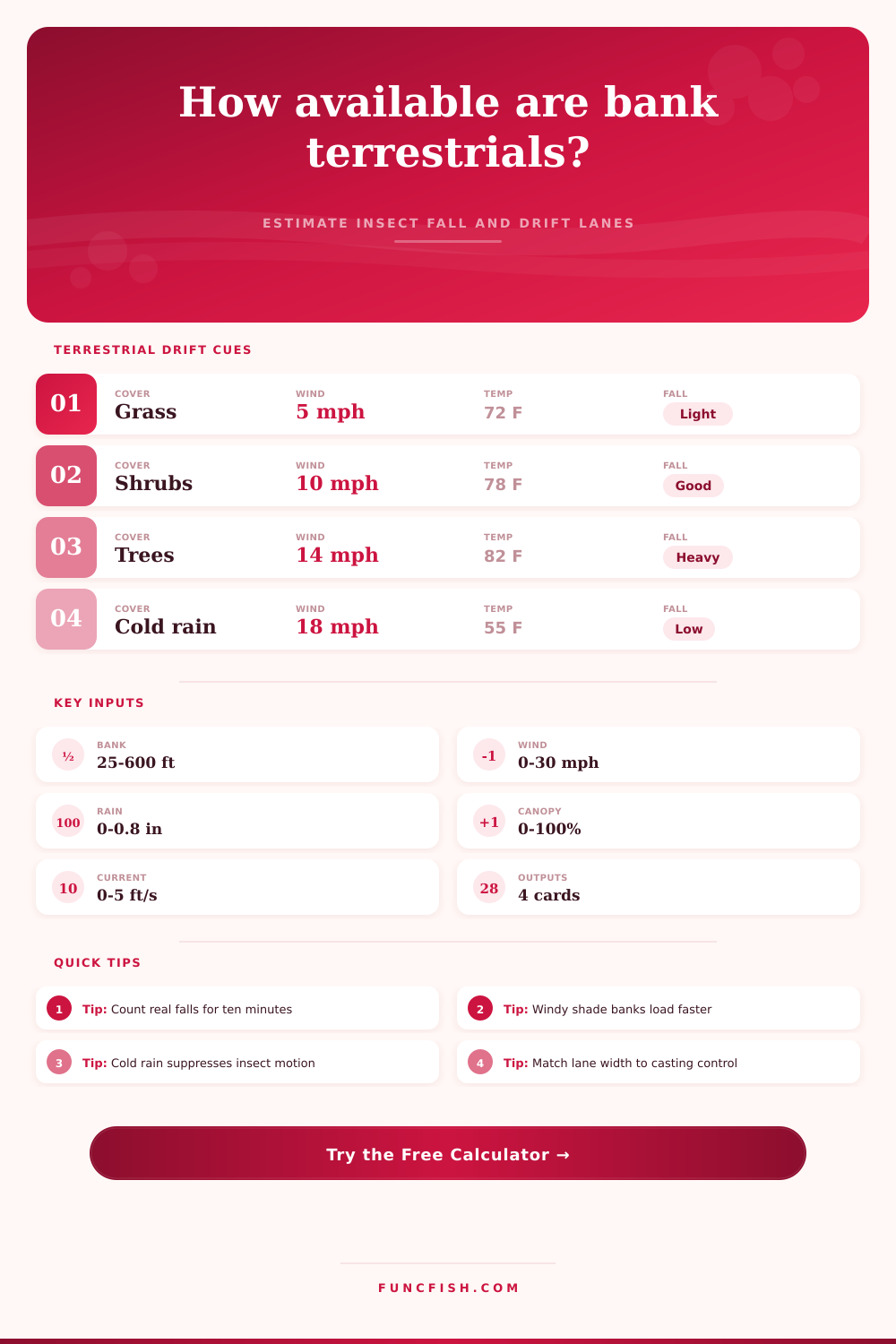
Terrestrial Fall Availability Calculator
Estimate how many ants, beetles, hoppers, caterpillars, crickets, cicadas, and mixed bank insects fall into a feeding lane from bank cover, wind, rain, temperature, canopy, current, and field counts.
📌Terrestrial fall presets
⚙Fall availability inputs
The field count is optional. If you count insects landing in the lane, the calculator blends that observation with modeled cover and weather availability.
Terrestrial fall result
Calculation breakdown
🐞Species comparison grid
Trout
Smallmouth
Bluegill
Carp
📊Reference tables
| Bank source | Relative fall | Best insects | Useful weather | Calculation note |
|---|---|---|---|---|
| Short grass or mowed bank | Low to moderate | Ants, small beetles | Warm breeze | Good observation count matters |
| Tall grass over water | Strong | Hoppers, crickets | Afternoon wind | Wide capture zone boosts results |
| Shrub and willow edge | Very strong | Beetles, caterpillars | Gusty shade bank | Canopy cover and overhang interact |
| Hardwood canopy bank | Heavy pulses | Caterpillars, cicadas | Warm showers | Large insects raise energy delivery |
| Sparse riprap or urban bank | Light | Mixed small flyers | Wind-blown slick | Delivery may matter more than source |
| Weather pattern | Fall response | Fishability | Watch point | Best use |
|---|---|---|---|---|
| Calm stable air | Low knockdown | Precise but sparse | Natural falls may be scattered | Small dries or tiny foam |
| Light breeze into bank | Reliable increase | High | Measure wind at insect height | Search shade seams |
| Gusty crosswind | Heavy bursts | Variable casting | Lane widens and shifts | Short accurate casts |
| Warm shower pulse | Temporary boost | Good if water stays clear | Cold rain reverses the effect | Fish after first drops |
| Cold rain or chill wind | Suppressed movement | Lower surface response | Insects become inactive | Reduce model confidence |
| Terrestrial type | Energy size | Typical lane | Species match | Pattern implication |
|---|---|---|---|---|
| Winged ants | Very small | Slicks and eddies | Trout, carp, bluegill | High counts can beat size |
| Beetles | Small to medium | Shade seams | Trout, chub, panfish | Hard profile, slow drift |
| Grasshoppers | Large | Grass banks | Trout, bass, chub | Fewer falls still matter |
| Caterpillars | Medium | Tree canopy edges | Trout, bluegill | Rain and canopy pulses help |
| Cicadas | Very large | Hardwood banks | Bass, carp, trout | Low counts can be enough |
| Delivery lane | Current cue | Capture behavior | Good fit | Calculation risk |
|---|---|---|---|---|
| Slack eddy or pond edge | Under 0.3 ft/s | Insects collect slowly | Carp, bluegill | Accumulation can look higher than new fall |
| Slow glide bank seam | 0.3 to 1.0 ft/s | Readable steady lane | Trout, chub | Use actual bank length |
| Riffle edge feed line | 1.0 to 2.5 ft/s | Fast delivery, fast decisions | Trout, grayling | Small insects may be missed |
| Wind-blown slick seam | Variable current | Wind piles surface food | Bass, carp | Lane moves with gusts |
| High water sweep | Over 3.0 ft/s | Many falls flush past fish | Opportunists | Delivery factor drops despite volume |
💡Calculation tips
Field count tip: Count visible insects that actually land in the drift lane for 10 to 15 minutes, then enter that number to calibrate the modeled bank source.
Lane tip: Use the fishable lane width as a casting-control check; heavy falls are less useful if wind and current push food beyond the target seam.
All you can see from your vantage point standing on the riverbank is water. The water’s surface seems lifeless. Your buddy throws out his line and in a few seconds he set the hook on a trout. How could that have happened? You were looking for the rise and didn’t notice anything going on above the water.
There’s always a gap between empty water and full fish. The difference between seeing no fish and knowing there are fish is understanding what the fish are seeing and what’s feeding them in the summertime: terrestrial insects. However, as an angler, it is hard to understand this without knowing the full picture.
How to Read the River for Terrestrial Fishing
The scarcity of insects isn’t usually the problem, it’s accessibility. There may be a ton of hoppers on the bank but when the wind is coming out of the west and blowing parallel to the shoreline, those bugs don’t come off the grass. The fish starve and the bugs remain unharmed.
In order to figure it out, you’ve got to realize how they’re getting down there. Wind is the key here. When the breeze is light and blowing toward the water from the bank, there’s a clear path for the insects to travel. That’s what they do; they set up a predictable runway along that lane.
This is where math comes into play. Where are these insects landing? It’s not random guessing where the fish will be, it’s calculating where the food is arriving. You need to understand what kind of bank we’re talking about.
On a short grass bank, bugs are sparse but exposed to the elements with minimal resistance. A heavy shrub or willow edge is another story. It retains moisture and harbors caterpillars and beetles. These are heavier bug, not prone to falling off easily. They require some sort of pulse of rain or gust of wind to dislodge them.
Once you plug in your wind speed and bank type into the calculator, you don’t have to guess at any coefficients and conversions. It does the math for you and lets you know whether or not that shade line is realy feeding the fish or simply looking nice.
Then there’s the added variable of rain. Suddenly, with a warm shower, everything that was knocked off comes back down again, and fish respond big time. On the other hand, when a cold front hits, it cools the insects. They don’t move, and they don’t fall. The water appears dead.
This is why the tool helps you check out the weather pattern. It accounts for how active insects are, and then adjusts the expected fall rate accordingly. When the rain is cold, the model indicates the availability will be low. In other words, your dry fly plan may not work because there isn’t any food up on the surface. It is not due to a lack of presentation, but simply a lack of food.
Another factor is current speed. Slow water sees insects drifting slowly and giving the fish plenty of opportunity to pick them apart individually. Fast riffles see the food moving too fast for the fish; they have to take what’s available. That alters the width of the lane you’re looking at.
While a wide lane in fast water may signal that there is insufficient food concentration, a narrow, focused seam will concentrate the food. Cast where the food piles up, not washes away.
It’s best to learn on the water: Theory has never trumped field observation. You can enter whatever count you’re observing. Spend 10 minutes looking at the water and find no insects? It factors in. That’s what makes this so good; it combines what an environment could be with how it plays out in reality.
Everything may be right. Heavy canopy, perfect wind, yet those bugs are dormant so it doesn’t show high. You can trust what your eyes tell you and not waste time fishing a hypothetical area void of insects.
The species also matter. Bass are aggressive and will patrol a larger area and attack anything that breaks the surface. Trout are more patient and will sit in a glide to wait for a single beetle to drift by. Trout is more patient. They’ll position themselves on a glide and wait for one to float past. Bluegill hover near the edges picking off ants as they bounce into the shallows.
The tool takes all of this behavior into account and provides a species fit score. What does that mean? It means it tells you whether the conditions line up for your target species. If not, change tactics or head to another bank where the fit might be better.
It’s laid out nicely on the page with the reference tables. It shows you what kind of insect goes with what kind of weather. In the wind, it’s hoppers from meadows; in the rain, it’s caterpillars from hardwood banks. That gives you a basis for deciding your fly pattern before tying in, which is a big help.
You are not fishing in the dark, but narrowing down your choices based off data. It is a structured search instead of chaos in an afternoon. Stop throwing things around and fish the environment’s logic.
To fish terrestrials, you must learn to read both the water and the air. Wind, rain, trees, fish; they all figure into what makes this game work. Match them and the water becomes full of activity where there was none before. You feel the tug, see the ripples.
It is a system you can read, so there is no more mystery river. Just wait until you read it. Then the fish aren’t really ever hiding; just waiting for someone to point them out. They should of known.