Tournament Big Fish Odds Calculator
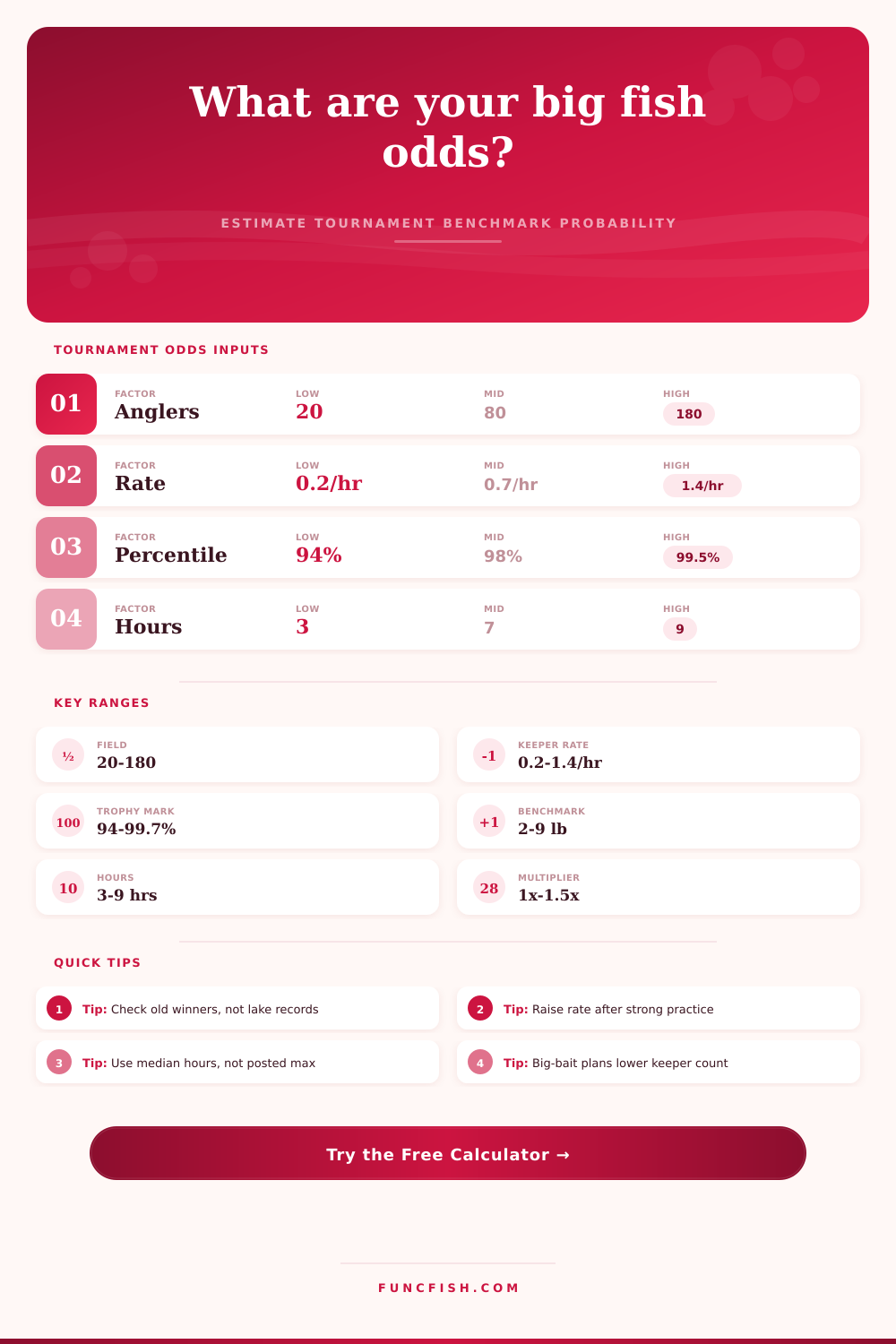
Estimate the probability that a tournament field produces a fish over a historical big-fish benchmark using field size, keeper rate, weight distribution, water, technique, and fishing time.
🏆Tournament presets
⚙Event inputs
Example: 98.5 means the benchmark is expected to beat 98.5% of normal keepers.
Big-fish probability forecast
Full breakdown
📋Gear and species comparison grid
Largemouth Bass
Smallmouth Bass
Walleye
Striped Bass
Catfish
Redfish
Mixed Field
Spotted Bass
📈Reference tables
| Water type | Keeper rate factor | Big-fish factor | Typical tournament read |
|---|---|---|---|
| Grass reservoir | 1.05x | 1.18x | More cover, more isolated quality bites |
| Highland reservoir | 0.92x | 1.04x | Lower numbers but clean deep fish potential |
| Natural lake | 1.00x | 1.10x | Broad habitat and seasonal shallow windows |
| Tidal river | 0.88x | 0.96x | Current timing controls the peak bite |
| Clear bay / big water | 0.84x | 1.22x | Harder to catch, stronger top-end weight |
| Brackish marsh | 1.12x | 1.06x | Good action with tide-sensitive size |
| Power-plant lake | 1.18x | 1.14x | Warm-water windows can compress big bites |
| Small impoundment | 1.08x | 0.88x | Numbers may hide a lower ceiling |
| Technique | Keeper factor | Trophy factor | When it raises big-fish odds |
|---|---|---|---|
| Balanced tournament mix | 1.00x | 1.00x | Unknown practice or mixed patterns |
| Finesse numbers pattern | 1.25x | 0.78x | Hard bite where every keeper matters |
| Power shallow cover | 0.94x | 1.18x | Big fish are relating to shallow targets |
| Big bait trophy hunt | 0.62x | 1.55x | You accept fewer bites for quality |
| Offshore electronics | 0.90x | 1.26x | Schools include better-than-average fish |
| Grass mat / punching | 0.78x | 1.38x | Cover creates a ceiling bite |
| Trolling spread | 1.15x | 1.08x | Covering water around roaming fish |
| Live bait / cut bait | 1.10x | 1.20x | Bait rules allow a direct trophy approach |
| Keeper distribution | Variation used | Tail adjustment | Best fit |
|---|---|---|---|
| Tight keeper band | 0.28 CV | 0.78x | Slot-like fisheries with similar keepers |
| Normal tournament spread | 0.42 CV | 1.00x | Most single-day club or open events |
| Mixed year classes | 0.55 CV | 1.14x | Several strong age classes are present |
| Top-heavy population | 0.68 CV | 1.34x | Low numbers but known quality |
| Rare trophy water | 0.82 CV | 1.52x | One fish can tower over the field |
| Benchmark gap | Model signal | Event odds feel | Interpretation |
|---|---|---|---|
| Benchmark near mean | Less than 1.5x mean | Very high | Historical mark may be too low for a true big-fish target |
| Strong local mark | 1.5x to 2.4x mean | Competitive | Good tournament baseline for ordinary fields |
| Exceptional mark | 2.4x to 3.4x mean | Long shot | Needs enough field volume or a quality pattern |
| Lake-record style mark | Above 3.4x mean | Rare | Use only when history shows repeated fish in that class |
💡Calculation checks
Tip: Enter keeper rate from recent tournament weigh-ins or practice logs. Total bites can exaggerate the forecast if short fish are included.
Tip: Use the benchmark from similar season, water level, and format. A spring grass event and a summer offshore event can have very different big-fish ceilings.
It’s all about hoping for the best while keeping one foot on the ground. You watch other anglers pull in at the ramp and wonder who is going to catch a big one that day. That’s competitive fishing. And we all want the big one. But we’re well aware it isn’t very common.
The odds calculator puts numbers to those emotions. Based off water conditions, keeper rates and size of field, it takes the guesswork out of angler hopes and fears.
How the Odds Calculator Works
“Most folks think that there’s just one factor: how many boats are on the water? That’s part of it; the more boats, the better chance you have. But then you’ve also got to look at type of water you’re fishing in and how fast you’re catching fish. If you’re talking about a big grass reservoir with fish spread out, it goes down. If we’re in a tight cove with everybody throwing to the same stuff, it goes up. The tool consider those factors. Does the lake get heavy pressure? Are there lots of angler on the water? It figures all that into the likelihood.”
Consider your method of attack. Catching numbers with big baits typically means catching less total fish. But those you do catch will be more likely to be trophies. That’s the trade-off that is shown in the model. You will catch fewer keepers but have more potential for outrageous weights. Choosing quality over quantity is a gamble that pays off in big fish moments.
Anglers who settle for fewer catches to get their shot at scales often find themselves in contention on tournament day. Consistency wins most tournaments.
Secondly, consider historical benchmarks. Based on previous tournaments, what’s been won? Set a realistic weight goal based on that history. Use the lake record as your mark and you’ll have it all wrong. Sure, chasing a lake record fish is fun but statistically unlikely in a normal event. And setting the bar too high will skew results. It will either give you false confidence or send you into needless despair.
Consider these tables from the page to see how typical weights are influenced by water type. Heavier fish per inch tend to come from clear water lakes. That changes math a lot.
The second component is field strength, and it’s more important than you may realize. A 100-boat event will have greater potential variance different than an event at your home lake with 20 other guys in your local bass club. The good anglers get on them quicker and they find the good ones easier. That makes results more consistent.
This is where the calculator kicks in. It accounts for this variable. It realizes that when you’re around more talented guys, there are fewer surprise big bites by less experienced boaters. Match the talent level with the outcome expectation.
The other big piece to this puzzle involves weather and bite windows. Even with the best odds they can dissapears when it’s post frontal and sluggish. For this there is a weather adjustment in the tool as well.
Location, weather and timing are all factors that can make or break fishing. You can set up perfectly, but if the fish aren’t feeding, your chances drop significantly.
So, it is about managing expectations. It doesn’t say go fish here. It says what are the chances of a big thing happening. If it’s low you may choose to run with numbers and be consistent because you know the chances aren’t great for something big. If the odds are high you have confidence to chase the bigger stuff. It turns a guess into an educated guess.
The next time you look at a string of boats in a tournament, remember there is still a big one out there. There’s always something waiting until it gets just right. Is it right for you? Let the calculator do the probability math so you can focus on making that cast. You should of used it sooner. Actually, catching numbers with big baits naturaly means catching less total fish. It’s more luxurius than fishing in a small pond.