Tournament Limit Projection Calculator
Project final bag weight, limit probability, cull value, and the pace needed to reach a tournament target before time runs out.
📌Scenario presets
⚙Tournament settings
Tournament limit projection
Full breakdown
📋Format and culling reference grid
📊Reference tables
| Format | Typical limit | Fast legal pace | Common target band |
|---|---|---|---|
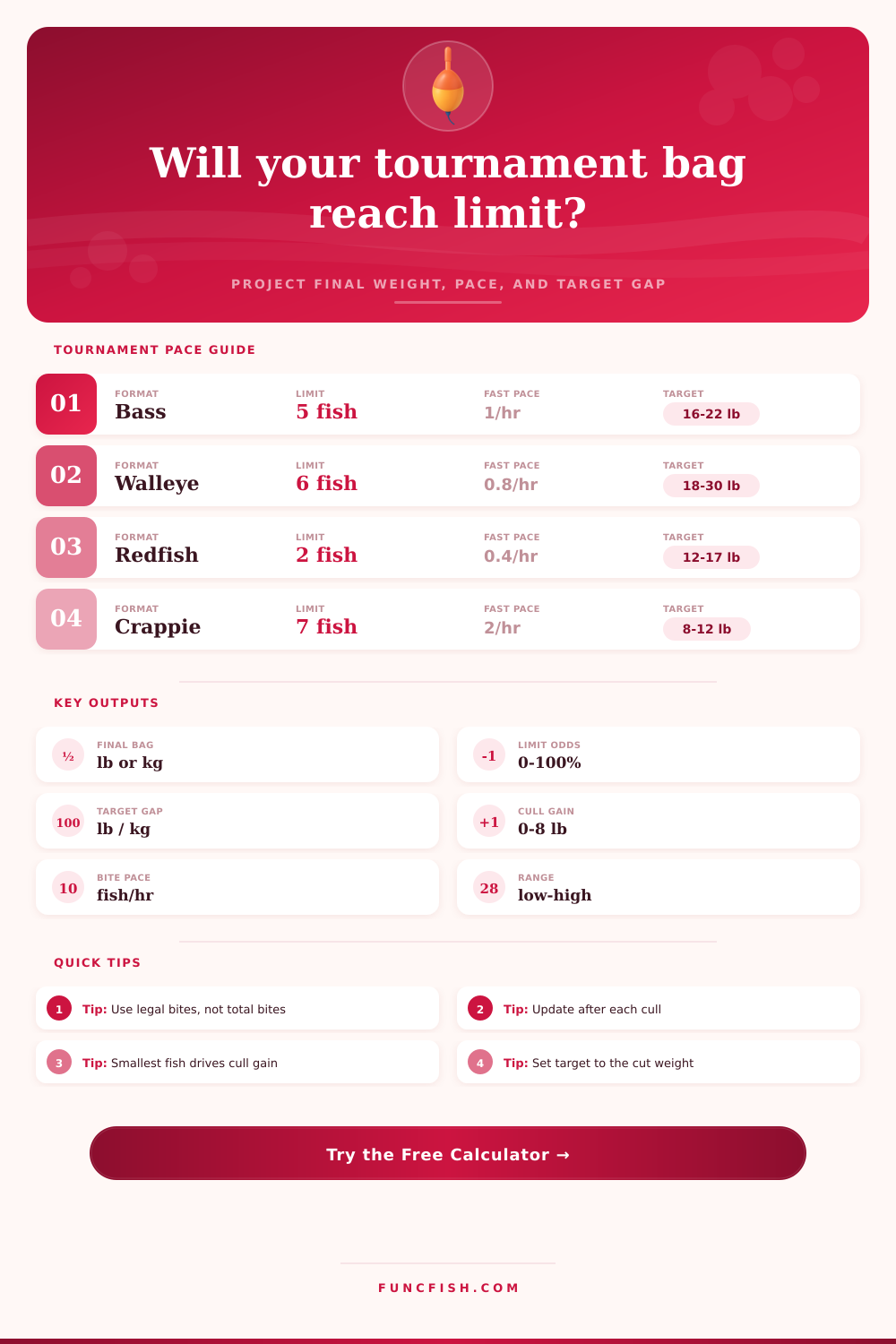
| Bass reservoir | 5 fish | 0.8-1.3/hr | 16-22 lb / 7.3-10.0 kg |
| River smallmouth | 5 fish | 0.7-1.2/hr | 13-19 lb / 5.9-8.6 kg |
| Walleye team | 6 fish | 0.6-1.0/hr | 18-30 lb / 8.2-13.6 kg |
| Redfish inshore | 2 fish | 0.3-0.6/hr | 12-17 lb / 5.4-7.7 kg |
| Crappie trail | 7 fish | 1.5-2.5/hr | 8-12 lb / 3.6-5.4 kg |
| Catfish big-three | 3 fish | 0.2-0.5/hr | 45-95 lb / 20-43 kg |
| Remaining trend | Bite multiplier | Kicker shift | Projection note |
|---|---|---|---|
| Steady | 1.00 | 1.00 | Use current pace as the center line |
| Improving window | 1.20 | 1.10 | Late feeding period adds upside |
| Fading bite | 0.72 | 0.75 | Expect fewer legal opportunities |
| Post-front tough | 0.55 | 0.60 | Range tightens but limit odds fall |
| Schooling flurry | 1.45 | 1.05 | High adds, moderate cull quality |
| Tide/current switch | 1.30 | 1.20 | Better chance at one heavy fish |
| Cull method | Scale uncertainty | Cull efficiency | Best use |
|---|---|---|---|
| Digital scale with tags | 0.02 lb / 9 g | 82% | Fast bass and walleye culls |
| Balance beam only | 0.05 lb / 23 g | 70% | Close replacement decisions |
| Spring scale tags | 0.10 lb / 45 g | 64% | Rough sorting, wider range |
| Certified digital scale | 0.01 lb / 5 g | 88% | Precise multi-cull bags |
| Length board conversion | 0.16 lb / 73 g | 58% | CPR-style estimates |
| Manual tags by memory | 0.12 lb / 54 g | 55% | Simple but mistake-prone |
💡Projection checks
Tip: Enter legal bites, not all bites. Short fish and missed strikes can make a remaining-time projection look stronger than it really is.
Tip: Recalculate after every cull. Once the limit is full, the smallest fish in the bag becomes the most important number in the projection.
Tournament fishing require you to determine if your current weight of fish will last you until the end of the tournament. A projection tool is an mathematical tool that will help you to determine your weight of fish at the end of the tournament. Furthermore, a tournament fishing projection tool will help you to avoid guessing at your weight of fishes.
Instead of guessing if you will catch more fish or if you will cull a fish, you can simply input the known data into the fishing tournament projection tool to calculate in what probability you will reach your fish limit before time expire. To calculate the correct weight of fishes that you will catch during your tournament fishing event, you must provide your data to the projection tool. You must provide the number of legal bite that you have taken while fishing, the number of hours that you have fished, and the number of hours that you have left to fish.
How to Use a Fishing Tournament Projection Tool
Furthermore, you must provide the weight of the smallest fish that you have caught, the weight of the keeper fish that you plan to catch, and the threshold for the kicker fish that you will catch. There are four specific outputs from the fishing tournament fishing projection tool. Each of these outputs presents a different value that will allow you to make a decision about your fishing strategy.
The first output will present you with a projection of the weight of your final bag of fish. The second output will determine the probability that you will reach your fish limit. The third output will determine if you are currently ahead of or behind in relation to the weight of your fish that will allow you to avoid being cut from the tournament.
Finally, the fourth output will allow you to determine the number of fish per hour that you must catch to close the gap in your target weight of fish. These outputs will allow you to make a decision based off your calculated data rather than based upon your feelings about where you feel you should fish. Within the projection tool, there are also tables that detail how various fishing scenarios will alter your calculated outcomes.
For instance, if you have a two-fish limit, the math will change from the scenario in which you have a seven-fish limit, as the two-fish limit requires that you catch heavier fish. Additionally, the cull method table will inform you of how various scales will impact the weight of your fish that is culled from your catch. Furthermore, the bite-trend tables will inform you of how a fading bite will impact your calculated outcomes.
The fishing tournament fishing projection tool is unable to account for all of the variables that may occur while fishing in the tournament. For instance, if you find a fishing partner who can catch more fish than you, this will change the variable of the bite rate. Additionally, if you lose a fish while you are culling fish from your catch, this will change your landing rate and the length of time that you spend culling fish.
Furthermore, if you possess knowledge of the fish that live in a specific location, you can find a way to catch more fish than the projection tool calculated. Because the fishing tournament fishing projection tool does not account for these variables, you should use the tool as a means of determining your strategy throughout the tournament rather than as the sole means of determining your strategy. Therefore, you should update your projection tool after you cull a fish, as well as after any change in the bite rate.
Perhaps the most valuable aspect of the fishing tournament fishing projection tool is that it allows you to adjust your fishing strategy. For instance, if you calculate with the projection tool that the number of fish that you will catch must reach a rate higher than your current bite rate, then you can choose to change your location or your method of fishing. Additionally, if your target gap and limit probability calculations reveals that you are likely to reach your fish limit, you can shift to a strategy of only catching keeper fish.
Thus, while a fishing tournament fishing projection tool does not eliminate the need for your experience in fishing, it does eliminate the guesswork involved in tournament fishing, especially when you are tired and under pressure to achieve your fishing goal. A fishing tournament fishing projection tool is a method for keeping score in your tournament. Furthermore, it allows you to transform your individual observations of your fishing effort into a single picture of your potential outcome.
This outcome may not correlate to your actual outcome in the fishing tournament, but the fishing tournament fishing projection tool will allow you to determine if your current strategy will allow you to reach your goal.