Trip Planning Gear Weight Calculator
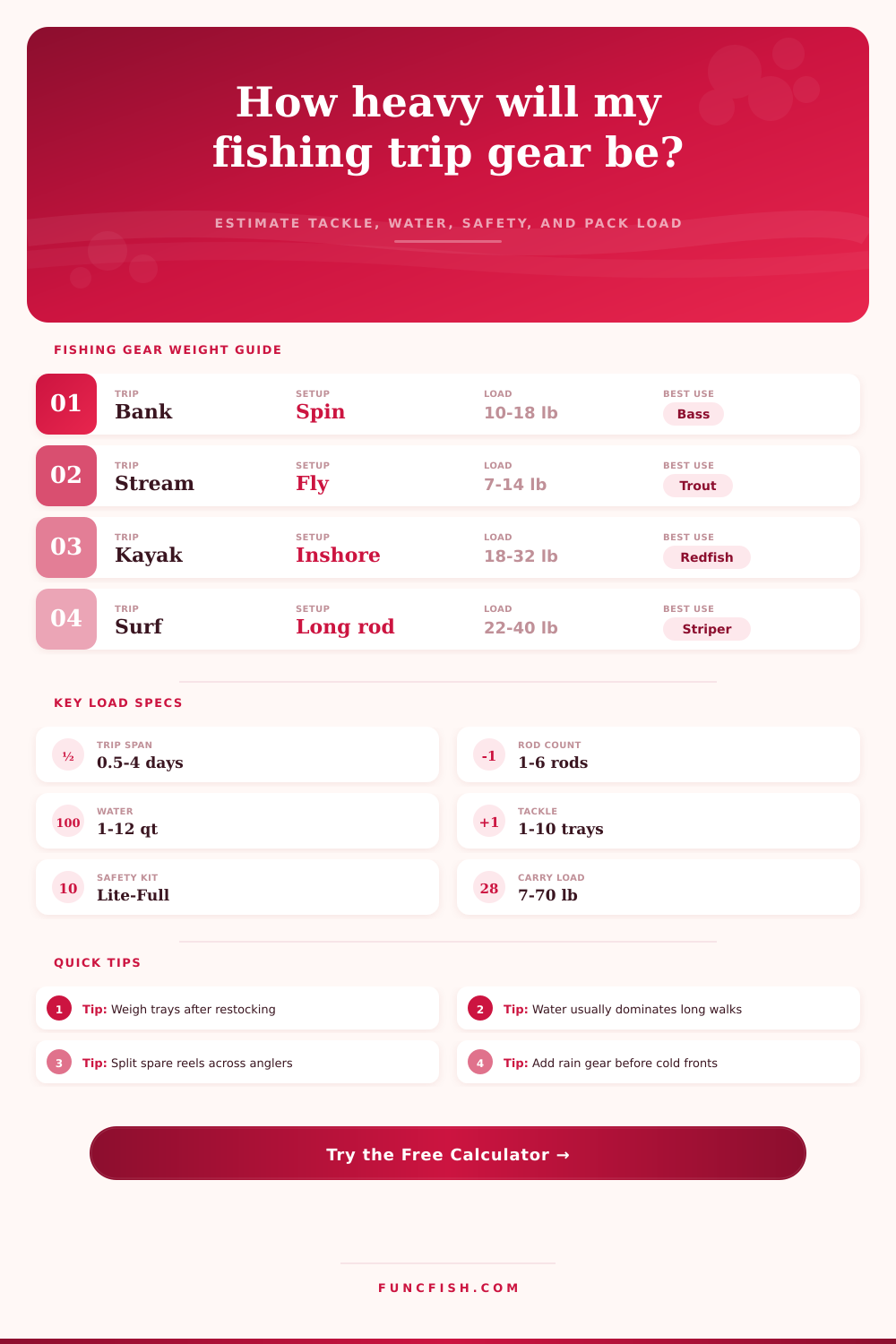
Estimate total carry weight for a fishing trip by combining rods, reels, tackle trays, water, food, safety gear, clothing, landing tools, and overnight items.
📌Scenario presets
⚙Trip load settings
The calculator treats rods, tackle, landing tools, safety gear, and camp extras as group weight, then divides shared items across anglers for the per-person load.
Trip gear load forecast
Full breakdown
📋Gear and species load grid
Ultralight Panfish
Finesse Trout
Bass Baitcaster
Walleye Jigging
Kayak Inshore
Surf Striper
Catfish Bank
Offshore Trolling
📊Trip format reference tables
| Trip format | Typical carry load | Shared gear factor | Calculator note |
|---|---|---|---|
| Bank walk | 10-22 lb / 4.5-10 kg | Low | Water and tray count drive most changes |
| Stream wade | 7-18 lb / 3.2-8.2 kg | Low | Fly boxes and rain shell matter more than rods |
| Kayak launch | 18-36 lb / 8.2-16.3 kg | Medium | Safety gear and landing tools climb quickly |
| Surf casting | 22-44 lb / 10-20 kg | Medium | Long rods, plugs, and water carry the load |
| Offshore crew | 35-75 lb / 15.9-34 kg | High | Heavy rods are divided across more anglers |
| Overnight camp | 35-70 lb / 15.9-31.8 kg | High | Shelter, stove, and food often exceed tackle |
| Species group | Common setup | Line range | Weight planning note |
|---|---|---|---|
| Panfish | Ultralight spinning | 2-6 lb / 1-3 kg | Keep tray count low for mobile fishing |
| Trout | Finesse spin or fly | 4-8 lb / 2-4 kg | Wading layers can outweigh the tackle |
| Bass | Baitcaster or spinning | 8-20 lb / 4-9 kg | Multiple rods are the main added weight |
| Redfish | Inshore spinning | 10-30 lb / 5-14 kg | Landing net and pliers are usually nonoptional |
| Catfish | Heavy bank rod | 20-50 lb / 9-23 kg | Rig boxes, holders, and lights add bulk |
| Pike / musky | Heavy casting | 30-80 lb / 14-36 kg | Large tools and lure boxes raise the load |
| Consumable | Imperial value | Metric value | When to increase |
|---|---|---|---|
| Water | 2.09 lb per qt | 1.0 kg per L | Hot sun, surf walks, dry access routes |
| Day food | 0.8-1.5 lb per day | 0.36-0.68 kg per day | Cold weather or long active hours |
| Terminal tackle | 0.01-0.06 lb each | 5-27 g each | Surf leaders, sinkers, or heavy rigs |
| Rain shell | 0.5-1.2 lb | 0.23-0.54 kg | Rain likely or cold wind |
| Battery light | 0.3-0.8 lb | 0.14-0.36 kg | Night trips and remote banks |
| Ice or bait box | 3-12 lb | 1.4-5.4 kg | Boat, surf, or catfish sessions |
| Carry score | Per angler load | Distance condition | Practical pack class |
|---|---|---|---|
| Easy | Under 12 lb / 5.4 kg | Short bank access | Sling, vest, or small pack |
| Moderate | 12-25 lb / 5.4-11.3 kg | Half to one mile walk | Framed day pack or crate system |
| Heavy | 25-40 lb / 11.3-18.1 kg | Long surf, kayak, or steep access | Supportive pack and rod straps |
| Expedition | Over 40 lb / 18.1 kg | Overnight or remote water | Split loads across anglers |
💡Load planning checks
Tip: Reweigh tackle trays after you refill sinkers, jigs, or plugs. Dense terminal tackle can double a tray weight without changing its size.
Tip: For a long carry, compare the per-angler result with water alone. If water is the biggest line item, reduce spare gear before reducing hydration.
With it, you’ll know how much weight is in your fishing pack. After walking three miles with a heavy pack, you probably has some shoulder pain now. Why? Because you were carrying too much. The calculator will help you put numbers to those vague feelings of being weighed down. It’ll do the math and all that sharing-the-load stuff, leaving you free to fish.
Many angler overlook weight of water. Each quart of water weigh two and a half pounds. That’s a lot of extra weight in your pack. Carry enough water for length of the trip.
How to Pack the Right Amount of Gear
Trip style affects baseline expectations, which is why this tool accounts for that. If you’re launching from a kayak, you can gets away with carrying heavier loads since the water carries some of it. If you’re hiking-in, you must strictly cut down your weight. These are different scenario treated differently by the calculator. Why? Because there is a limit on how much a human being can comfortabley carry over time.
Sharing gear makes things lighter for each person. When you share gear, no one have to carry as much. You don’t have to carry three landing nets. You don’t have to carry three first-aid kit. You divide the heavier stuff up between everyone. So how does the calculator determine weight? It takes the total weight and divides it by number of anglers. This means that each person’s load are realistically divided out for them.
Twenty-five pounds? Okay, you’re going to need a hip-belted, framed pack. No way can you carry that much in a sling pack. Cross that line and you’ll be exhausted when you get there.
What percent is consumable vs. Fishing equipment? Mostly, food and water weigh more than your tackle. For overnight trips, add cooking equipment and shelter. Stove, sleeping bag, and tent might tack on ten pounds. Toggle these on/off in the calculator. Off = Day trip. Turning it on means camping. The math updates instanty. This allows you to determine whether the added weight is worth an overnighter. Your knees may not be able to handle it. Better to find out in the parking lot then out there on the trail.
The table on the page has reference numbers for various species, and it will give you an idea about typical loads. Use these as benchmarks for your own input. If your number is far off the average, double-check your inputs. Did you add too many rods? Overestimate food? It’s simple to overpack with unlikely scenarios in mind. Instead, pack for the likely scenario.
Do you really need that heavy gaff for a panfish creek? Do you really need three trays of lures for a short trip? Cut things that aren’t needed. Before you fill out your tray, weigh the tray first. Know exactly what you’re taking. It takes the guess work out. No more worrying that you’ve forgotten something critical. No more guessing what to do next. The plan is in place and so are the numbers.
Know your limitations. Forget the aches and pains. Go fishing.
Set up with the presets. Slide the slider. Find the right weight for you. And then go fish.