Troll Pass Overlap Calculator
Estimate trolling lane spacing, lure-spread overlap, effective corridor width, and pattern time for repeated passes over contour lines, weed edges, bait pods, or open-water search grids.
📌Trolling pass presets
⚙Overlap inputs
Trolling overlap result
Formula breakdown
🛠Trolling spread data grid
Tight stern spreads fish nearly their full measured width in calm water.
Planer boards cover width well, but gusts and turns can pinch the edge lures.
Wire, leadcore, and divers lose width when they arc behind the boat.
Large saltwater spreads need more lane spacing and more turn allowance.
🐟Gear and species comparison grid
Often benefit from higher overlap because inside boards track differently on contour turns.
Downriggers create predictable lanes, so moderate overlap keeps the grid efficient.
Heavy rigs sweep a narrower practical lane than the rod-tip spread suggests.
Wide open-water searches tolerate lighter overlap when the target zone is broad.
📊Reference tables
| Spread style | Usable width factor | Typical measured spread | Overlap note |
|---|---|---|---|
| Flatline pair | 0.92 | 20-45 ft (6-14 m) | Good for tight shorelines, kayak passes, and narrow lanes. |
| Downrigger pair | 0.88 | 35-80 ft (11-24 m) | Tracks consistently; spacing can be closer to the math target. |
| Inline planer boards | 0.78 | 70-180 ft (21-55 m) | Add overlap when waves or turns collapse one board line. |
| Leadcore or wire divers | 0.74 | 60-150 ft (18-46 m) | Deep lines arc and lag, so the outer path is not full coverage. |
| Saltwater outriggers | 0.68 | 160-360 ft (49-110 m) | Large spread but wide turns make clean parallel coverage harder. |
| Umbrella or mojo spread | 0.72 | 45-140 ft (14-43 m) | Heavy lures swing inward when the boat changes heading. |
| Target pattern | Suggested overlap | Corridor check | Spacing style |
|---|---|---|---|
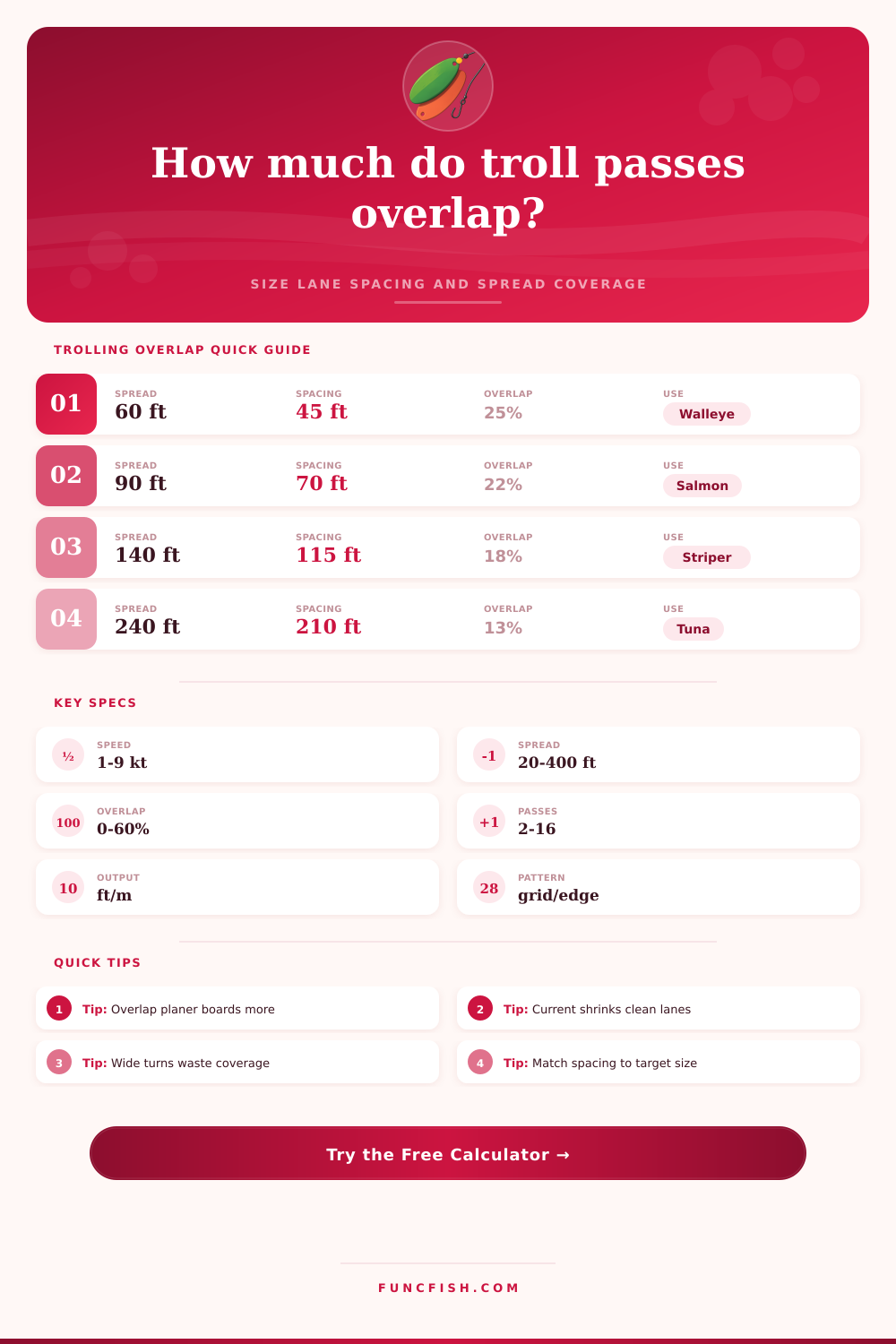
| Walleye contour troll | 22-32% | 120-350 ft (37-107 m) | Use closer lanes on bends, points, and inside turns. |
| Salmon thermal grid | 14-24% | 300-900 ft (91-274 m) | Parallel lanes work well when bait depth stays steady. |
| Striper bait school passes | 12-22% | 250-800 ft (76-244 m) | Box the school with repeat passes instead of one wide sweep. |
| Muskie weed-edge sweep | 25-40% | 80-220 ft (24-67 m) | Heavy overlap keeps lures near the strike edge longer. |
| Mahi weedline passes | 10-18% | 400-1200 ft (122-366 m) | Follow the edge; use overlap mainly for S-turn variation. |
| Tuna open-water search | 6-16% | 0.2-1.0 mi (0.3-1.6 km) | Coverage efficiency matters more than perfect no-gap lanes. |
| Cross-set condition | Lane correction | When it matters | Calculation effect |
|---|---|---|---|
| Calm or aligned drift | 0 ft/min | Sheltered lakes, current with heading | Lane spacing equals the planned GPS spacing. |
| Light cross-current | 0.34 ft/s | Reservoir points, slow river mouths | Small shift over each pass can narrow one side of the grid. |
| Moderate cross-current | 0.84 ft/s | Channels, inlets, thermocline edges | Use the corrected spacing before judging gaps or overlap. |
| Strong cross-current | 1.52 ft/s | Rips, tidal passes, wind-against-current water | Frequent reset lines are better than long single passes. |
| Wind pushes boards outward | -6% spacing | Quartering wind with planer boards | Creates more overlap than the charted centerlines show. |
| Wind pinches boards inward | +8% spacing | Following or beam wind with outside boards | Raises gap risk even when GPS lanes look tight. |
| Actual overlap | Coverage reading | Best use | Adjustment |
|---|---|---|---|
| Gap below 0% | Lanes do not touch | Very broad search zones only | Reduce spacing or widen the spread. |
| 0-10% | Light overlap | Open-water tuna, mahi, scattered bait | Efficient, but not ideal for compact marks. |
| 10-25% | Balanced overlap | Salmon, striper, trout, mixed bait lanes | Good default for repeatable parallel passes. |
| 25-40% | Heavy overlap | Walleye boards, muskie edges, contour turns | Strong coverage, but less new water each pass. |
| Over 40% | Very heavy overlap | Short hot-zone repeats | Use only when target size is small or bite window is tight. |
💡Calculation tips
With a focused mindset, you begin making a trolling pass by ticking off the seconds between casts and noting it on your GPS. As you work along a weed edge or contour line, you’re covering water efficienty and feeling good about your productivity. Then you glance down at your spread, pull up the fish finder or check out your GPS track and realize there’s a problem: Your coverage have holes where fish has slithered through without being noticed. Or you’ve repeated the exact same cast in the same stretch of water, say 20-feet wide, without considering the areas next to it that holds more productive water. That’s the consequence of what I believe most anglers think they’re covering, but isn’t.
Lure spread doesn’t equate to effective coverage width. But here’s the kicker: Your equipment doesn’t necessarily follow a true path through the water. Not even close. Wind, current and turn radius all impact its tracking. Downriggers and planer boards don’t track in a perfect straight line directly parallel to centerline of your boat. Rather, they will arc, pinch and drift outward as the wind slaps them on the backside. And while a ninety foot spread may sound great on paper, if the lures on the outside tend to track slightly inward on turns, it may only cover seventy feet of useable water.
How to Trolling Better With a Calculator
That’s where the great anglers separate themself from the good… Understanding the disconnect between theory and reality.
There’s a calculator to do the math for you here. It takes your specific gear configuration and translates it to realistic effective corridors and overlap percentages. You measure out the width of your spread and enter your desired spacing between lanes. Instead of guessing if your passes are too wide or narrow, the tool accounts for things like wind that closes the gap between your boards or cross currents that throw your bait off target. And it provides you with a clear number that shows how much your passes overlap the last.
Is it so little that you’re wasting time recasting over water you’ve already covered? Or is it so much that you’re creating gaps for fish to easily find refuge?
Plug in your measured spread width and your planned lane spacing The proper overlap is based off the structure and target, as well as environmental factors like wind, current, and turn time. Are you searching for a scattered school of open-water fish such as mahi or tuna? Efficiency matters. Because you’re covering large expanses of water, you have time for a fair amount of space between each cast with little overlap needed. Or perhaps you’re hunting muskies along a thick weed line or walleye on a tight contour bend. Precision trumps speed here, so you’ll need a lot of overlap to make sure that no strike zone goes unchecked. It’s all laid out nicely in the reference table on the page, showing that different structures call for different spacing strategies depending than the species you’re after.
Most anglers have fallen into the trap of thinking that a trolling spread is a rigid grid. They program waypoints on their GPS, expect it to hit them each time, and fail to account for the fact that water in motion are not static. Even a mild cross-current moves your effective lane a few feet along a long troll, which turns what was once a great overlap into an empty gap on one side or the other. With this calculator, you have an option to account for current and wind conditions. It forces you to think beyond the ideal geometry on the screen and into the real world of how your gear and boat move across the water.
You should also consider turn time. You’re losing fish time every time you come to the end of a pass because it takes some time to make the turn, reset your boards, and get back on course. Wide turns waste more time turning than fishing if you have wide lanes. Narrow ones don’t let you cover as much new water in the same time. So you’ve got both the spatial overlap to consider and the time efficiency of your pattern. The tool lets you see how many minutes per day you’ll really be fishing and how many you’ll be maneuvering, so you can improve your daily schedule.
You should of used this earlier.
All of this boils down to one thing, the art of effective trolling is putting constant pressure on the appropriate water by moving beyond intuition and using data to fine-tune your method. Determining how many baits are in the water, then accounting for external conditions helps fill the holes in your presentation. Taking the guesswork out of fishing stops you from second-guessing yourself and lets you know precisely what has been covered and what hasn’t. The end result is turning the unpredictable into the predictable and going from good days to great days where each pass contributes to packing the livewell.