Trolling Depth Correction for Braid Calculator
Convert a published mono trolling dive curve into a braid-corrected running depth using line diameter, line out, lure style, speed, current, leader drag, and rod-tip height.
📌Scenario presets
⚙Line, lure, and water inputs
Braid-corrected trolling depth
Results update after calculation.
Calculation breakdown
🧵Braid construction correction data
4-Carrier Braid
8-Carrier Braid
12-Carrier Slick
Metered Trolling
📊Reference tables
| Braid test | Typical braid diameter | Mono chart equivalent | Expected depth gain | Common trolling use |
|---|---|---|---|---|
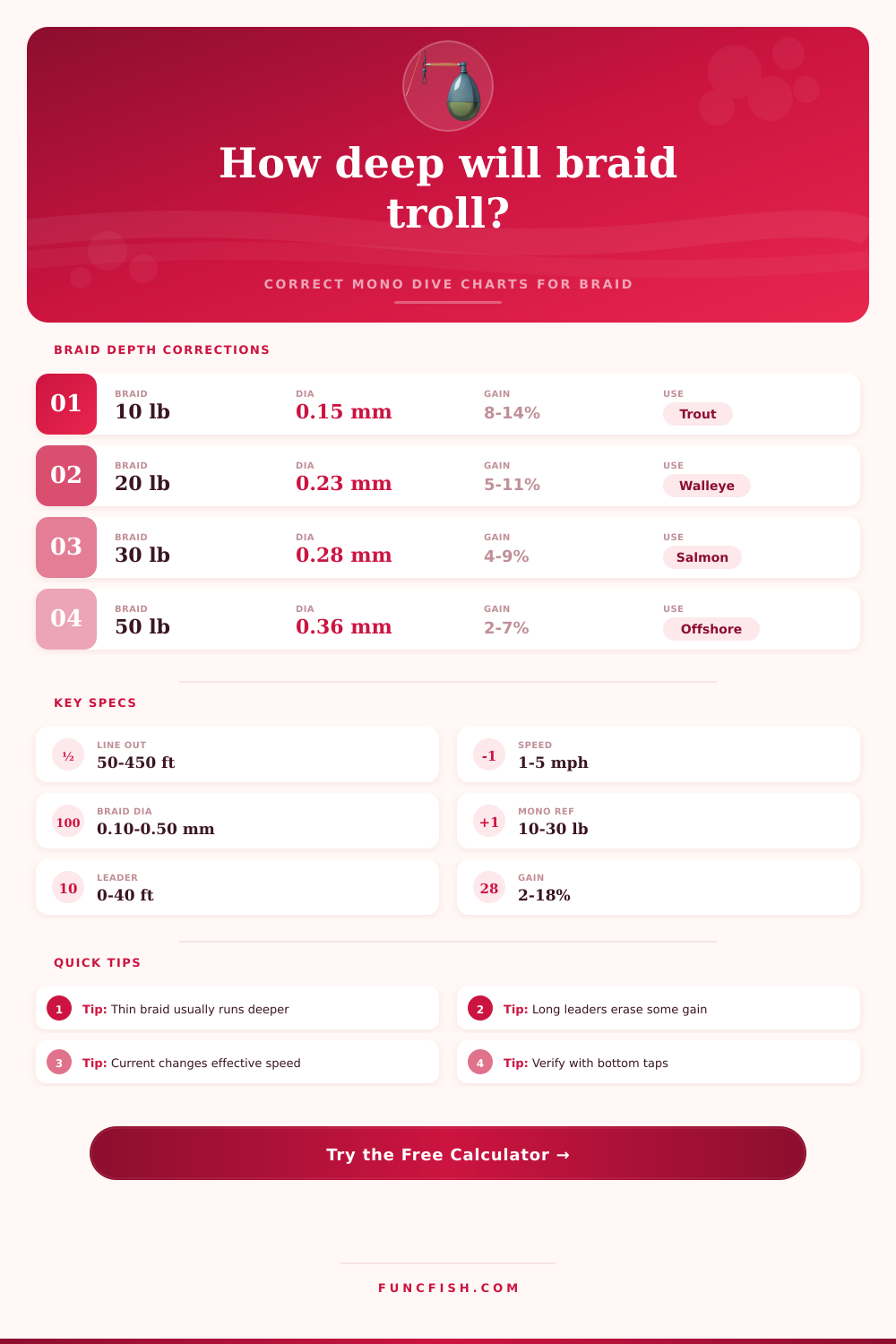
| 8 to 10 lb | 0.005 to 0.006 in / 0.13 to 0.15 mm | 4 to 6 lb mono diameter | 8 to 16 percent deeper | Trout, kokanee, light walleye |
| 15 to 20 lb | 0.007 to 0.009 in / 0.18 to 0.23 mm | 6 to 10 lb mono diameter | 5 to 12 percent deeper | Walleye cranks, planer boards |
| 30 lb | 0.011 in / 0.28 mm | 10 to 12 lb mono diameter | 4 to 9 percent deeper | Salmon spoons, striper plugs |
| 40 to 50 lb | 0.013 to 0.014 in / 0.33 to 0.36 mm | 14 to 17 lb mono diameter | 2 to 7 percent deeper | Divers, musky, offshore plugs |
| 65 to 80 lb | 0.016 to 0.018 in / 0.41 to 0.46 mm | 20 to 25 lb mono diameter | 0 to 5 percent deeper | Heavy divers and big planer rigs |
| Mono dive curve type | Reference depth at 100 ft | Line-out exponent | Best speed window | Correction note |
|---|---|---|---|---|
| Shallow crankbait | 7 ft / 2.1 m | 0.72 | 1.5 to 2.6 mph | Small gains; bill stalls if over-sped |
| Medium diving crankbait | 15 ft / 4.6 m | 0.78 | 1.7 to 2.8 mph | Most sensitive to braid diameter |
| Deep diving crankbait | 24 ft / 7.3 m | 0.82 | 1.8 to 3.0 mph | Large bill creates strong line angle |
| Trolling spoon | 8 ft / 2.4 m | 0.64 | 2.0 to 3.2 mph | Spoon lift offsets some braid gain |
| Inline weight plus lure | 20 ft / 6.1 m | 0.88 | 1.2 to 2.5 mph | Weight dominates more than diameter |
| Directional diver | 38 ft / 11.6 m | 0.91 | 2.0 to 3.3 mph | Side pull reduces vertical efficiency |
| Species or spread | Typical braid | Target band | Common lure curve | Depth correction priority |
|---|---|---|---|---|
| Walleye on planer boards | 10 to 20 lb metered braid | 12 to 32 ft / 3.7 to 9.8 m | Medium crankbait | Very high because small depth changes matter |
| Great Lakes salmon | 30 to 50 lb braid backing | 20 to 70 ft / 6.1 to 21.3 m | Spoon, diver, plug | High when matching multiple rods |
| Reservoir trout | 8 to 15 lb braid | 6 to 25 ft / 1.8 to 7.6 m | Flatline spoon or small plug | High with long setbacks |
| Striped bass | 30 to 50 lb braid | 10 to 45 ft / 3.0 to 13.7 m | Tube, plug, umbrella | Medium; lure drag is large |
| Musky trolling | 50 to 80 lb braid | 8 to 28 ft / 2.4 to 8.5 m | Large crankbait | Medium; heavy braid narrows gain |
| Condition | Effective speed change | Depth effect | When to adjust | Field check |
|---|---|---|---|---|
| No current | 0.0 mph / 0.0 km/h | Baseline | Calm lakes and controlled trolling | Use GPS speed plus lure action |
| Following current | -0.2 to -0.4 mph | Usually shallower | Rivers and tidal passes | Watch rod pulse slow down |
| Opposing current | +0.2 to +0.4 mph | Usually deeper until lure blows out | Up-current passes | Check lure still tracks true |
| Turns and surges | Variable | Inside rods sink, outside rods rise | Big S-turns and quartering waves | Compare hits by side of spread |
🎣Gear and species comparison grid
Walleye Crank Spread
+6-12%Thin 10 to 20 lb braid often runs a crankbait noticeably deeper than the 10 lb mono chart, especially beyond 100 ft of line out.
Salmon Spoon Rod
+3-8%Spoons create lift, so braid still helps but the correction is smaller than a hard-diving crankbait or diver.
Diver on Braid
+4-10%Low-stretch braid improves trip response and reduces belly, but side-pulling divers cap the vertical depth gain.
Musky Heavy Braid
+0-5%Large lure drag and heavy line diameter make braid correction modest; lure model and speed usually matter more.
💡Depth correction notes
The depth change comes mostly from drag area. Two braids with the same pound-test can differ enough in diameter to move a crankbait several feet at long setbacks.
Make one pass over a known contour at steady speed. If the lure taps early or late, adjust the chart confidence input and save that line-out note for the same rod.
Calculator estimates are planning values. Lure model, knot bulk, weed load, boat turns, waves, current shear, and rod angle can shift actual running depth.
Although the chart indicates it will run deep, it’s not running deep and all you can do is watch your trolling motor humming along as your lure sits shallow. Why? Because traditional dive charts is based off monofilament that has a lot of drag and diameter. Braid is slicker and thinner and cuts through water with less resistance. In current or deep water where pinpointing depths are critical, that makes a big difference.
You just plug in the speed and your exact line diameter into the calculator and it do the math for you. No more guesswork on how much deeper your lure will get then the printed stuff out there. Hydrodynamic drag is the key here. Monofilament is thick, which mean it catches a bunch of water compared to braid (think about a parachute). By switching to an eight-carrier round braid, you take away that drag surface area. Your line pulls the lure down instead of holding it up; that’s immediate and measurable.
Why Lures Run Shallow With Braid Line
But what many anglers fail to remember is that a long fluorocarbon leader add another source of drag into the equation. Half the advantage you achieved with your braid transition can be eaten up by a forty-foot leader. That’s why it works, but only when you factor in every foot of material between hook and rod tip.
Everything else changes with speed. Even if you are crawling along at one point five miles per hour, a medium diving crankbait might stay shallow regardless of your line choice. Water has to run across the bill of the bait to create its downward force. That’s why the calculator will adjust to account for lure speed versus This is about boat speed. Boat speed. When you are fishing tidal areas or rivers where current opposes your boat movement, this difference are important. Your GPS may say you’re trolling at a constant speed but a good following current will slow the effective water over the lure and cause it to rise. You feel it more than you see it on a screen.
A more subtle but real factor is construction type. Four-carrier braid is flatter with slight roughness. Also, not all braid are created equal. It has more drag than a slick twelve-carrier line of the same pound test. That added friction holds the lure slightly shallower which can make a difference as you attempt to thread that sweet spot in a depth zone near a drop-off. On the page there’s a table that shows the roundness and drag coefficient of various braid constructions so you get a better sense of what happens in the water with your particular spool.
The other thing I want to mention is the height of rod tip. A higher rod handle or planer board change the angle at which your line enters the water, and that angle dictates how much vertical force is applied to the lure. The steeper the angle down into the water, the deeper the lure get with less line out. The calculator takes this into consideration as well so you don’t have to guess at it in your head from up on a bouncy boat deck. It shows you a corrected running depth based off reality instead of theory.
But again, it’s all relative. A few feet one way or the other could of been caused by knot weight, weed lines, water temp, etc. So I think the best thing to do is plug them in and start there and double check with a fish finder or tapping bottom. Find something similar and adjust a bit up or down based off feeling a difference with your rod. Eventually you figure out what a little braid does with current and then those annoying shallow runs aren’t so much mysterious fails but more like known oddities. You’re fishing the depth, instead of the line counter, which I think is where the real gain comes from.