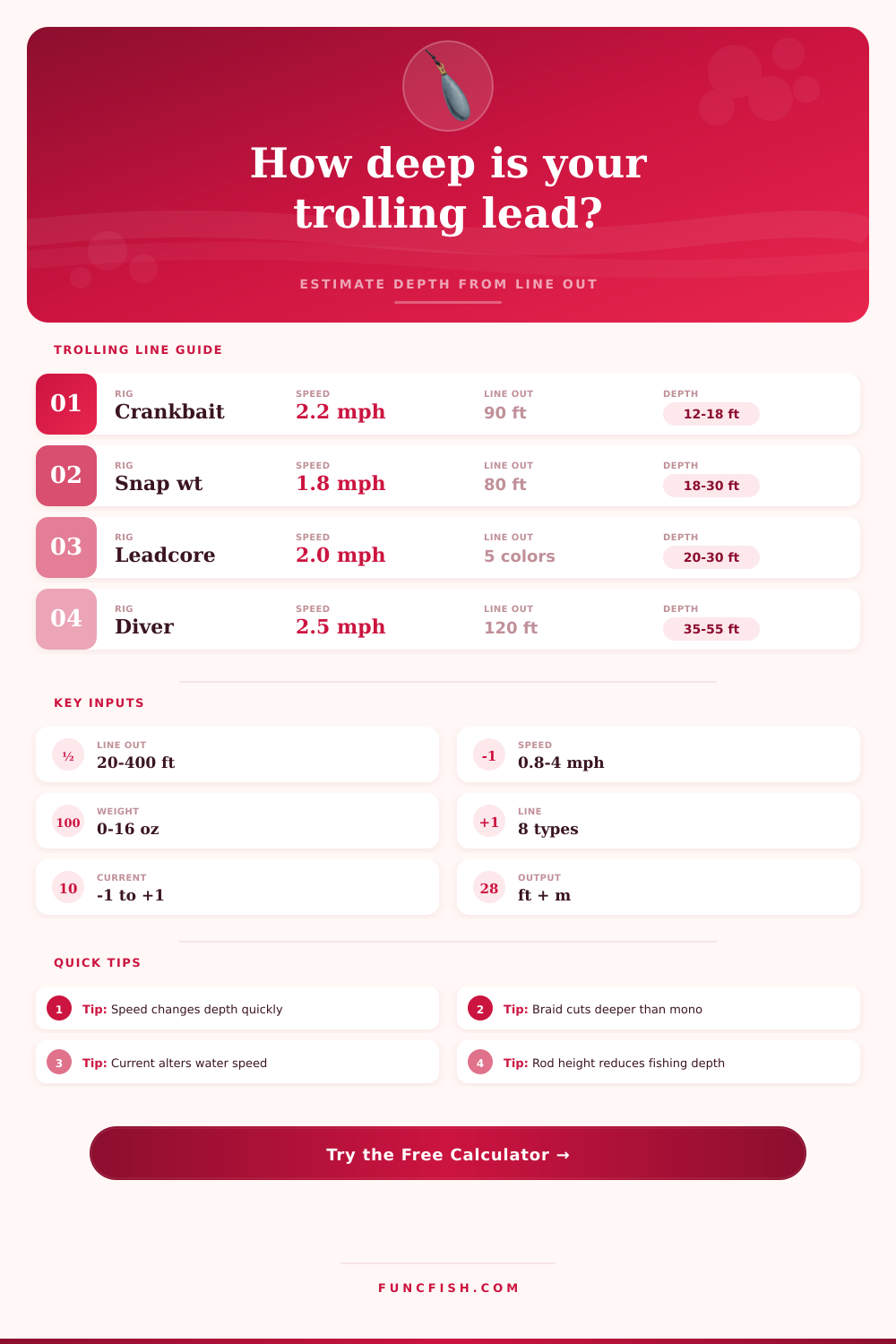
Trolling Lead by Line Out Calculator
Estimate running depth from line out, trolling speed, sinker or diver style, line diameter, lure drag, current, rod-tip height, and target depth.
📌Scenario presets
⚙Trolling setup inputs
Trolling depth estimate
Full breakdown
📋Trolling device reference grid
Depth comes mostly from lip design, then line out and diameter fine-tune the track.
Good for repeatable walleye and trout passes when the lure needs separation.
A color is 10 yards of line; actual depth changes with speed and lure drag.
Divers convert line pressure into depth and side spread, especially with braid.
📊Line and speed reference tables
| Line type | Typical diameter | Depth effect | Best trolling use |
|---|---|---|---|
| 10 lb mono | 0.011 in / 0.28 mm | Baseline drag | Cranks and light leads |
| 20 lb mono | 0.018 in / 0.46 mm | Runs shallower | Big plugs and musky |
| 10 lb braid | 0.006 in / 0.15 mm | Runs deeper | Divers and small spoons |
| 20 lb braid | 0.009 in / 0.23 mm | Deep with control | Weighted trolling rigs |
| 18 lb leadcore | 0.032 in / 0.81 mm | Sinks by color | Trout and walleye spread |
| 45 lb copper | 0.037 in / 0.94 mm | Heavy sink | Salmon and lake trout |
| Scenario | Normal speed | Common line out | Depth check |
|---|---|---|---|
| Walleye crankbait | 1.5-2.2 mph | 60-150 ft | Watch turns |
| Salmon diver | 2.2-3.0 mph | 90-220 ft | Use braid counter |
| Leadcore trout | 1.6-2.4 mph | 3-8 colors | Speed is critical |
| Crappie longline | 0.8-1.3 mph | 40-90 ft | Small changes matter |
| Lake trout weight | 1.2-2.0 mph | 80-220 ft | Track bottom gap |
| Inshore spoon | 2.5-3.5 mph | 50-140 ft | Account current |
| Species | Typical target | Lead style | Useful margin |
|---|---|---|---|
| Walleye | 8-35 ft | Crank or snap | 1-3 ft high |
| Trout | 10-45 ft | Leadcore | 2-5 ft high |
| Salmon | 25-90 ft | Diver or copper | Near marks |
| Striped bass | 12-50 ft | Umbrella or jig | Above bait |
| Crappie | 4-18 ft | Longline jig | 1-2 ft high |
| Musky | 6-25 ft | Big plug | Over cover |
💡Practical checks
Tip: Treat the output as a repeatable starting point. Trolling depth changes fast when speed, lure drag, current, or line diameter changes.
Tip: If the calculator says you are just above bottom, shorten line or raise speed before crossing humps, weeds, or shell.
Trolling depth are the measurement of how deep a lure is while the boat is moving. The trolling depth of a fishing setup can be variable and change based on many differentaly factors. For example, a person may expect the fishing setup to reaching a certain trolling depth with a specific amount of line out.
However, the trolling depth may be different than the expected trolling depth due to changes in the water conditions or changes in the fishing equipment. If the trolling depth is incorrect for the fishing setup, then the lure will not be in the same area as the fish. Therefore, the fish will not being caught.
How to Calculate Trolling Depth
The trolling depth can be affected by several different factor. One of the most important factors that can affect trolling depth is the diameters of the fishing line. Lines with a thin diameter will allow the fishing lure to travel through the water more easy than lines with a thick diameter.
Therefore, the trolling depth with a thin braid line will reach deeper into the water then trolling with a thick monofilament line. Additionally, the shape of the lure can also affect trolling depth. For instance, crankbaits have bills on the lure that help it dive into the water deeper.
Conversely, flashers and flies will allow the lure to travel upward toward the water’s surface. Another factor that can change trolling depth is the speed at which the boat are traveling. Small changes in the boat speed can result in several feet’ change in trolling depth.
Changes in the boat speed can change the water pressure against the line and lure. Other factors that can change trolling depth are the water currents. Current can change trolling depth in two different ways.
If the boat is traveling with the current, the trolling depth will allow the lure to travel to a greater depth. However, if the boat is traveling against the current, the trolling depth will cause the lines to rise off the bottom of the boat. Additionally, the turns that the boat take while on the water can change the trolling depth created by the water current on the sides of the boat.
These changes in the current will impact the trolling depth on the inside lines of the boat compared to the trolling depth of the outside line. The calculator allows you to estimate the trolling depth by entering specific data point into the form. You must enter the amount of line out, the boat speed, the weight or diver type, the type of line, the type of lure, the current, and the target depth.
The calculator will provide the estimated trolling depth for you’re setup, as well as provide the amount of line that you will need to reach the specific depth you target. Knowing the amount of line that is necessary to reach your target depth will allow you to better set your trolling rig so that the lure is within the area where the fish are locate. Furthermore, the rod height and the length of the leader will also impact the trolling depth.
If the rod tip is raised to a higher point, this will create an angle in the line that lifts the bait closer to the water’s surface. Additionally, if the leader is longer than the recommended length, it may sag in the water, forcing the sinker to work harder to maintain the trolling depth. Both of these variable are accounted for in the calculator.
Many angler make mistakes when attempting to manage the trolling depth. For instance, they believe the trolling depth will remain the same throughout the day, but the depth of the water and the current changes throughout the day. Furthermore, if the types of lures are changed, the trolling depth may have to be adjusted to account for the change in depth caused by the change in lure.
For instance, changing from a small spoon bait to an umbrella rig will change the trolling depth due to the increased drag of the umbrella rig. Using this type of calculation to determine the trolling depth will help the angler to avoid hitting the bottom of the lake or hitting weeds. If the trolling depth as calculated is too deep for the target fishing spot, the boat speed can be increased or the amount of line that is dropped can be decrease.
However, if the trolling depth is too shallow, more weight or line can be added to increase the depth of the trolling line. Thus, using this type of calculation to determine trolling depth allows the angler to establish a starting point for the depth of the trolling line, without having to rely on luck to find the proper trolling depth.