Trolling Motor Runtime by Amp Draw Calculator
Estimate trolling motor battery runtime from measured amp draw, usable battery capacity, chemistry, voltage system, reserve, duty cycle, accessories, temperature, battery age, and water load.
📌Trolling motor presets
⚙Runtime inputs
Use a meter, motor display, or manufacturer amp table for the measured draw. Capacity per parallel string means the Ah rating of one full voltage string: one 12V battery for 12V, two series batteries for 24V, or three series batteries for 36V.
Runtime estimate
Calculation breakdown
🔋Battery chemistry comparison
Flooded Lead
AGM
Lead-Carbon
LiFePO4
📊Typical amp draw by motor class
| Motor class | Voltage | Low-speed draw | High draw range | Planning note |
|---|---|---|---|---|
| 30 lb transom | 12V | 5-12 A | 25-32 A | Small jon boats, kayaks, short moves |
| 40-45 lb | 12V | 8-18 A | 35-42 A | General small boat use |
| 50-55 lb | 12V | 10-24 A | 45-55 A | Common bass and utility setup |
| 70 lb | 24V | 12-28 A | 35-42 A | Better efficiency under heavier load |
| 80 lb | 24V | 14-32 A | 42-56 A | Wind, larger boats, longer days |
| 101-112 lb | 36V | 18-38 A | 45-62 A | Heavy bass boats and offshore control |
⏱Runtime example table
| Bank setup | Chemistry | Average load | Planning reserve | Estimated runtime |
|---|---|---|---|---|
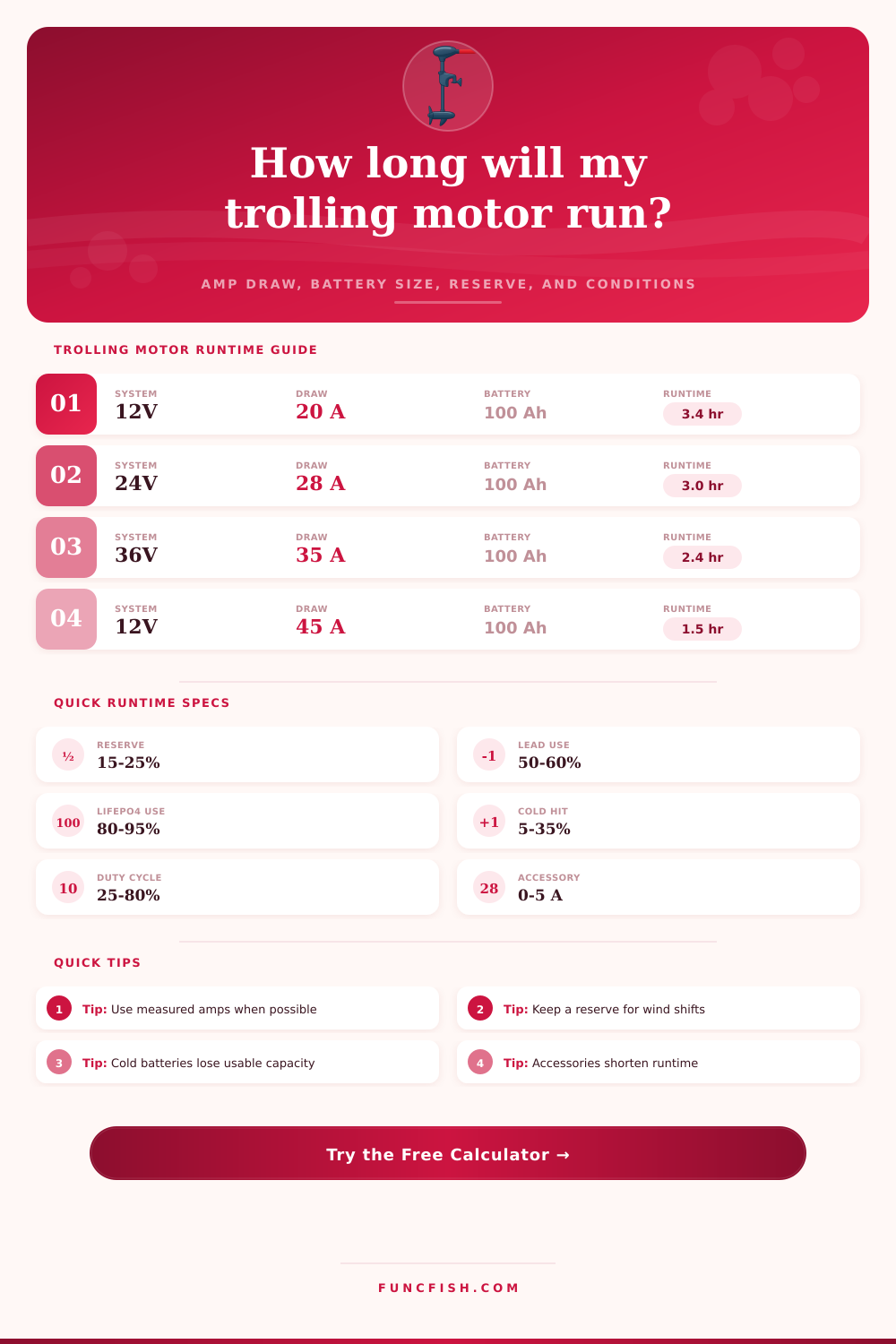
| 12V 100 Ah | Flooded lead | 18 A | 20% | About 2.4-2.8 hr |
| 12V 100 Ah | LiFePO4 | 18 A | 15% | About 4.3-4.8 hr |
| 24V 100 Ah | AGM pair | 22 A | 20% | About 2.4-2.9 hr |
| 24V 100 Ah | LiFePO4 pair | 22 A | 15% | About 3.7-4.2 hr |
| 36V 100 Ah | LiFePO4 trio | 30 A | 15% | About 2.8-3.2 hr |
| 12V 200 Ah | AGM parallel | 16 A | 25% | About 5.5-6.5 hr |
🌡Condition adjustment table
| Condition | Load multiplier | Reserve target | Capacity effect | Runtime planning use |
|---|---|---|---|---|
| Calm water | 0.95x | 10-15% | Normal | Best for measured amp tests |
| Light breeze | 1.05x | 15-20% | Normal | Typical casting day |
| Moderate chop | 1.18x | 20-25% | Minor voltage sag | Plan shorter legs |
| Strong current | 1.35x | 25-35% | Higher voltage sag | Recheck after first hour |
| Weeds or grass | 1.25x | 20-30% | Prop drag losses | Clean prop often |
| Cold batteries | 1.00x | 20-30% | 5-35% loss | Capacity, not draw, is hit |
⚖Battery bank comparison grid
| Voltage bank | Series batteries | Ah meaning | Watt-hour formula | Common motor match |
|---|---|---|---|---|
| 12V | One 12V battery | Label Ah is bank Ah | 12 x Ah | 30-55 lb class |
| 24V | Two 12V in series | Ah stays the same | 24 x Ah | 70-80 lb class |
| 36V | Three 12V in series | Ah stays the same | 36 x Ah | 101-112 lb class |
| Parallel 12V | Two strings | Ah adds together | 12 x total Ah | Long small-boat days |
| Parallel 24V | Two 24V strings | Ah doubles | 24 x total Ah | Large boat endurance |
| Parallel 36V | Two 36V strings | Ah doubles | 36 x total Ah | Heavy tournament use |
💡Runtime planning tips
Measure the draw: A trolling motor rarely stays at nameplate maximum amps all day. Runtime is far better estimated from real draw at your normal speed, then adjusted for wind, current, duty cycle, and accessories.
Protect the reserve: Keep extra battery capacity for returning to the ramp, stronger afternoon wind, heavier current, and voltage drop near the end of discharge. Deeply draining lead-acid batteries shortens their service life.
It’s easy to get panicked when your sun starts setting and you’re three miles from dock and your trolling motor dies. Your heart doesn’t race due solely to getting stranded. Rather, it races because this was suppose to be a four-hour outing but has turned into a two-and-a-half-hour race against the clock. This is due to your lack of knowledge regarding current or using old lead-acid batteries which don’t hold their power like they once did back in 2019.
How many amps is actualy flowing out of your battery bank per hour? That single number typically separates a leisurely day from a stressful trek back to the ramp. When most of us read the spec on a battery and notice it’s 100 amp-hour deep cycle, we think we’re good for pulling all 100 amps without issue. We aren’t.
How to Calculate Your Boat Battery Life
This concept is called the Peukert effect. Running a battery down too quick results in lower capacity. A flooded lead-acid cell may only deliver half its stated capacity when pulled at thirty amps continuously. Lithium Iron Phosphate are more forgiving, letting you tap into at least 90% or more of its reserves. But those batteries has their own limitations.
Don’t guess at what coefficient fits your old gear, just plug in your exact set-up and let the calculator above do the math for you. Instead of looking at max setting, you need to know how much your motor really draw when fishing your desired speed. For example, your fifty-five pound thrust motor can pulls 40 amps on high gear running across a big lake, yet maybe just 12 amps creeping down a weed edge.
That’s where you spend most of your day so we are looking for a middle ground. The more water you can cover without quickly using up your energy the better. If you put that amount drawn into the tool, you’ve built a realistic profile based off what you do during a day versus some theoretical best-case scenario.
Also take into account the other electronics you have on the boat. The phone charger, live well pump and fish finder don’t seem like much until they adds up to a handful of amps that eat away at your runtime during a six-hour day. This equation is also heavily dependent upon water conditions. That means a windy afternoon on the bay are not the same thing as a calm morning on the pond.
As wind resistance goes up, it creates drag. This exponentially increases the amount of resistance against your motor. To hold a constant speed mean your motor has to work harder. The calculator accounts for these variables by adjusting for current strength and wind chop, which decreases your battery run time.
If you’re dealing with a bunch of heavy grass that clogs up the prop or a strong tide that battles back, those things will cause your amp draw to spike. Don’t neglect that load; it’s better to overestimate your drain then to run out of batteries in fading light.
Long trips has a lot to do with battery temperature and battery age. Lead-acid batteries don’t work well in cold temperatures because they limits the chemical reaction within the cell, and even a cool fall day can drop their usable capacity by 20 percent or more. Years of cycling an older battery bank will also diminish its ability to hold energy different than what it held out of the warehouse. By adding a temperature adjustment and battery health factor into the tool, you won’t be surprised halfway through a trip when it shuts down prematurely.
You should of known your reserve line before you reach it… Not after. Managing risk That’s what your runtime is for. If you know exactly how many ounces left are in the tank, you can fish confidently knowing that you’ve accounted for the amount of juice still remaining. It is better to have accurate data than to guess, whether you are using lithium for steady performance or just tightening your settings on an old lead acid pack.
Run ’em hard and plan your legs based off the numbers while leaving some left over for the way back. That way, when you see the voltage dropping and the shore still out of reach, it won’t be.