⚓ Trolling Motor Thrust Calculator
Find the right thrust rating for your boat — based on weight, conditions & motor type
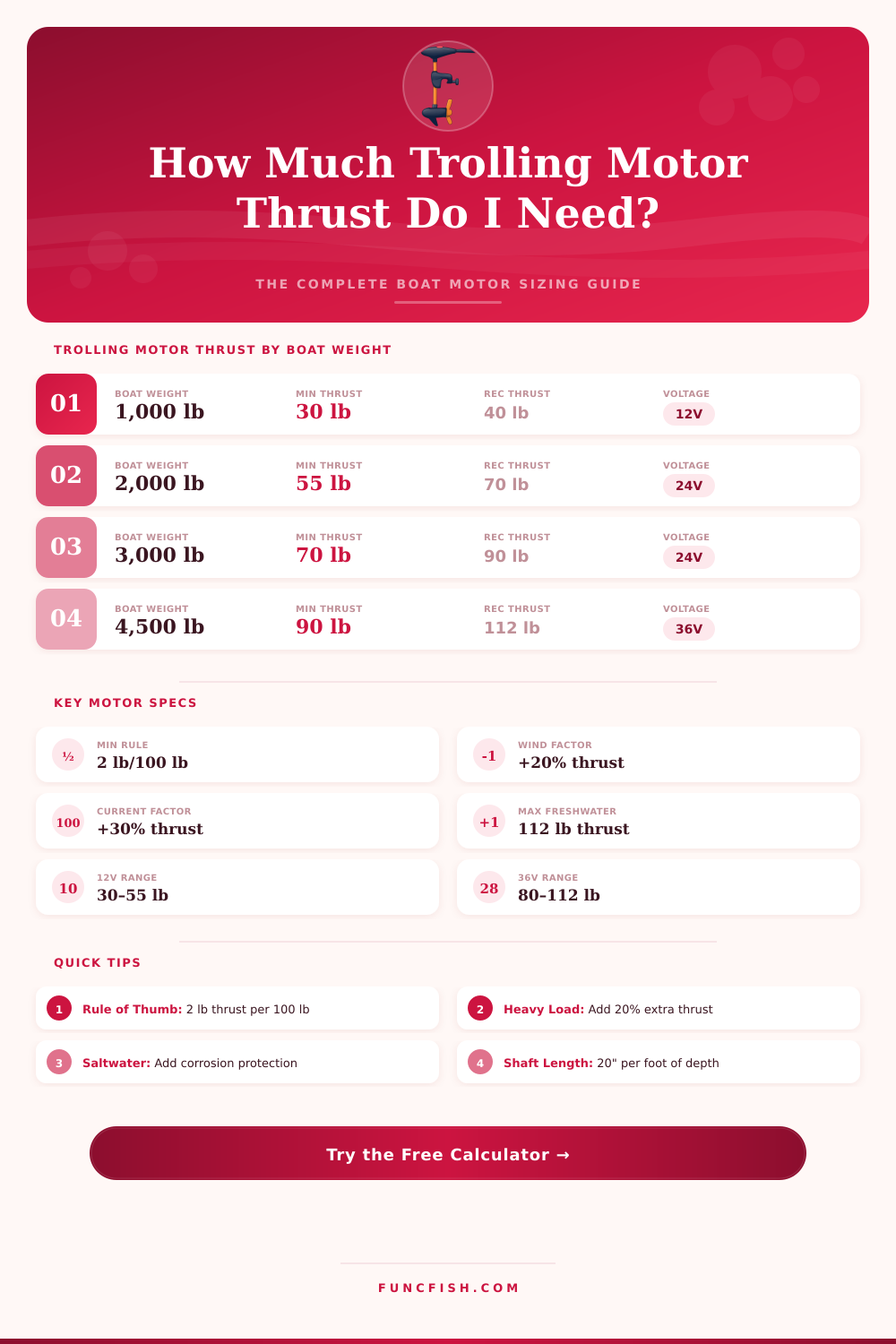
| Total Weight (lb) | Total Weight (kg) | Min Thrust (lb) | Recommended Thrust | Voltage |
|---|---|---|---|---|
| Up to 500 | Up to 227 | 10 lb | 20–30 lb | 12V |
| 500–1,000 | 227–454 | 20 lb | 30–40 lb | 12V |
| 1,000–1,500 | 454–680 | 30 lb | 40–55 lb | 12V |
| 1,500–2,000 | 680–907 | 40 lb | 55–70 lb | 24V |
| 2,000–2,500 | 907–1,134 | 50 lb | 70–80 lb | 24V |
| 2,500–3,000 | 1,134–1,361 | 60 lb | 80–90 lb | 24V |
| 3,000–3,500 | 1,361–1,588 | 70 lb | 90–100 lb | 36V |
| 3,500–4,500 | 1,588–2,041 | 80 lb | 100–112 lb | 36V |
| Species | Avg Boat Size | Thrust Needed | Voltage |
|---|---|---|---|
| Largemouth Bass | 16–20 ft | 55–80 lb | 24V |
| Walleye | 17–20 ft | 55–80 lb | 24V |
| Crappie / Panfish | 12–16 ft | 30–55 lb | 12V |
| Catfish | 17–22 ft | 70–100 lb | 36V |
| Striped Bass | 20–24 ft | 80–112 lb | 36V |
| Trout / Stream | 10–14 ft | 20–40 lb | 12V |
| Bow Height | Shaft Length | Boat Type |
|---|---|---|
| 0–10" (0–25cm) | 36" (91cm) | Canoe / Kayak |
| 10–16" (25–41cm) | 42" (107cm) | Jon Boat |
| 16–22" (41–56cm) | 48" (122cm) | Bass Boat |
| 22–28" (56–71cm) | 52" (132cm) | Walleye / Multi-S |
| 28–34" (71–86cm) | 60" (152cm) | Pontoon / Pontoon |
| 34"+ (86cm+) | 72" (183cm) | Large Pontoon |
| Motor Type | Best Use | Thrust Range | Voltage | Notes |
|---|---|---|---|---|
| Bow-Mount | Bass / Walleye fishing | 45–112 lb | 12–36V | Best control & maneuverability |
| Transom-Mount | Jon boats, kayaks | 30–55 lb | 12–24V | Easy install, budget-friendly |
| Engine-Mount | Larger boats | 55–112 lb | 24–36V | Uses outboard bracket |
| Hand-Control | Small boats, canoes | 30–55 lb | 12V | Simple, no foot pedal |
| Foot-Control | Tournament fishing | 55–112 lb | 24–36V | Hands-free boat control |
| GPS Spot-Lock | All scenarios | 55–112 lb | 24–36V | Holds position automatically |
| Saltwater-Rated | Saltwater / Bay | 55–112 lb | 24–36V | Corrosion-resistant build |
| Wireless Remote | Solo fishing | 45–80 lb | 12–24V | No cables, remote operated |
The thrust of a trolling motor is measured in pounds, and it simply points to how strongly the engine can push. Think of thrust as the basic force by which the engine pushes water backwards and moves your boat. A stronger engine gives more spin to the propeller which results in more power against the water and can handle heavy ships.
Here the question that each asks: how much thrust do you really need? Here is a rough rule that works out, about 2 pounds of thrust for every 100 pounds of the fully loaded weight of the boat. It covers passengers, gear, drinks, ice, everything that is on the deck.
How Much Thrust Do You Need for Your Boat
Another way to think about that: 5 pounds of thrust for every 200 pounds of whole mass. If you have a 2000-pound boat, you want at least around 40 pounds of thrust. At the end of the day, more force helps to escape problems with less effort.
I never heard that someone complains about a too strong trolling motor.
Trolling motors come in models of 12V, 24V and 36V. The heavy models, those with more then 100 pounds of thrust, work for pontoons. With 12V you reach around 55 pounds. The most common trolling motors have 72 to 75 pounds, which matches almost one horsepower.
But mind: bigger thrust not always gives bigger speed. Almost all trolling motors run at a similar maximum speed, because it depends on the motor itself and the size of the propeller. So even the best models reach only under 5 miles per hour.
For a canoe or kayak, a 20-pound engine does the task. With thrust up to 30 pounds you already reach the limit. A 28-pound engine works great on a typical fishing pontoon.
On the other hand, I saw an 80-pound engine on a 21-foot boat, that moves at more than 5 mph on smooth water and handles waves very well. There is also a setup with a 120-pound engine on a 28-foot boat, that carries almost 9000 pounds when fully loaded.
Wind and currents change everything entirely. A small 5-pound engine works well on a calm morning, but becomes almost useless when the water gets rough. A 55-pound engine on a 16-foot boat runs smoothly without big effort, but against back wind or incoming tide?
The battery drains soon. Good boating rules force you to prepare for hard situations, not only for calms. Saltwater engines work in fresh water even better, they simply have a stronger body against corrosion.
Pairing your engine with lithium batteries canreally extend the time of use.
From 36 to 55 pounds the improvement is modest, but the drain on the battery becomes a problem. The body of the engine itself must be much more strong to last that extra thrust.