🚤 Trolling Speed Calculator
Calculate your ideal trolling speed based on species, lure type, water conditions, and current adjustments
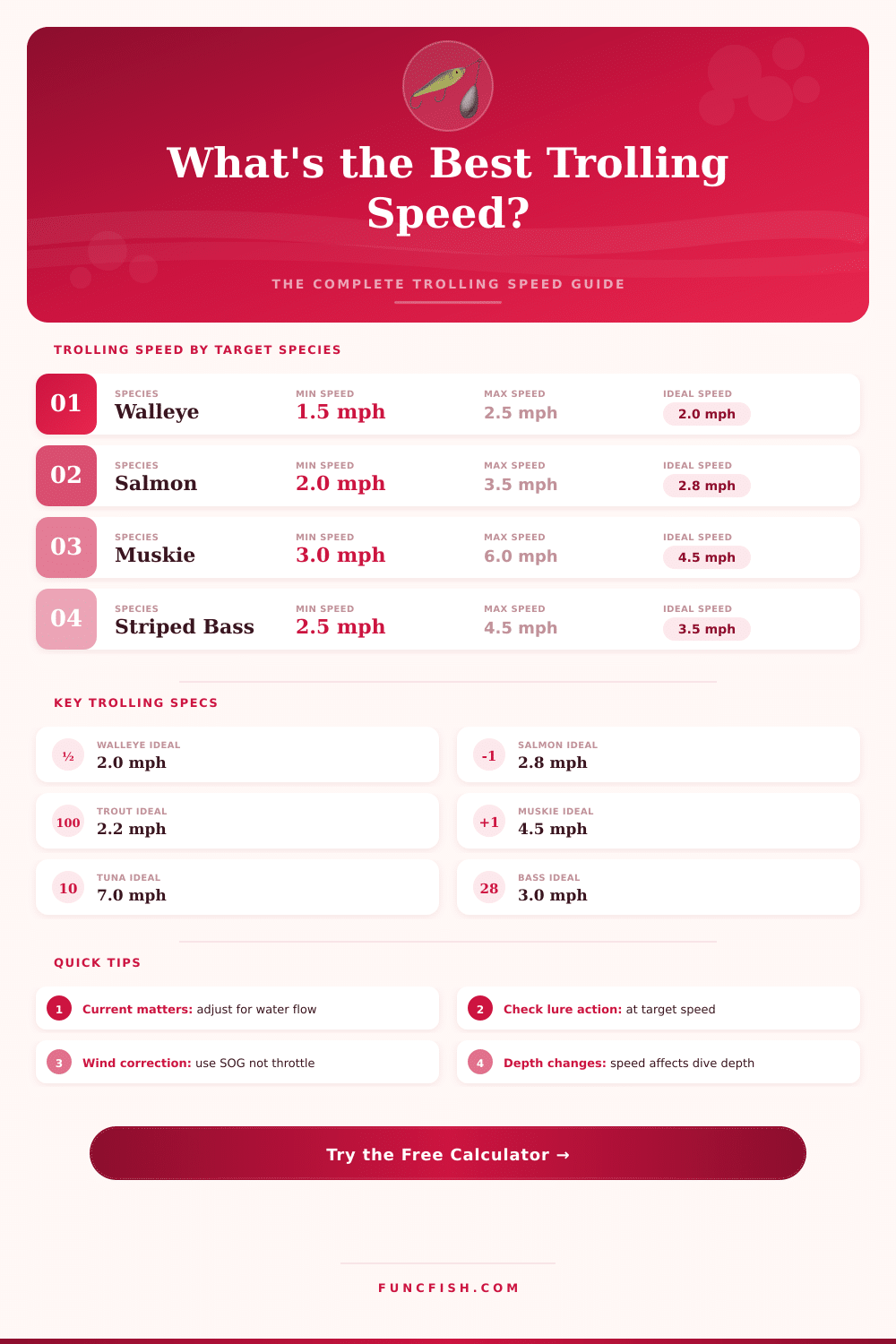
| Species | Min Speed (mph) | Ideal Speed (mph) | Max Speed (mph) | Ideal (km/h) |
|---|---|---|---|---|
| Kokanee Salmon | 1.0 | 1.5 | 2.0 | 2.4 |
| Walleye | 1.5 | 2.0 | 2.8 | 3.2 |
| Lake Trout | 1.8 | 2.2 | 3.0 | 3.5 |
| Coho / Chinook Salmon | 2.0 | 2.8 | 3.5 | 4.5 |
| Rainbow / Brown Trout | 1.5 | 2.2 | 3.0 | 3.5 |
| Largemouth / Smallmouth Bass | 2.0 | 2.5 | 3.5 | 4.0 |
| Striped Bass | 2.5 | 3.5 | 5.0 | 5.6 |
| Muskie / Northern Pike | 3.0 | 4.5 | 6.0 | 7.2 |
| Mahi-Mahi (Dorado) | 5.0 | 7.5 | 9.0 | 12.1 |
| Yellowfin / Bluefin Tuna | 5.0 | 7.0 | 9.0 | 11.3 |
| Marlin / Billfish | 6.0 | 9.0 | 12.0 | 14.5 |
| Wahoo | 8.0 | 12.0 | 15.0 | 19.3 |
| Line Type | Speed (mph) | Approx Depth (ft) | Depth (m) | Notes |
|---|---|---|---|---|
| Monofilament 12lb | 2.0 | 8–12 | 2.4–3.7 | Lure dependent |
| Braid 20lb | 2.0 | 10–16 | 3.0–4.9 | Less drag, deeper |
| Lead Core (per color) | 2.0 | 5–6 per color | 1.5–1.8 | ~10 colors = 50–60 ft |
| Copper 200ft | 2.0 | 35–45 | 10.7–13.7 | Deep presentation |
| Downrigger | 2.0 | Any (set depth) | Any | Most precise depth |
| Dipsy Diver #1 | 2.5 | 20–30 | 6.1–9.1 | Depth by setting |
| Dipsy Diver #3 | 2.5 | 40–55 | 12.2–16.8 | Larger disc = deeper |
| Current Speed | Trolling With | Trolling Against | Lure Speed Effect |
|---|---|---|---|
| 0.5 mph (0.8 km/h) | +0.5 mph SOG | −0.5 mph SOG | Minimal |
| 1.0 mph (1.6 km/h) | +1.0 mph SOG | −1.0 mph SOG | Noticeable |
| 1.5 mph (2.4 km/h) | +1.5 mph SOG | −1.5 mph SOG | Significant |
| 2.0 mph (3.2 km/h) | +2.0 mph SOG | −2.0 mph SOG | Lure may stop working |
The Speed probably is the most important element during Trolling. There is no absolute rule for the Trolling Speed. It never existed and never will exist.
Any value works for something. The ideal Trolling Speed simply determines what attracts the fish.
How Fast to Troll
Because we deal with trout and salmon, a good range to start is between 1.5 and 2.5 miles per hour according to the GPS. Trout usually troll at Speed of around 1.5 to 3 miles per hour. With worm rigs, it is possible to start at about 0.8 miles per hour and reach up to 1.5, which works very well.
Diving toys best work starting at 1.5 miles per hour and up to 2.5. Floating Rapala-toys work well at lower Speed than sinking versions, while spinners have their own range, where too slowly or too quickly simply stops the move.
If you go much more slowly than the best Speed, that affects the action of the toy and alters its depth. Speed-dependent toys sink more down when trolled slowly, and climb in the watre column during faster trolls. The right Speed makes the toy change sides with energy, but not capsize.
When we talk about ocean species, the situation fully changes. Rockfish respond well at around 2.8 to 3.2 miles per hour. Striped bass favor about 3 to 4 miles per hour.
Spanish mackerel are fast creatures and like 6 to 9 knots. Fishermen for wahoo commonly troll between 14 and 20 knots using heavy toys and deep-diving plugs, although wahoo also attack at normal tuna Speed of 6 to 9 knots. To attract big wahoo, you maybe need to reach up to 16 miles per hour.
After capture of wahoo, quickly slowing too 7 or 8 miles per hour is important, because they have soft mouths and hooks easily pull out.
Current flow and wind complicate everything. GPS maybe shows 5 or 6 miles per hour, while the boat actually moves only at around 1.5 relative to the water. When wind pushes the boat in the Trolling direction, it makes it go faster.
Strong flow can require 4.5 knots only to prevent toys touching the bottom. Use a paddle wheel to measure the Speed through water, instead of only trusting GPS, helps to solve that problem.
A good method is to watch the swimming of the toy beside the boat to find the right Speed, then note that value on the gauge. Like this wind or flow does not matter. Doing gentle S-turns during Trolling is also useful, because it varies the Speed of toys on different sides of the boat.
Sometimes only a tiny change in Speed can cause bites. Another trick is shifting to neutral, letting the toy float free for a minute, and then reaching Trolling Speed again. Trolling basically isexploration for fishing, covering areas along banks and structures.