Trolling Weight by Speed and Depth Calculator
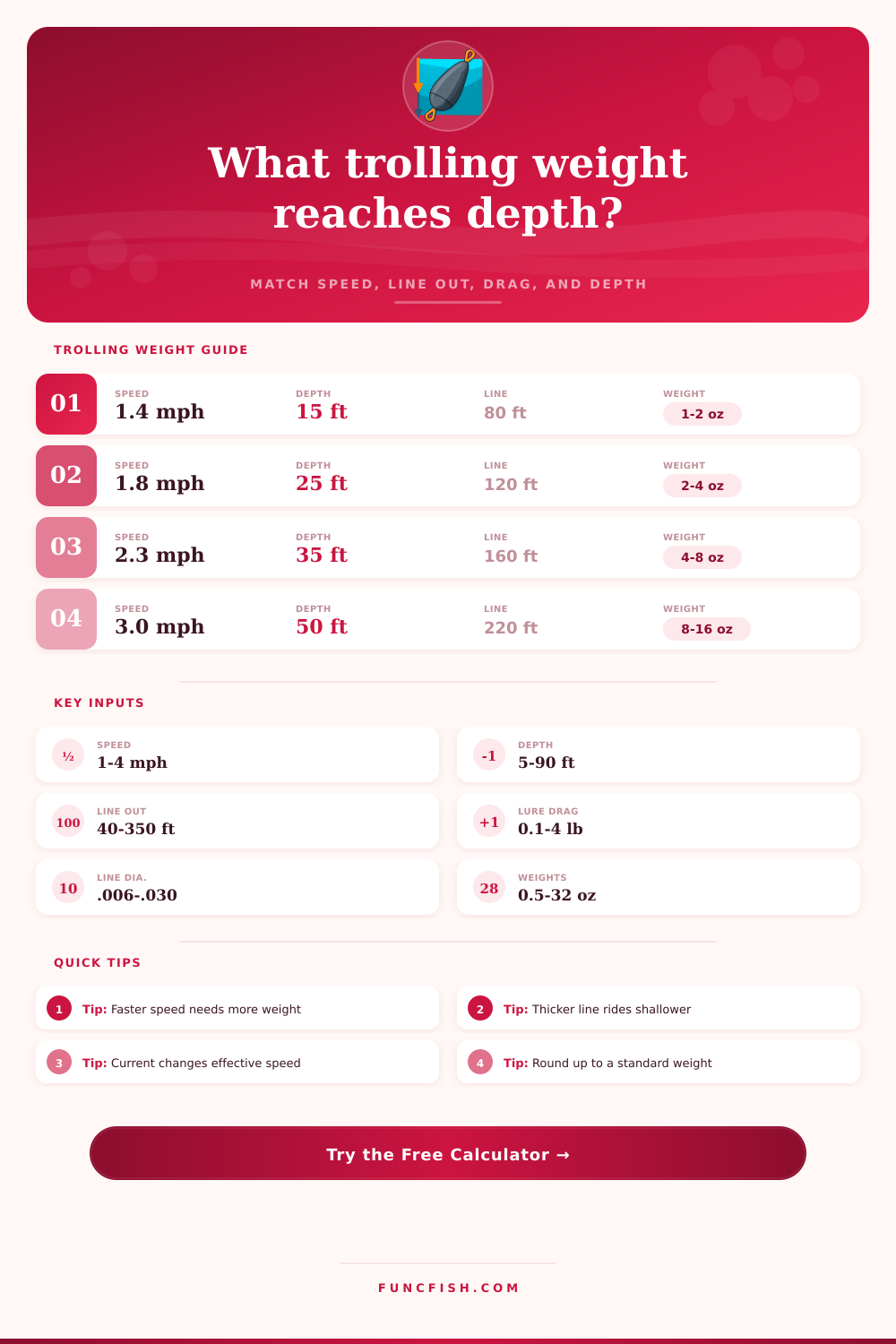
Estimate trolling weight from target depth, boat speed, line out, line diameter, current, and lure pull using a practical drag-and-line-angle model.
📌Scenario presets
⚙Trolling inputs
Trolling weight forecast
Full breakdown
📋Line profile drag grid
10 lb Braid
20 lb Braid
10 lb Mono
14 lb Mono
20 lb Mono
12 lb Fluoro
30 lb Wire
Lead Core
📏Standard trolling weight table
| Standard weight | Metric equivalent | Typical trolling window | Common use |
|---|---|---|---|
| 0.5-1 oz | 14-28 g | 1.0-1.8 mph, shallow | Kokanee, trout, light cranks |
| 1.5-3 oz | 43-85 g | 1.5-2.4 mph, mid depth | Walleye cranks, small spoons |
| 4-6 oz | 113-170 g | 1.8-2.8 mph, deeper sets | Salmon spoons, snap weights |
| 8-12 oz | 227-340 g | 2.2-3.2 mph, high drag | Umbrella rigs, current edges |
| 16-24 oz | 454-680 g | 2.5-4.0 mph, heavy pull | Saltwater drails, deep torpedoes |
| 32 oz | 907 g | Deep or fast specialty | Large spreads and heavy water |
| Weight style | Drag behavior | Depth efficiency | Best fit |
|---|---|---|---|
| Inline lead | Moderate | Baseline | Simple crankbait and spoon trolling |
| Snap weight | Moderate-high | Slightly reduced | Planer boards and repeatable setbacks |
| Torpedo | Low | High | Deep salmon or trout presentations |
| Keel sinker | Moderate | Baseline | Anti-twist spoon and bait rigs |
| Bottom bouncer | High | Bottom-oriented | Crawler harnesses near bottom |
| Drail | Low-moderate | High | Saltwater spoons and cigar sinkers |
🎣Technique reference table
| Technique | Typical speed | Target depth band | Starting weight style |
|---|---|---|---|
| Walleye crankbait | 1.5-2.4 mph | 12-35 ft | Inline or snap weight |
| Kokanee dodger | 1.0-1.6 mph | 10-45 ft | Light inline or keel |
| Salmon spoon | 2.0-3.0 mph | 25-80 ft | Torpedo or snap weight |
| Striper umbrella | 2.5-3.5 mph | 15-45 ft | Heavy inline or drail |
| River plug | 1.2-2.2 mph | 8-30 ft | Three-way dropper |
| Bottom bouncer | 0.8-1.6 mph | Bottom contact | Bottom bouncer |
💡Practical checks
Tip: Treat the result as a starting point, then verify with a known bottom touch, lure tick, or sonar pass. Small changes in lure pull and current can move a trolling rig several feet.
Tip: When the calculator asks for lure pull, use the pull you feel at about 2 mph. Wide wobbling plugs and umbrella rigs can require much more weight than slim spoons at the same target depth.
Trolling weight depend on multiple factors that interact with one another. Many anglers guesses at the appropriate trolling weight by adding more lead to the bottom of the jig when the lure sit too high, yet many others guess by removing some lead altogether when the lure hits the bottom of the fishing zone. However, using specific measurements for each of these factor creates a trolling weight that is more accurate than guessing, and that set of calculation can help you to create a consistant and repeatable setup for trolling sucess.
The speed of the boat and the angle of the line that hang from the boat have a primary relationship with the depth of the trolling weight. The faster the boat is traveling, the more pressure that the water will exert on the line and the lure. This pressure force the trolling weight to travel to shallower depths in the water.
What Affects Trolling Weight
By contrast, if the boat is traveling more slow, the trolling weight can travel to greater depths due to the influence of gravity. However, unless the lure does not create a horizontal fishing line, any depth achieved by the trolling weight will be negated. Lures that exhibit a horizontal movement or that use umbrella design for the lure will force adjustments to the drag value of the fishing lure.
This alteration of the drag value will change the trolling weight by several ounce. The diameter of the fishing line also change the depth to which the trolling weight will travel. Using a thicker fishing line will increase the surface area that the water can push against the fishing line.
As a result, the trolling weight will ride high in the water column. For instance, switching from a 10-pound line to a 20-pound line will require the addition of one or two extra ounce of lead for the trolling weight to reach the same depth. Using different line diameters or employing different construction of the fishing line will alter the