Trotline Hook Spacing Calculator
Estimate hook count, center-to-center spacing, leader swing clearance, and usable mainline for a cleaner trotline layout.
📌Scenario presets
⚙Spacing inputs
Trotline spacing plan
Full calculation breakdown
🧵Mainline comparison grid
Good knot grip, moderate sag, strong abrasion behavior for fixed hook drops.
Lower stretch and low water uptake; spacing stays predictable on long straight runs.
Smooth and springy; add spacing when bait spin or memory twists leaders.
Very stable under tension, but hardware and clips usually need more reserve length.
📊Reference tables
| Preset comparison | Mainline | Hooks | Minimum spacing | Leader | Best use |
|---|---|---|---|---|---|
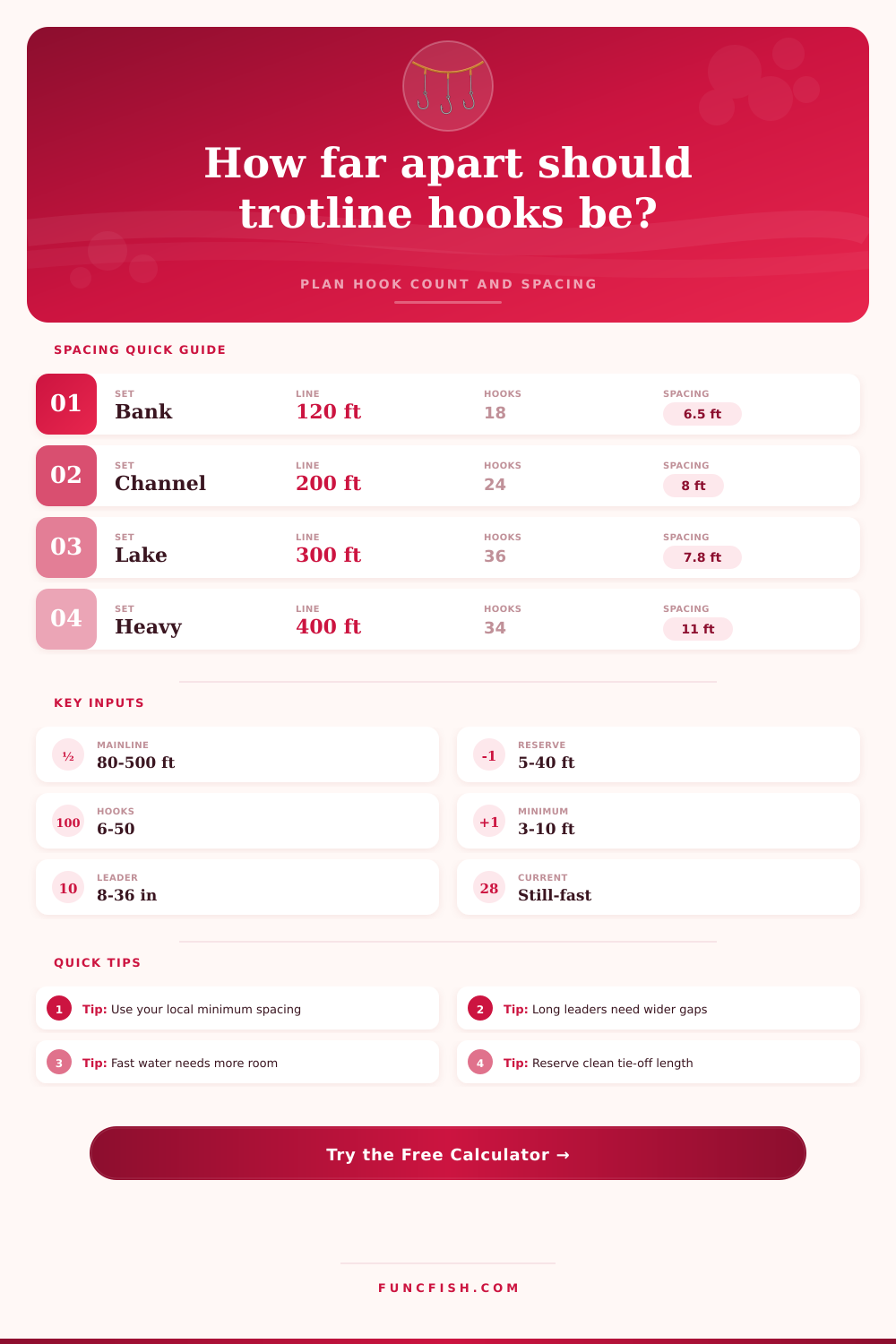
| Bank Catfish Evening | 120 ft / 36.6 m | 18 | 5 ft / 1.52 m | 16 in / 41 cm | Short, easy-to-check bank run |
| Slow River Channel | 200 ft / 61 m | 24 | 6 ft / 1.83 m | 20 in / 51 cm | Moderate channel layout |
| Wide Lake Flat | 300 ft / 91.4 m | 36 | 6 ft / 1.83 m | 18 in / 46 cm | Broad water with even spacing |
| Heavy Blue Cat Spread | 400 ft / 121.9 m | 34 | 9 ft / 2.74 m | 30 in / 76 cm | Large bait and wide fish room |
| Fast Tailwater Check | 220 ft / 67.1 m | 18 | 9 ft / 2.74 m | 24 in / 61 cm | More swing room in pushy water |
| Target class | Base lane spacing | Leader range | Bait room | Calculator use |
|---|---|---|---|---|
| Eating-size channel cat | 4.8 ft / 1.46 m | 12-20 in / 30-51 cm | Low to medium | Efficient hook density when water is calm |
| Mixed channel and flathead | 6.2 ft / 1.89 m | 16-26 in / 41-66 cm | Medium | Balanced spacing for mixed bait sizes |
| Large blue catfish | 8.4 ft / 2.56 m | 24-36 in / 61-91 cm | High | Wider gaps for heavy bait and rolling fish |
| Flathead near cover | 7.5 ft / 2.29 m | 20-32 in / 51-81 cm | High | Extra clearance around brush and timber |
| Light mixed set | 4.2 ft / 1.28 m | 8-14 in / 20-36 cm | Low | Short leaders and small bait only |
| Mainline material | Sag allowance | Stretch behavior | Spacing effect | Layout note |
|---|---|---|---|---|
| Tarred nylon braid | 8% | Moderate | Adds a small buffer | Friendly to knots and fixed staging marks |
| Braided polyester | 5% | Low | Closest to measured spacing | Good for long straight center-to-center layouts |
| Twisted nylon cord | 11% | Higher | Needs more reserve | Check spacing after soak and load |
| Heavy monofilament | 14% | Springy | Wider gaps reduce leader wrap | Memory can twist short leaders |
| Coated wire core | 3% | Very low | Stable spacing | Hardware length matters more than sag |
| Light bank-line cord | 13% | Moderate | Buffer recommended | Best with shorter leaders and lower hook counts |
| Adjustment | Low setting | Middle setting | High setting | Why it changes spacing |
|---|---|---|---|---|
| Current or wind pull | Still 1.00x | Moderate 1.14x | Surging 1.30x | Moving water sweeps leaders into the next lane |
| Bait profile | Dough 0.2 ft | Cut bait 0.8 ft | Live bluegill 1.7 ft | Active bait needs room to swim and spin |
| Leader pattern | Alternate 0.78x | Straight 1.00x | Deep drop 1.12x | Alternating sides reduces leader overlap |
| End reserve | 5-10 ft | 10-25 ft | 25 ft plus | Anchors, floats, knots, and clips consume line |
💡Calculation tips
With a bucket of cut bait and a coil of tarred line in your hand, you step onto the bank. How many hooks should you tie on? Too few and you’ll go through your mainline faster then necessary. Too many and your leaders gets tangled as a fish digs its head. This is where the sweet spot lives and this is also where most novice angler lose their supper.
Plug your hook number and your line length into our calculator (above) and it figure out the rest for you. No more guesswork about whether your leaders will just barely miss each other or swing into each other’s path. Now you have a concrete plan you can trust before the water gets cold, that’s where the fun starts.
How to Use the Fishing Calculator
The second place to look is at the amount of line that’s left after hooking fish. Sure you can purchase a couple-hundred-feet of mainline, but what percentage of that will actualy be used for hooks? Remember, you need to leave some extra line on either end for tying anchor knots, attaching floats, securing the set to a stake, etc. Otherwise you’ll be left with your last and first hooks adjacent to the hardware, where the line gets tangled in the knot and the float drifts into the leader.
This ‘dead’ zone needs to be subtracted from your total length, giving you an idea of how much usable line you’re truly working with. This subtraction happens automatically with the tool and allow you to see quickly how much ‘working runway’ is available for fishing portion of the rig.
The hook count varys based off movement of the water as well as what you’re chasing. A big blue cat will roll up on it and bite. They require space to execute that roll-up and turn back around without ripping their leader out of the other guy’s bait. A small channel cat in slack water doesn’t exert such violent torque on the line, so he can gets away with sharing narrower lanes. Minimum space between lines for target species is shown in the table on the page. Add additional space if running the fish fast through tailwater where current is sweeping leaders downstream. This effectively crowds the lines.
Strength of current is ignored at your own peril; you’ll be wishing you should of left more room after losing an entire set in a single night. More important is what the mainline is made of. Most folks don’t think about this enough. Nylon tarred braid has some stretch and good grip properties. Polyester braid remains stiff and true under load. Heavy monofilament springs back as soon as tension is relieved. If not accounted for, it will pull the hooks tighter to each other. And if you’re using line that stretches or sags much, the center-to-center measurement on paper won’t translate into reality. That’s where the buffer comes into play to compensate for stretch and sag.
By letting you choose line type, the calculator takes that into account for expected spacing. It means what you plan on the shore stands up when the line gets wet.
The last variable that threads everything together is leader length. Long leaders allow for more natural feeding by the fish but they also result in larger swing arcs. An eighteen-inch leader may be comfortabley in a six-foot lane but requires almost twice as much clearance from neighboring hooks for a thirty-six inch dropper. When fishing with live baits such as bluegill or shiners, increase your buffers. The bait swims around and spins before being taken on hook. Spinning bait need more room to move.
Remember to check the rules where you fish before doing so. Local rules may require you to keep more distance between hooks to avoid any accidental catches and/or hook contact issues. That’s the law of the land and inputting that minimum spacing into the tool becomes a safety floor. If your target number of hooks puts you below the required spacing, the system will alert you. Then it’s up to you: either drop some hooks to increase space or take fewer bites to stay within the rules. Be safe and plan on one less hook than you want.
A good setup is invisible. Once the set’s down, don’t think about leader clearance; don’t bother. The way it sets up just feels right, there’s plenty of space for each piece to perform its duty without getting in the way of the other. Spend a few minutes figuring it out on dry land and the water will reward you with full baskets and clean lines. A little up-front planning buys you peace of mind all night long.